







By Joseph Ax
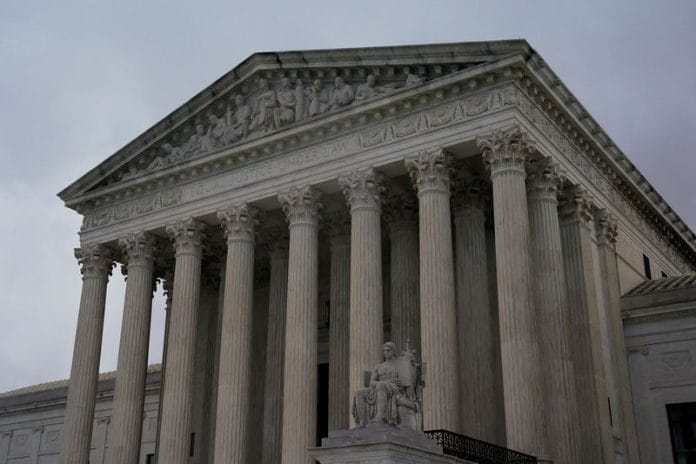
April 29 (Reuters) – The U.S. Supreme Court’s decision weakening a landmark voting rights law opens the door for Republican lawmakers to dismantle Democratic-held U.S. House districts with majority Black or Latino populations across the South, potentially giving Republicans an electoral advantage for years to come.
Wednesday’s ruling escalates a national battle over congressional maps that has raged since last year, when President Donald Trump launched an unprecedented mid-decade redistricting campaign to protect his Republicans’ narrow House majority in this November’s midterm elections. Typically, states only draw maps at the start of each decade to account for the U.S. Census count.
The decision severely weakens legal constraints that have historically forced state legislators to ensure voters of color are not marginalized when drawing maps. It is likely to result in a fresh round of tit-for-tat redistricting that extends into the 2028 election.
It remains to be seen whether statehouses will use the court’s ruling to try to install new electoral maps before November. Lawmakers have little time to do so. Most states are well into their 2026 election calendar, with filing deadlines for candidates already past and primary votes looming.
In Georgia and Alabama, for instance, two states where Republican legislators might be expected to take advantage of Wednesday’s ruling by eliminating majority-Black districts, voters have begun casting early ballots ahead of their May 19 primary elections.
Even in Louisiana, whose congressional map was struck down in the Supreme Court case, lawmakers face hurdles in passing new district lines. Candidates have been raising money and campaigning for months. The state has mailed absentee ballots and early voting begins on Saturday for the May 16 primary.
In court filings, Louisiana’s top election official had asked the court to rule no later than early January to ensure enough time to administer the election.
“It is very late in the cycle to make changes to maps,” said Danielle Lang, vice president for voting rights at the nonpartisan Campaign Legal Center. “It would be enormously disruptive and chaotic.”
House Speaker Mike Johnson, a Louisiana Republican, told reporters it wasn’t clear whether lawmakers would try to draw a new map immediately.
“We have, as you know, a primary coming up in about two weeks,” he said. “So we’ll see if the state legislature deems it appropriate to go in and draw new maps.”
ADDING TO THE CHAOS
Even if states hold their fire until after the November election, Republicans appear poised to target as many as a dozen Democratic-held districts with a majority of Black or Latino voters ahead of the 2028 presidential election.
Democrats could even respond by taking apart majority-minority districts in states they control, with the aim of spreading Black and Latino voters, who traditionally vote Democratic, across more districts.
The result would be to dilute the voting power of racial minorities across the country by denying them the opportunity to elect candidates of their choice, advocates said.
Janai Nelson, president of the Legal Defense Fund, who argued the case before the Supreme Court on behalf of Black voters in Louisiana, said it was too soon to tell whether states would try to redistrict immediately, but she noted that state lawmakers have “wide latitude” to change elections even in unprecedented ways.
Either way, she said, the decision would upend decades of protections for voters of color.
“This is a day of infamy for the court,” she told reporters. “It is a day of devastation for our democracy.”
The ruling adds fuel to a national redistricting war, which started last summer when Trump convinced Texas Republicans to draw a new map taking aim at five Democratic incumbents. Other states, both Republican- and Democratic-led, have followed suit.
As it happens, Wednesday’s ruling arrived as Florida Republicans were debating a new partisan map, drawn by Governor Ron DeSantis, intended to flip four Democratic seats in November. The legislature approved the plan shortly thereafter.
States are already permitted to draw maps for partisan advantage, a practice known as gerrymandering, thanks to a 2019 Supreme Court decision.
“The court has just added more chaos to a system that’s already chaotic,” said Kareem Crayton, a redistricting expert at the Brennan Center for Justice.
With Trump’s mid‑cycle push and the Supreme Court’s latest ruling, the legal and institutional guardrails that once constrained redistricting may be giving way to a free‑for‑all, turning voters into “pawns in a set of political games instead of being the decision‑makers themselves,” Lang said.
(Reporting by Joseph Ax; editing by Paul Thomasch and Howard Goller)
Disclaimer: This report is auto generated from the Reuters news service. ThePrint holds no responsibility for its content.