





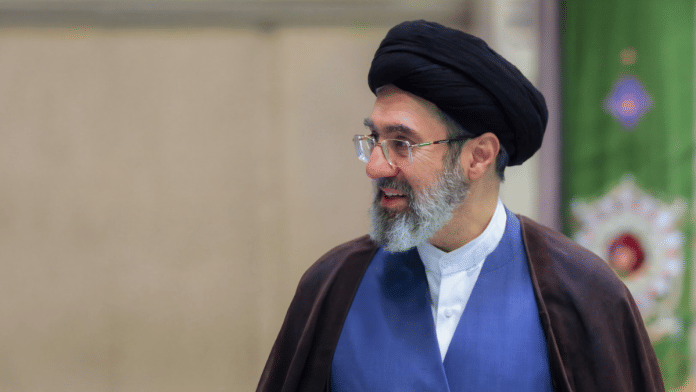



New Delhi: Iran’s new Supreme leader Mojtaba Khamenei used his Eid message to assert that his country had no role in the attacks on Turkey and Oman and expressed his willingness to broker peace between Afghanistan and Pakistan.
“I should remark that the attacks against Turkey and Oman were in no way carried out by the armed forces of the Islamic Republic,” Khamenei said, describing them as “a ploy by the Zionist enemy, employing the false flag tactic to create discord.” In the same address, he stressed the importance of regional unity betwwen Afghanistan and Pakistan.
“For a long time, I have known Pakistan to be a country that was especially beloved by our martyred Leader, a sentiment that was evident in the emotion in his voice during Friday prayer sermons over the devastating floods that threatened the lives of our religious brothers there,” he said.
“For various reasons, I have always held this view myself and have not refrained from expressing it in various meetings. Here, I would like to urge that our two brotherly countries, Afghanistan and Pakistan, establish better relations with each other – if only for the sake of divine pleasure and to avoid division among Muslims – and for my part, I am ready to take the necessary steps.”
Khamenei also framed Iran’s outreach to neighbouring countries as rooted in shared religious and cultural ties.
“We recognize … our shared devotion to the noble religion of Islam,” he said, alongside “common strategic interests, particularly in confronting the front of arrogance,” which he said could strengthen relations across the region.
The remarks come at a time when Pakistan seems to be shifting strategic alignments.
On Thursday, Islamabad joined a bloc of Arab and Islamic countries in condemning Iran’s retaliatory strikes across the Gulf, calling on Tehran to “halt its attacks’ and warning that future relations would depend on respect for sovereignty and non-interference. The statement was endorsed by countries including Saudi Arabia, Qatar, the UAE, Egypt, Turkey and Azerbaijan.
Pakistan has historically maintained ties with Iran, but has in recent times moved closer to Gulf Arab states, particularly Saudi Arabia, with which it signed a strategic mutual defense agreement last year.
That shift has been reinforced by Pakistan’s growing alignment with Azerbaijan and Turkey, forming a trilateral partnership that has expanded cooperation in defense and regional security. The framework, which emerged after the 2020 Karabakh war and was strengthened through subsequent agreements, reflects a broader realignment in which Pakistan is increasingly embedded in a Gulf-oriented strategic orbit.
Public messaging from Pakistani leaders has echoed that direction. Prime Minister Shehbaz Sharif recently reaffirmed solidarity with Azerbaijan and called for de-escalation through dialogue as Field Marshal Asim Munir warned the Shia community to “go to Iran”, if they love the country so much.
At the same time, Pakistan has also tried to walk a diplomatic tightrope. Deputy Prime Minister and Foreign Minister Ishaq Dar had earlier called attacks on Iran as “unwarranted,” urging a return to negotiations.
Earlier, Iranian Foreign Minister Abbas Aragchi thanked Pakistan for their ‘full throated’ support to the country and also put out a tweet for Afghanistan hoping that “peace and tranquility will also endure in Afghanistan.”
Since the fall of Kabul and Taliban’s return in 2021, Iran has pursued a pragmatic relation with a group it did not initially support. In 2001, Tehran supported the Northern Alliance. It does not officially recognise the Taliban but has maintained diplomatic ties and also expanded economic ties.
In September last year, a senior delegation led by Iran’s Minister of Industry, Mining, and Trade, Seyed Mohammad Atabak, visited Afghanistan for trade talks aimed at boosting bilateral trade to $10 billion and developing the Khaf-Herat railway along with an increased use of Chabahar port, which would allow Kabul to bypass Pakistan.
Three months on, Araghchi said that stability in Afghanistan is a strategic necessity for the entire region, stressing that Iran’s security is “directly tied to the interests of all neighbouring countries.”
(Edited by Tony Rai)
Also Read: Israel says Larijani killed in midnight strikes. Then comes Iran intel chief’s handwritten note
Hum to doobe hain sanam, tumhe bhi le doobenge !