





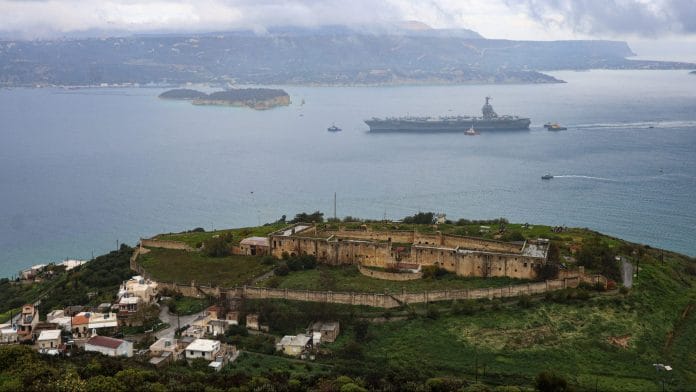



The USS Gerald R. Ford aircraft carrier arrived at a port in Crete on Monday after it had to leave the Middle East — and the war against Iran — when a fire broke out in its laundry area. But the massive ship’s problems run a lot deeper than that.
Delivered years late in May 2017, the Ford is the most expensive American warship ever built, at $13.2 billion.
And it’s been sent to sea for an extended deployment that included the conflicts with Venezuela and Iran — despite open questions about how well it would perform in a war.
The concerns around the Ford range from the potentially grave to the mundane, according to a new assessment from the Pentagon testing office, with many issues surfacing after it started combat testing in October 2022.
Among the lingering concerns: there isn’t enough current test data to assess the carrier’s “operational suitability,” or the reliability of several key systems, including its jet launch and recovery system, its radar, its ability to keep operating if hit by enemy fire and its elevators for moving weapons and munitions for warplanes from the hold to the flight deck.
The Pentagon’s test office said “insufficient data are available at this time” — nine years after the ship was delivered — “to determine the Ford-class’s operational effectiveness,” due to incomplete realistic combat testing.
That means it’s not clear how well the Ford — and other ships in its class, which have yet to be delivered — can detect, track or intercept enemy aircraft, anti-ship missiles or small attack aircraft. It’s also unclear how the aircraft carrier’s systems would perform under the wartime strain of continuous takeoffs and landings.
The Navy’s Ford officials “have been working closely” with test office personnel “ensuring a robust and informed understanding” of the vessel’s “effectiveness and sustainability,” and “will continue to improve sustainability where needed, informed by the remaining tests” and operations, the service said.
The Navy’s assessments “consider both the performance in testing as well as the ship’s operational employment to date,” as during those deployments “overall, operations have demonstrated the ship’s ability to meet the demands of combatant commanders with system reliability and maintainability, supporting mission accomplishment” while “continuing to improve,” the service said.
The service said it “will continue to improve sustainability where needed, informed by the remaining tests” and operations.
The Ford, which was dispatched to the Red Sea for operations against Iran, ended up leaving the battle for Crete not because of an enemy attack but after the fire broke out. It resulted in more than 200 sailors being treated for smoke inhalation, Senator Tim Kaine, a Virginia Democrat, wrote last week to Navy Secretary John Phelan.
The episode underscored how even the US Navy’s most advanced assets are under strain as the Trump administration relies on a version of gunboat diplomacy to accomplish geopolitical goals in Iran and Venezuela — assembling armadas to pressure foes with the prospect of military action.
The Ford spent months at sea beyond a standard deployment after participating in US operations against Venezuela before dispatched by President Donald Trump to the Middle East. While a normal tour lasts about seven months, the Ford has been at sea for around 9 months — since June of last year.
The Ford “is on track to break the record for longest carrier deployment since the end of the Vietnam War,” Kaine wrote, adding the extended tour “has forced sailors to improvise with broken equipment and ship support systems.”
Some testing problems have been identified but not fixed. While the Ford’s ability to defend itself against drones and small, high-speed attack boats was tested back in 2022, the Navy has developed fixes for combat systems — identified in a classified assessment — but “the fixes still remain largely unfunded,” the test office said.
The testing office found other issues.
One is that there isn’t a “sufficient” number of bunks, with a 159 additional bunks required to properly house all of the Ford’s sailors in addition to personnel in temporary units accompanying the ship into battle. The shortfall could get worse if the carrier’s air wing diversifies further to include additional F-35 warplanes or staff to operate Boeing MQ-25 Stingray refueling drones.
“These berthing shortfalls will affect quality of life onboard,” the testing office said.
As with a new and very complicated system like the Ford, Navy officials say, testing and monitoring continues long after it leaves the shipyard.
Disclaimer: This report is auto generated from the Bloomberg news service. ThePrint holds no responsibility for its content.
Also read: ‘Toilet wars’ hobble Trump’s $13-billion aircraft carrier USS Gerald Ford amid US-Iran tensions