





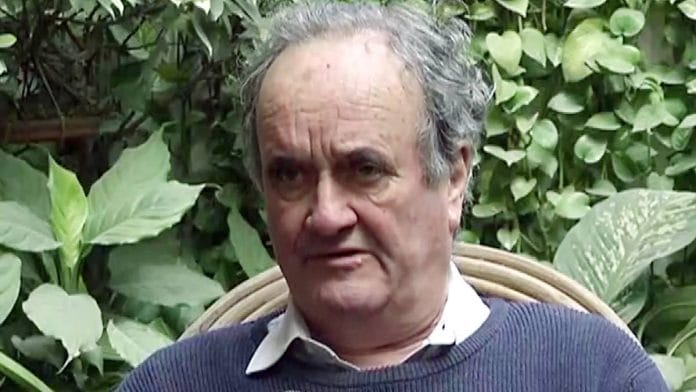



New Delhi: BBC’s India correspondent for over two decades, Mark Tully was born in Tollygunge, Calcutta, on 24 October, 1935. He spent the initial years of his life in India, studying in Darjeeling, before moving to the UK where he studied theology at Cambridge University and meant to become a priest.
He, however, joined the BBC and moved back to India in 1965 where he was appointed the New Delhi bureau chief from 1972 to 1994. During his tenure, he covered major events in South Asia and India—conflicts with Pakistan, the birth of Bangladesh, Bhopal gas tragedy, Operation Blue Star, assassination of Indira and Rajiv Gandhi, the anti-Sikh riots, and the Babri Masjid demolition. The government expelled him from the country in 1975 following the imposition of Emergency but he returned a year and a half later.
Mark Tully came to be known as BBC’s “voice of India”, travelled the nation extensively, authored several books and became fluent in Hindi. He was awarded two of India’s highest honours, the Padma Shri and the Padma Bhushan.
Tully passed away Sunday, aged 90, in New Delhi.
In this 2007 episode of Walk The Talk, Tully has an engaging chat with ThePrint’s Editor-in-Chief Shekhar Gupta.
Here is a complete transcript of the interview, edited for clarity.
SG: Hello and welcome to Walk the Talk. I am Shekhar Gupta and my guest this week, a legend of our times, Mark Tully. Sir Mark Tully, welcome to Walk the Talk.
MT: I don’t like to think of myself as a legend.
SG: I could have called you the Knight of Nizamuddin East.
MT: Well, I’ve been very lucky in my life, Shekhar, you know. I put most of it down to luck, actually.
SG: Well, I mean, luck and good timing. What’s a journalist without good timing?
MT: Yeah, timing as well, a bit of timing as well, definitely, yeah.
SG: Timing, instinct, all those things matter.
MT: Yeah, they do matter. But luck also matters a lot, you know.
SG: Yes, and intellect helps.
MT: Well, maybe, I don’t know. I don’t think journalists have great intellect, do you?
SG: Well, I mean, they are not reputed to. I don’t know, as they say, one of their KRAs. But look at the book you’ve produced now. That is an intellectual/spiritual/political exercise in ‘India’s Unending Journey’.
MT: Well, it’s an exercise I was very nervous about, Shekhar, because it’s far more personal than any book I’ve ever written before. And I honestly didn’t know what the reaction to it would be. I thought some people might say Mark Tully’s gone balmy or Mark Tully’s become a religious maniac.
SG: Well, I’ve heard people say Mark Tully’s finally shown his Hindu side. Some people have said Mark Tully has finally given evidence in writing that he’s an unreconstructed socialist. Which one do you buy?
MT: Well, you know, this is the interesting thing about it, that there’s a quote in the book from Dr Manmohan Singh, where he says, if you advocate the middle road, and the whole book is about advocating the middle road, it’s about not being Hindutva, but equally not being so secularist that you despise religion. And what Manmohan Singh said is that if you pursue the middle road, you’re bound to get hit from the left and from the right. And actually, funnily enough, I haven’t been hit from the left.
SG: But that’s how you drive on an Indian road.
MT: Yeah, but I hope not to get hit.
SG: From my reporting years, I went to Dara Adham Khel. Remember the village where they sell arms?
MT: Yes.
SG: Pakistan’s frontier?
MT: Yeah.
SG: You know, after I’d examined all the machine guns and stuff, they said, but we can also get you 80-62 tanks. We just got one from the mujahideen. And I said, what will I do with it? And how will I take it to India? They said, we’ll deliver it to you across the border, then it’s yours. And I thought for a moment, it might be useful in Delhi. You can drive in the middle of the road, nobody cuts in front of you.
MT: Well, certainly, I mean, it would be very useful as well, because the number of times that people seem to bang into my car, I have to go to get it put right.
SG: Back to the book. Is this the spiritual side to you? We all know you started out being educated to be a theologian.
MT: Yes, yes, I did. I start out to be a priest in the Church of England. And I’ve lived, like you, a pretty rough life as a journalist. It’s, you know, a rough and tough life.
SG: Many times together.
MT: Many times together, indeed. And you probably didn’t see any spiritual side in me when I was drinking or we were going to be having a drink together in the bar.
SG: In our reporting years, the spiritual side was something of the evening.
MT: But I never quite lost this side. And they always say that the older you get, the more interested you get in these things. And I do believe that in India as well, it’s a very special, very important side, because after all, the vast majority of Indians are actually religious. And therefore, getting the spiritual side properly in balance in a country like this is hugely important, I feel myself.
SG: You know, spirituality and hacks don’t always go together. You know, it always reminds me of Wellington’s line on his army when he said, I think gin is the spirit of their patriotism.
MT: Well, I can assure you that I’ve done my bit at bars and things like that, as you know and the last thing I believe in is, that spirituality should be any form of killjoy or anything like that. And I dislike excessive puritanism, especially the sort of puritanism you sometimes see in this country, like what’s happened to Hussain, for instance, that sort of thing, I think is deplorable.
And I think it’s deplorable, you know, in part because it actually denigrates religion and makes people think religion is stupid.
SG: Absolutely. And your teachers figured you out early on.
MT: Yes.
SG: That you weren’t the right candidate for this.
MT: Absolutely.
SG: That is what happened. I think you go to the pub too often.
MT: Bishop of Lincoln said, you know, in a church, people preach from the pulpit. So, the Bishop of Lincoln said to me, I think, Mark, your place is more in the public house than in the pulpit.
SG: But is this nostalgia for your early years or is it a distillation of your years in India?
MT: No, it’s not really nostalgia. There is an element of nostalgia in it. I mean, there’s huge nostalgia in the fact that, as I say in the book, I have a deep love of the liturgy of the Anglican Church, just as you might have a deep love of the worship in the Golden Temple, which you attended when you were young or anything like that. So, in that sense, it’s nostalgic. But in another way, it’s very much not, because the whole change which has come about with me in India, and one reason I wrote this book, is that when I was young, we were taught that really Christianity was the only way to god. But living in India has taught me, yes, it is one way to god, but there are lots of other ways to god as well. So, it’s changed very radically.
SG: But you know, Mark, in your reporting years, you’ve seen the same gods turn against the people of India, turn against some people of India, turn against the government of India. You’ve seen a lot of problem in the name of religion.
MT: Yes, I have.
SG: We were together in the Golden Temple. You saw Babri Masjid.
MT: Yeah, but you see, I would say two things there, Shekhar. First of all, I’d say that whenever we saw the trouble…
SG: And now we see this whole Bangalore business.
MT: Yes, but you know, whenever we saw the trouble, firstly, there was almost always politics behind it. It was politicians who were stirring it up. We know about the history of the Bhindranwale movement and who actually really stirred the whole thing up. Secondly, these issues are never entirely religious. They get clothed in religious clothes, but there’s usually economics behind it quite often, language behind it quite often, ethnicity behind it as well. So, it’s not just religion doing these things. And you know, finally, I would say, even on Islam, well, I don’t mean even on Islam, because I have a great respect for Islam, but we do need to think what it is which persuades these people to do these dreadful things. They are dreadful, and I’m not saying we should condone them or condone the people, but we cannot simply say…
SG: Because Britain has a serious problem now. It seems to be the epicentre of this.
MT: Yes, well, you see, Britain has a serious problem. One of the reasons it has a serious problem is, of course, the Iraq War. But another reason is because there are Muslims who genuinely feel that there is an attempt, basically, for the western culture and civilisation to dominate the world. And they feel that this culture and civilisation has no respect for God. And they will often tell you, as they must have told you, they’ve often told me, they see it as obscene because of the way women are portrayed and treated.
SG: It’s very interesting, given the fact that America now is more religious than it was maybe two decades back. More people go into church than before.
MT: Yes, you see, but I think the thing about America which is interesting is that a lot of the religion is a fundamentalist type of Christianity. And my view is, and the view of a lot of people in my book, I quote a great writer on religion, Karen Armstrong, who says there is a symbiotic relationship between religious fundamentalism and what you might call excessive materialism. When a society becomes excessively materialist, then religious people, as another quote in my book, they run back to Nellie. They go to someone who says, you’re secure behind here, you don’t need to think about these things, you don’t need to worry.
SG: How do you explain what’s happening in Pakistan now? This whole Lal Masjid business, the fight Musharraf’s having with fundamentalists, the very people that the Pakistani army and ISI created. Very much like Bhindranwale and the state of India.
MT: Well, there are many similarities, you know. One of the great similarities, of course, is why did he not take action against them before they made such a fortress out of the place, in exactly the same way as why did Indira Gandhi not take action against Bhindranwale before he fortified the Golden Temple. And also, of course, there is Musharraf’s fear of reaction among the supporters of these people outside the Lal Masjid, as Indira Gandhi’s fear of the Sikhs’ reaction in the countryside in Punjab.
SG: There are also incredible similarities between the way the two operations went. You know, two days ahead, they blast a wall, an officer dies, and then more people go in, then the siege becomes thicker.
MT: Yeah, well, you see, yes, I think so. I think that also, I mean, I don’t know enough about the Lal Masjid. But I think also, you see, what happened with the Golden Temple, and you were actually there, was that the army thought that getting inside there and getting Bhindranwale would be much easier than it was. And I would imagine the Pakistan army thought the same thing. And in the end, of course, the Pakistan army dragged the thing out much longer. But basically, they had to go in and do a lot of damage and kill a lot of people. In the same way, the Indian Army underestimated the resistance of Bhindranwale, thought he would just surrender. And in the end, they had to go in and do a lot of damage and kill a lot of people.
SG: Mark, go back to your reporting years. Tell us some of the most interesting moments, some of the most difficult moments India, Pakistan, Afghanistan, Bangladesh, wherever.
MT: One of the most difficult moments I had was a strange personal experience. You know, we all used to have to go dress up as a mujahideen and go in with the mujahideen into Afghanistan. But once when I did this, the first thing we had to do was climb a very steep mountain. I got about three quarters of the way up this mountain and started to feel very, very sick and giddy. And I suddenly realised that I was… not a mujahideen.
SG: Yeah.
MT: Getting altitude sickness. So, then I looked down and there below were the plains of Pakistan. And I thought to myself, god, I’m going to be an absolute idiot if I go back and say I couldn’t even get over the first mountain. And I heard a train of mules coming up, the bells ringing. Fortunately, my Urdu was recognisable by Pashtun speakers. So, I said to these people, put me on one of your mules, I would say. And sure enough, they did. So, I rode in triumph into Afghanistan on the back of a mule.
SG: Mark on a mule.
MT: But you know, another chap, I remember another guy, the last time almost I saw Bhindranwale, there was an American correspondent, can’t remember who he was, who said to Bhindranwale, why should I grow a beard? Bhindranwale said, because you’re a man and god gave you hair on your face, so you should grow a beard. And this guy said to Bhindranwale, but some people would say the way you’re dressed, you look like a woman. And I said, my god, what on earth is going to happen now? And he was literally pushed out by Bhindranwale’s supporters, you know.
SG: But I think they were hairy moments.
SG: You were banned from India.
MT: Yes, during the Emergency. I was given 24 hours to leave because we wouldn’t sign the censorship. And when the Emergency first started, there’s a story I said in my book, which is confirmed by Inder Gujral, that Muhammad Yunus ordered me to be arrested and have my pants taken down and given a good smacking, because they said, I had said that Jagjivan Ram had resigned from the government and Gujral, bless his heart, he went and he found out that this was not true, I hadn’t said this. And somehow or other, the whole thing disappeared before I thought.
SG: Did you meet Mr Shukla?
MT: Yes, Shukla and I had many conversations. I remember one with Shukla. Shukla said to me, Shukla used to get a lot of rubbish information about what the BBC said. And once he said to me, how did you know that the bomb had exploded in the courtyard of an All India Radio station? And I said, I didn’t, Mr Shukla. Now you’ve told me, thank you very much. I’ll go and broadcast this.
SG: I’m sure it wasn’t a sudden decision to stay back in India. A little bit about how India grew on you.
MT: Yes, it’s something which happened to me in a funny sort of way. You see, twice I was taken out of India by the BBC, once by the BBC themselves. They said, you’ve done four years, that’s enough. Then they posted me back. Then came the Emergency. So, after that, I began to think, well, there must be some reason that this is really where I’m destined to be. Of course, I was enormously happy here. I had lots of friends like you and other people. I felt very much at home and settled here.
SG: You also built the tradition of BBC offices and bureaus all over the region being open houses for journalists.
MT: Well, we did try to do that. In a funny way, I wonder whether some of this was a reaction to my childhood, because as a child in India, you see, I was a very, very English child and I was kept in a very separate place.
SG: Because so many of us, even if we went to Kabul, the first place we went to was the BBC office as if it was our office. You went to file stories there. You went looking for sandwiches there.
MT: Well, I think there were lots of other BBC people who contributed to that.
SG: But the tradition did get built.
MT: Yes, it did. And certainly, I was very, very keen, very keen that we should have as (many) open offices as possible.
SG: You were nearly banned in Pakistan as well.
MT: Oh, yes, I had a lot of troubles in Pakistan. General Zia was always very hostile towards me. Once, during the anti-Bhutto riots, Bhutto made a whole speech against the BBC and me and he ended it up saying, but we are a generous nation, so we will not throw him out. Now, the irony of it all is that since I left the BBC and stayed on in India, I have never once been able to get a visa to go to Pakistan.
SG: Is that so? And have you ever asked them why?
MT: Oh, absolutely. I have asked why and nobody gives a reason, you know.
SG: Mark, go back to reporting. Tell us some of the most dangerous moments and some of the funny ones.
MT: Well, one of the most dangerous moments, funnily enough, was actually, when the mosque was coming down. They were looking for Mark Tully. They found me and they surrounded me and a huge argument started as to whether they should kill me, literally beat me up and kill me, or whether… and some people were arguing in favour there.
SG: This was the mob?
MT: Yeah. And others were saying, no, no, no, (it would be) be very dangerous for us if we do this. In the end, a compromise was reached and I was shoved into a room, put under arrest, basically, in a temple and locked in there.
SG: The Voice of America guy was thrashed quite badly.
MT: He was, yes. But the interesting thing again is, you see, that I was with some Indian journalists and when I was arrested, I could hear these Indian journalists talking outside and saying, you must let this guy go. And they said, it’s nothing to do with you, we have nothing against you, you go on and do your work. And these people said, no, we’re not going to go away until he’s been released. So, eventually, they got arrested as well.
SG: The honour among thieves.
MT: Absolutely. Yes, yes, yes.
SG: And some funny ones?
MT: Well, of course, there have been quite a few funny ones, but I suppose one of the funniest ones was, I can’t use the exact language, but I was asked to make a film about Morarji Desai. And you know, I was very, very fond of Morarji and I had a big admiration for him.
SG: He never invited you for a drink?
MT: No, but I knew that he drank his urine, you see. So, the spokesman for the external affairs ministry said to me, I am not going to allow you to make this film because I’m not going to allow you to take the, out of my prime minister. The word beginning with P and ending in S. You see. So, somehow or other, I told Morarji this and Morarji said, rubbish, we’re going to do the interview. So, we did the interview.
SG: And he drank it?
MT: No, he didn’t drink it, but we discussed it absolutely openly. And very, very briefly, you know what he said to me? He said, how do I look? And I said, well, you look rather well because you have this wonderful translucent skin, very, very clean, white clothes. And I sort of murmured, well, you actually look rather better than I do, you know. And he said, yes, and I’m 80 something and you’re 40 something. So, that was the end of the argument. What could be wrong with doing that?
SG: Did you ever follow his advice after that?
MT: No, I didn’t. No, no, no. Perhaps I should. Now I’m 70. Perhaps I should do.
SG: You could do with being 40 again.
MT: Yes, certainly. Absolutely, yeah.
SG: You know, my favourite Tully story is from the coup in Maldives.
MT: Yes.
SG: In, I think, September, October of ’85, or maybe Diwali Eve of ’85. And there was a whole bunch of foreign journalists also had come in and that little island Malé had, was crawling with Indian paratroopers and journalists. And all that Indian paratroopers wanted to see was Mark Tully.
MT: And I wasn’t there.
SG: Somebody started a story, I think it was Derek Brown or somebody, of going up to the jawans and saying, I am Mark Tully. And soon enough, all of them were saying, I am Mark Tully, and they were being plied with lots of spiritual help.
Do you regret the fact, and how do you explain it, that no BBC correspondent, chief of bureau since then has become that kind of household name? Is it because they are not Mark Tully? Or is it because India has changed?
MT: No, no, it is not because they are not Mark Tully. It is for two reasons really. Two reasons. One is because they don’t stay as long as I was allowed to stay. Another is, of course, that there has been this tremendous expansion in television and in print. And you know, if I could just get one word in, I find it absolutely incredible that with all this expansion in television, all this expansion in print, poor old radio, which is the medium I love best, is still held in chains by the government. And I don’t understand it.
SG: And that’s because of this idiotic policy of not allowing news on FM.
MT: I know. And I don’t understand it. It’s a lunacy.
SG: You can have it on TV, but you can’t have it on radio.
MT: Absolutely. It’s a lunacy to me, you know.
SG: It’s good for us. It’s our good fortune, Mark, that you’ve stayed around. Your new book is wonderful, as your other ones have been. And we all know this is not at all the full stop for you. There will be many commas and hyphens, and the journey will go on. I don’t know unendingly.
MT: I don’t know about that, Shekhar. But everyone has to stop at some point, don’t they?
SG: Wonderful chatting with you. Even if it’s not in the evening in Amritsar or Kabul or one of the war zones, and we are not indulging in our own kind of spirituality.
MT: It still is like the old days. Thank you so much, Shekhar.
Also Read: Started playing badminton because my parents used to play, I only wanted to win—Saina Nehwal in 2015