





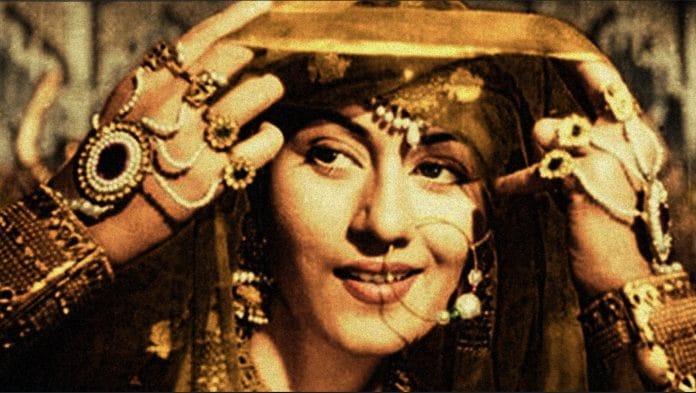



Long before flashy item numbers tried to define sensuality, there was Madhubala in Howrah Bridge. When the first notes of Aaiye Meherbaan begin to play, the invitation in the lyrics is polite and formal. But Madhubala’s performance is where the mischief lies.
In the nightclub, Madhubala, dressed in a modest outfit, moves like she has all the time in the world. Every step is measured, every turn is deliberate. Her eyebrow lifts half a second before the line lands. She doesn’t seduce by showing skin. She seduces with restraint and expressions.
“Though Madhubala was fully covered, it remains one of the most sensuous songs ever filmed,” Anuradha Dar, theatre practitioner and educationist, told ThePrint.
Madhubala, often dubbed the ‘Indian Marilyn Monroe’, was born on 14 February 1933. She stepped into the world of cinema at the age of 9, making her debut as a child artist in Basant (1942). But it was her first major adult role as Ganga in Neel Kamal (1947) that announced the arrival of a star. Her career spanned over two decades with 70 films.
But beyond her dialogue delivery and beauty, it was the nuance she brought to the songs picturised on her that made her performances unforgettable.
In Achha Ji Main Haari from the 1958 film Kala Pani, she brought lighthearted flirting and teasing expressions, while Zindagi Bhar Nahin from Barsaat Ki Raat (1960) allowed her vulnerability to surface. Aaiye Meherbaan in Howrah Bridge showcased her sultry command of the frame. In contrast, Mohe Panghat Pe Nandlal Chhed Gayo Re from Mughal-e-Azam (1960) highlighted her grace in a classical setting. This tells that Madhubala possessed a rare instinct: she understood exactly what a song required. And, then gave it more.
Dar said that Madhubala’s allure in songs like Aaiye Meherbaan “came not from costume, but from expression.” She points to the playfulness in her eyes, the grace in her movements, and the quiet confidence she carried.
“Madhubala proved that true sensuality lies in subtlety and dignity,” Dar added.
Performance for the books
If Aaiye Meherbaan was a masterclass in sensuousness, Pyaar Kiya Toh Darna Kya from Mughal-e-Azam was Madhubala at her most majestic. Her unwavering gaze, trembling vulnerability, and quiet strength gave the song, which was composed by Naushad and written by Shakeel Badayuni, immortality.
Actress Sheena Chohan told ThePrint that even today she revisits Madhubala’s performances to study her expressive eyes, graceful movements, and nuanced emotions.
“I’ve been given references by filmmakers time and again, which I have currently worked with and tried to take inspiration from them to bring that depth into my present films as an actress,” she said.
The Sheesh Mahal glitters with a thousand reflections, crystals shimmer, and an emperor’s authority hangs heavy in the air. Then she steps forward, anklets chiming, deer-like eyes wanting to say something, chin lifted in defiance. The voice behind Pyar kiya… koi chori nahin ki is Lata Mangeshkar’s. But the courage, the rebellion, the unbearable vulnerability belong to Madhubala.
Even under the physical strain she endured during the filming of Mughal-e-Azam, as she was battling a heart condition, weighed down by heavy costumes, her commitment to the craft was fixated.
Her expressions aligned with musical phrasing and she internalised the emotional arc of a composition. She did not treat songs as mere ornaments. She treated them as narrative turning points.
For Dar, too, Pyar Kiya Toh Darna Kya remains her favourite.
“Her eyes carried the weight of love and rebellion. The grandeur of the set was magnificent, but it was her conviction that gave the song its soul,” she said.
Long before songs were measured by digital virality, this one swept across the nation like wildfire. It was hummed in homes, quoted in love letters, replayed on radio waves, because Madhubala made it unforgettable.
“Her screen presence was not loud, but luminous and perhaps it is no coincidence that she was born on 14 February, she truly became India’s eternal Valentine, spreading love through every smile and every song,” Dar added.
Giddy smiles, playfulness
Madhubala today is often remembered for her beauty and aching vulnerability. But, she was far from one-note. She possessed a sparkling playfulness that lit up the screen, her giddy smiles and teasing glances were full of life.
Indian journalist and author Yasser Usman said that Madhubala had “that rare magic of filling black-and-white frames with color.”
“If you watch a song like Achcha ji, main haari, nothing about her felt posed or forced…like she was performing for the camera. That contrasting yet perfect mix of innocence and flirtation, simplicity and sophistication, with pure glamour. And even today, it says something that most viral AI clips of classic Bollywood actresses so often feature Madhubala,” said Usman.
In Achha Ji Main Haari, she plays with mock surrender and playful pride. The rhythm becomes a conversation. And, Madhubala responds with her expressive eyes that have the potential to carry the whole conversation.
Alongside this Asha Bhosle classic, Usman also cited Ye Kya Kar Dala Tune from Howrah Bridge as one of his favourite Madhubala performances. What makes this song remarkable, he said, is its simplicity — it is set against everyday moments, without extravagant sets or elaborate choreography, allowing her natural charm and emotional ease to take centre stage.
“It’s just her presence that makes them utterly charming and unforgettable. That playful, tender, and sensuous energy she radiates in these songs,” he said.
Then there is Haal Kaisa Hai Janab Ka from Chalti Ka Naam Gaadi (1958). A pure joyous track. Here, Madhubala showcases her gift for comedy, which is utterly natural. The song dances between flirtation and fun, and she matches every musical beat. Her laughter feels unscripted.
Among these, the haunting allure of Aayega Aanewala from Mahal (1949) often gets ignored. This earlier collaboration between Madhubala and Lata Mangeshkar ideally changed the soundscape of Hindi cinema.
“She didn’t just appear in the song, she floated through it. The way she used stillness, silence, and expression made it unforgettable,” Dar noted.
The song’s slow, echoing introduction became iconic, and Mangeshkar herself often remembered how its immense popularity marked a turning point in her career.
“A lot of the credit for the impact of Aayega Aanewala went to Madhubala. She stipulated in her contracts that she wanted only me to do her playback singing. This was after the success of ‘Aayega aanewala’ in Mahal, though I had sung for her earlier….During those days we’d meet socially quite often. That kind of camaraderie no longer exists,” Mangeshkar revealed in one of her interviews.
Also read: Madhubala and K Asif’s grandeur is what makes Mughal-e-Azam an epic
Respect the lyrics
For contemporary actors, Madhubala’s musical legacy offers lessons. First and foremost, respect the lyrics. Then, understand the emotional architecture of a song.
But above all, recognise that playback singing is a partnership, the unseen voice and the seen face must breathe together. Madhubala did justice to the voices of both Mangeshkar and Bhosle, turning every song into a seamless, living performance.
However, Dar said actors today should learn authenticity from her.
“She never seemed to ‘perform’ for the camera, she became emotional. Even in grand, dramatic settings, she remained natural. Her expressions were never exaggerated, yet they reached straight to the heart,” she said.
While films like Mughal-e-Azam, Amar, and Sangdil proved her depth, there were very few films where she got truly author-backed roles. Often, her breathtaking beauty and magnetic screen presence elevated parts that weren’t written with equal strength.
“At times, her breathtaking beauty and screen presence outshone parts that simply weren’t written strongly enough. Her true screen presence, and a natural connection to the character was magical,” Usman noted.
This magic extended to the songs picturised on her, where she seamlessly translated melody into emotion. According to Usman, if today’s actors are to take a lesson from Madhubala, it would be “the natural, effortless ada… never a note too high, never too low… just perfectly luminous.”
(Edited by Aamaan Alam Khan)