





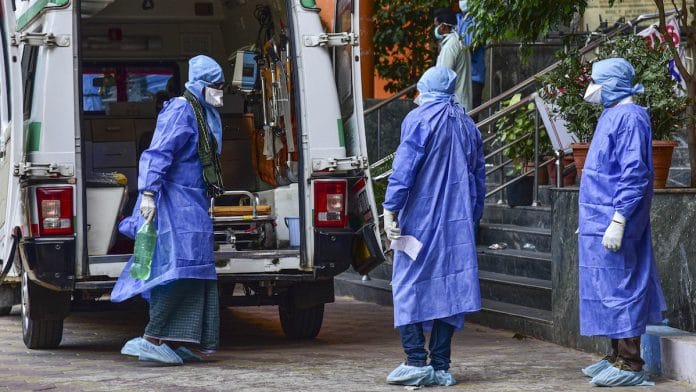

New Delhi: The Congress Monday hit out at the Narendra Modi government citing the scarcity of personal protection equipment (PPE) for medical personnel treating coronavirus patients.
Party spokesperson Randeep Surjewala, in a video message, said, “Our doctors don’t have adequate PPEs (personal protection equipment) … But your government allows export of these items at prices 10 times higher.”
Dear PM,
As you address the Nation today, the two acts of your Govt jeopardising the health of Doctors & health workers must be punished -:
1. Why did Health & Textile Ministries didn’t determine specifications for PPE’s between 1st Feb to 2nd March, 2020?#COVID2019
1/2 pic.twitter.com/JxtI9ifi3R
— Randeep Singh Surjewala (@rssurjewala) March 24, 2020
The criticism comes in the wake of several health workers complaining about the shortage on social media over the past few days.
“No N95 masks for Drs and Sisters in Emergency in GTB hospital. And no proper PPE (sic),” posted a Dr Dushyant Sisodiya.
Another user, Nadeem Seikh said, “We are trying our best as medical fraternity but we are also humans so please provide us with PPE so that our first line of defence remains safe. At least provide us N-95 mask.”
No N95 masks for Drs and Sisters in Emergency in GTB hospital. And no proper PPE.@ArvindKejriwal @narendramodi @AmitShah @MoHFW_INDIA @satyendrajain @aajtak @ZeeNews @indiatv @ndtv pic.twitter.com/8BANh50IjP
— Dr.Dushyant Sisodiya (@dushyant5162) March 22, 2020
Critical protective gear
According to the World Health Organization (WHO), PPE consists of garments worn to protect healthcare workers or any other person from getting infected.
The list of such garments typically includes gloves, mask and gowns. On 27 February, as the outbreak was taking a turn for the worst, the WHO published guidelines in which it recommended the use of “gloves, medical masks, goggles or a face shield, and gowns, as well as for specific procedures, respirators (i.e., N95 or FFP2 standard or equivalent) and aprons”.
The N95 or FFP2 respirators are types of masks essential for health workers treating coronavirus patients since the virus is transmitted through droplets an infected person might cough up or spray while sneezing.
In India, the government’s National Guidelines for Infection Prevention and Control in Healthcare Facilities furnished an elaborate list of PPEs to use when tending to patients. This included three types of gloves (non-sterile, sterile single-use and heavy-duty), aprons and gowns, and facial protection. It also recommends the use of N95 respirators.
Despite this, several reports emerged, pointing to a lack of PPEs in hospitals.
The shortage prompted the government to float tenders for 7,25,000 body cover, 1.5 million N-95 masks and 1 million 3-ply masks on 21 March. It’s nodal agency HLL Lifecare floated tenders to vendors like US multinational 3M and local manufacturer Venus.
Other reports also revealed flaws in the procurement process, including the centralisation through HLL Lifecare. Currently, manufacturers send the PPE to HLL Lifecare, which assembles it into kits and sends them to hospitals.
Also read: Need more masks, sanitisers — doctors say hospitals ill-equipped to fight COVID-19
Lessons from China, Italy
Italy, which became the hotspot for the outbreak after Wuhan, faced a similar crisis over the shortage of PPEs. Doctors and nurses were forced to use ineffective surgical masks without a protective filter.
Last week, a report by Gruppo Italiano per la Medicina Basata sulle Evidenze or GIMBE (Italy’s Group for Evidence-based Medicine) revealed that about 2,629 of the country’s health workers had become infected with coronavirus in February.
This accounted for 8.3% of the total number of cases in the country.
In China, this percentage was over 3.8, and accounted for five deaths, according to data put out by JAMA Network Open, published by the American Medical Association.
Also read: Italy doctors’ plea to world: Treat more COVID-19 patients from home to contain virus spread