



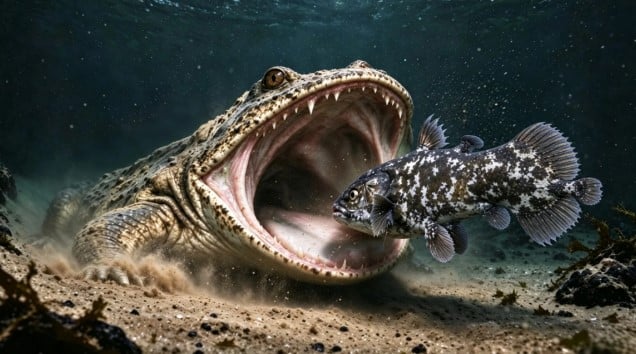
New Delhi: Around 237 million years ago, when dinosaurs were beginning to emerge on land, an unusual amphibian inhabited the seas around what is now south-western China. Measuring roughly 75 centimetres in length, it had a flattened body, a broad mouth and a covering of bony plates.
The animal, named Gerrothorax maritimus, is significant for a reason beyond its age. Researchers believe it is the first known amphibian adapted to a fully marine lifestyle, an environment that no living amphibian species is known to inhabit exclusively.
The findings, based on two nearly complete skeletons discovered in Guizhou province, were published in the journal Nature Ecology & Evolution on 26 October. They raise questions about how a group of animals whose biology generally restricts them to freshwater environments could have adapted to life in the ocean.
The discovery also offers a glimpse into an important principle of evolution: biological limitations can sometimes be overcome when existing features are adapted to serve new purposes. But the fossil record also reminds scientists that an evolutionary solution does not necessarily become a permanent feature of a group.
Why is this amphibian so unusual?
Modern amphibians include frogs, salamanders and caecilians. Most depend on freshwater environments, or habitats where seawater is diluted, because their permeable skin allows water and dissolved substances to pass through it.
That skin is useful in freshwater, where amphibians can absorb water and, in some species, exchange gases through their bodies. In seawater, however, the difference in salt concentration creates a problem. Water can leave their bodies through the skin, while managing excess salt becomes difficult.
Some living amphibians tolerate brackish water or brief exposure to saltier conditions. But none is known to spend its entire life in the open sea.
Gerrothorax maritimus appears to have crossed that boundary millions of years ago.
The researchers examined two almost complete skeletons preserved in rocks formed from marine sediments. The fossils were found in a region that was underwater during the Late Triassic and at least about 30 kilometres from possible islands. Their relatively complete preservation suggests that the animals died close to where they lived, rather than being washed out to sea from a river or lake.
The team also examined strontium isotopes in the bones. These chemical signatures were consistent with those expected in the seawater of the period, strengthening the case that the amphibians grew up in a marine environment.
Taken together, the location, preservation and chemical evidence suggest that this was not simply a freshwater animal whose remains ended up in the ocean.
Also Read: Why Apple is bringing a touchscreen to the MacBook. Steve Jobs had famously said no
How could it survive in saltwater?
The most intriguing clue may be its armour.
Unlike the soft-skinned appearance associated with many living amphibians, Gerrothorax maritimus had extensive bony plates covering much of its body. The researchers suggest that this armour, inherited from an armoured freshwater lineage, may have helped reduce the exchange of water and salts through its skin.
That could have changed how the animal managed its internal water balance. Rather than relying primarily on its skin, it may have swallowed seawater and handled the excess salt through other parts of its body.
The creature’s broad, flattened skull and large mouth also suggest that it may have hunted close to the seabed. Researchers propose that it used suction feeding, rapidly expanding its mouth to draw in water and prey, potentially catching fish and other small marine animals.
Its armour may also have offered protection against predators. The ancient seas included large marine reptiles, making a protective covering potentially useful for a relatively small animal living near the seafloor.
What does the discovery reveal about evolution?
The existence of Gerrothorax maritimus suggests that the challenges posed by seawater did not make a marine existence impossible for every amphibian lineage. Its ancestors already possessed extensive armour, and researchers propose that this feature helped the animal cope with the demands of a saltwater environment.
A common misconception is that evolution moves steadily towards a more advanced form, with modern animals representing the final stage of that process. In reality, evolution produces branching lineages, each responding to different environmental pressures.
The discovery suggests that an ancient amphibian lineage explored an ecological niche that living amphibians have not occupied. It does not mean that amphibians as a whole were on an inevitable journey towards marine life, or that this species was the ancestor of modern ocean-going animals.
Its adaptations may have worked well in the environment in which it lived. Yet no living amphibian is known to have retained this fully marine lifestyle. The fossil record does not, by itself, establish precisely why the lineage disappeared or why the adaptation was not carried forward.
The absence of fully marine amphibians today does not prove that such a lifestyle was always impossible. Instead, this discovery indicates that at least one ancient lineage may have crossed the boundary, using a combination of anatomical features that is no longer represented among living amphibians.
That distinction matters: evolution produces a wide range of experiments, but only some lineages survive to the present.
The larger lesson is that evolution is not a fixed ladder of progress. It is a branching history of adaptation, in which inherited features can acquire new functions and animals can occupy ecological niches that later disappear from their group.
Gerrothorax maritimus is a reminder that the limits we observe in living animals tell only part of the story. The fossil record can reveal evolutionary possibilities that nature explored millions of years ago, even if none of those experiments survives today.