


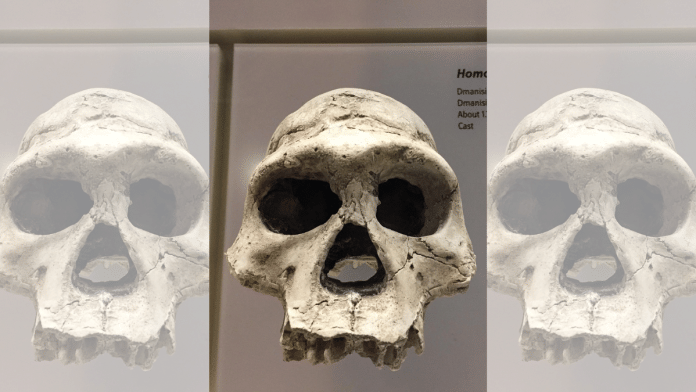
New Delhi: The familiar illustration of human evolution, showing an ape gradually standing upright and transforming into a modern human, has long shaped how we imagine our origins. But evolution did not follow a straight line. It branched like a tree, with different human species emerging, evolving and sometimes living alongside one another.
And sometimes, all it takes to uncover another branch is a single tooth.
That is the possibility raised by nine ancient teeth discovered in two caves in southern China.
Scientists have identified eight of them as belonging to Homo erectus, an extinct human relative that first appeared nearly two million years ago. But the ninth tooth is different. It does not match Homo erectus, modern humans (Homo sapiens) or other known human groups, including Neanderthals and Denisovans, closely enough for researchers to identify its owner.
The discovery, published in Nature, suggests that two different human groups may have inhabited the same region between 324,000 and 184,000 years ago.
What did scientists discover?
The nine fossilised teeth came from Naxian and Baxian caves in southern China.
Researchers examined their shapes and studied proteins preserved inside the enamel, the hard outer covering of a tooth.
Proteins are tiny biological building blocks that help form and maintain our bodies. Some can survive in fossils long after DNA, which carries genetic instructions, has broken down.
By studying these ancient proteins, scientists can sometimes identify which species a fossil belonged to.
Eight teeth were identified as Homo erectus.
But one tooth, labelled PA1796, stood out.
Its shape differed from the others, and its protein profile did not match the human species used for comparison.
Researchers believe it belonged to another ancient human group, although they cannot yet say which one.
How could two human species exist at the same time?
Because human evolution produced several branches, many of which existed at the same time.
Homo erectus was among the earliest human relatives to spread from Africa into Asia.
Other groups, including Neanderthals, Denisovans and eventually Homo sapiens, also inhabited different parts of the world.
Our own species even encountered and interbred with some of them.
Many people living today carry small amounts of Neanderthal DNA, evidence that these encounters sometimes resulted in offspring.
So the possibility of two ancient human groups occupying southern China isn’t inherently surprising.
What makes these fossils significant is that they place Homo erectus in southern China much later than previously thought, while raising the possibility that another, still-unidentified human lineage inhabited the same region. The teeth also come from an environment that challenges earlier assumptions about where ancient humans could survive.
However, the teeth do not prove that individuals from both groups met face to face. They suggest overlapping populations in the region, potentially across a long period.
Why is Homo erectus surviving so late important?
Scientists previously believed Homo erectus had largely disappeared from mainland Asia around 400,000 years ago.
The newly dated teeth suggest the species survived in southern China much later, possibly until around 184,000 years ago.
That pushes back the estimated disappearance of Homo erectus from the region by roughly 200,000 years.
But the discovery is important for another reason. The fossils suggest that Homo erectus inhabited southern China’s tropical rainforest environments, challenging the idea that these ancient humans were largely restricted to more open landscapes.
Dense rainforests presented a different set of challenges. Thick vegetation made movement difficult, while finding and obtaining food required navigating an environment very different from the open grasslands often associated with early humans.
The presence of Homo erectus in these forests suggests that the species may have been more adaptable than previously believed. It also raises questions about when ancient humans developed the ability to survive in such demanding environments, a capability often associated with our own species.
Could the mysterious tooth belong to a Denisovan?
The tooth’s discovery in China raises the possibility of a Denisovan connection, although its location alone cannot establish its identity.
Denisovans were an extinct human group whose existence was first established through ancient DNA recovered from fossils in Siberia. Subsequent discoveries have provided evidence of their presence in other parts of Asia, including the Tibetan Plateau.
They overlapped in time with other human populations and interbred with some of them, leaving traces of their DNA in people living today.
Since Denisovans inhabited Asia during parts of the period covered by the Chinese fossils, researchers cannot rule out a connection. But the mysterious tooth has not been conclusively identified as Denisovan, and it could belong to another human lineage altogether.
More fossils and further analysis will be needed to establish its identity.
For now, the discovery offers another reminder that humanity’s past was far more crowded than we once imagined.
Today, Homo sapiens is the only surviving human species. Hundreds of thousands of years ago, we were just one branch of a much larger family.