





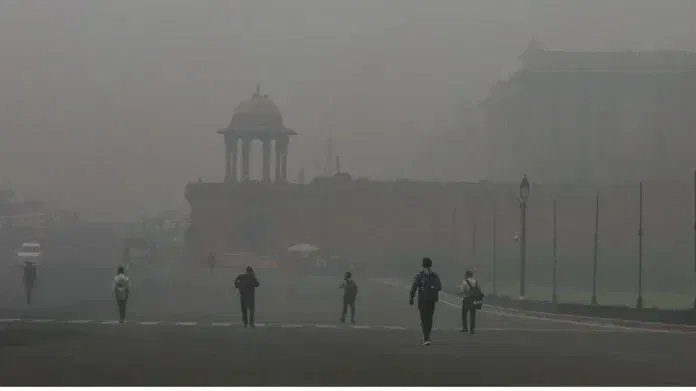



New Delhi: If Delhi implements COVID-19 lockdown-like curbs, the city could lower its national annual average PM2.5 levels enough to meet the national ambient air-quality standard by 2040, a new paper has highlighted.
The study, titled ‘40 by 2040: Cost of inaction and delays in reaching Delhi’s air quality target’, noted how a dramatic drop in pollution was observed across the globe during the COVID-19 lockdown periods.
It mentioned that the lockdowns resulted in a drastic cut in emissions from all sectors, consequently a drop in pollution, which was clearly observed in satellite data and became a subject of numerous media highlights worldwide.
“At the peak of the restrictions, there were drops of 50 per cent in PM2.5 concentrations and blue skies with views of Himalayan peaks 200 km away. Most uncontrolled activities in 2020 were winter heating and stubble burning,” the report read.
Air quality researchers Sarath Guttikunda and Sai Krishna Dammalapati from Urban Emissions, an environmental advocacy group that also mapped Delhi’s PM2.5 concentrations from 1989 to 2025.
According to them, despite several policy announcements, the city’s annual average pollution between 2019 and 2025 mostly hovered around 100 µg/m³ consistently. This is around 2.5 times the national standard and 20 times the World Health Organisation (WHO) guideline of 5 µg/m³.
Also read: What is autopen? The signature device Trump is threatening ‘sleepy Biden’ for
Stubble-burning; winter heating emissions
The report noted that achieving the national ambient standard of 40 µg/m³ set by the Central Pollution Control Board (CPCB) would require a mix of measures.
This list includes up to a 55 per cent reduction in emissions from all human-made sources, a 75 per cent decrease in winter heating emissions, and the complete elimination of stubble-burning emissions.
The authors also outline two major financial and health risks in the study—the cost of inaction and the cost of delayed action.
If Delhi reaches only 60 µg/m³ by 2040 instead of the target 40 µg/m³, the city would see 11.6 per cent more exposure cases. If concentrations remain at 100 µg/m³, the increase jumps to 35.3 per cent more mortality cases for every 100 cases projected under the 40 µg/m³ scenario.
The study attributes the problem primarily due to delays in implementation, not to gaps in scientific understanding or policy design.
It emphasises that had all measures stated in the National Clean Air Programme’s 2019 clean air plan been carried out as intended, Delhi could have achieved the national annual ambient standard by 2040.
However, the researchers say, if cities like London, Los Angeles, and Beijing can reach cleaner, manageable air quality numbers in 10 to 15 years, it is realistic to assume that Delhi too can replicate the same results.
But a cohesive strategy and implementation plan need to be set into motion in 2026.
(Edited by Saptak Datta)