





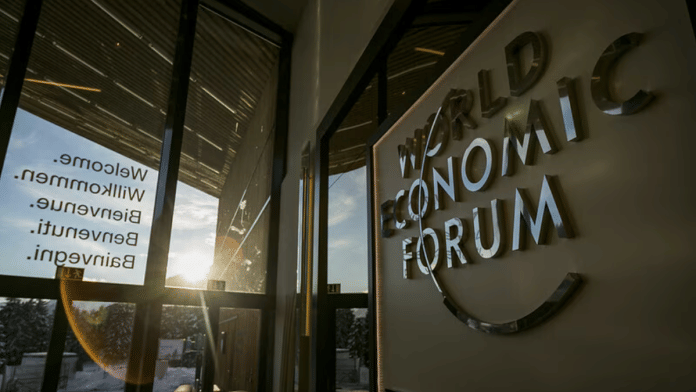



Hyderabad: At the ongoing World Economic Forum 2026 in Davos, Switzerland, nine Indian states are presenting themselves as a single, integrated market under the India Pavilion. The annual summit facilitates global public-private cooperation across sectors, and the nine Indian states are highlighting their special strengths to tap into the global energy and technology supply chain.
The year’s theme, ‘A Spirit of Dialogue’, brings together global leaders from government, business, civil society, and academia at the event, which will conclude on 23 January.
Union Ministers Ashwini Vaishnaw, Shivraj Singh Chouhan, Pralhad Joshi, and K Rammohan Naidu are expected to attend the annual meeting along with chief ministers of Maharashtra, Andhra Pradesh, Assam, Madhya Pradesh, Telangana, and Jharkhand.
At the national level, the Department for Promotion of Industry and Internal Trade (DPIIT) is participating to promote India as an investment destination, while the Confederation of Indian Industry (CII) is acting as the nodal agency coordinating activities at the India Pavilion.
The nine participating Indian states include Gujarat, Andhra Pradesh, Kerala, Maharashtra, Madhya Pradesh, Uttar Pradesh, Telangana, along with Assam and Jharkhand, which are making their WEF debut. Major states are capitalising on the WEF’s Digital FDI initiative that helps countries attract investment in digital infrastructure.
One of the objectives of the nine states at Davos 2026 is highlighting ease of doing business to boost investor confidence. The World Bank ranks economies from 1 to 190 based on their regulatory and legislative environment for conducting business. A high ease of doing business ranking means it’s easier for a firm to start and operate a business in the country. These states are also integrated into a central digital platform called National Single Window System (NSWS) to streamline business approvals and clearances.
Maharashtra: The state dominates India’s data-centre market and forms the manufacturing and logistics backbone of the country with a well established maritime, shipbuilding, and container-handling ecosystem.
At Davos, it is positioning itself as a global digital and maritime convergence hub, linking data centres, ports, shipbuilding, green steel, and renewable energy.
Andhra Pradesh: It is a coastal state with multiple ports, industrial corridors, food processing capacity, and under-utilised manufacturing zones. It is positioning itself as a port-led manufacturing and food-security state, expanding into defence, tourism, and clean energy.
Gujarat: India’s most industrialised coastal state with strong ports, and petrochemicals, chemicals, auto, and export manufacturing clusters, Gujarat is reinforcing its position as India’s lowest-risk, scale-ready manufacturing base. It is exploring opportunities to deliver advanced technology solutions through Global Capability Centres (GCC) and textile parks.
Kerala: It is a human-capital rich state with strength in services, IT, healthcare and education, but limited heavy manufacturing. It is positioning itself as a knowledge-driven green economy, focused on technology-led and skill-intensive sectors.
Also read: What is Nata Vivah? Contractual marriage recognised by Rajasthan High Court
Telangana: This southern state is India’s pharma and life sciences hub, with Hyderabad producing vaccines and bulk drugs, and conducting R&D. It also hosts major global and Indian companies across IT and manufacturing.
Expanding beyond pharma into deep tech, high-value R&D, and innovation activity in the medical sector, it is positioning itself as a next-generation life sciences and AI hub.
Uttar Pradesh: One of India’s largest consumer markets, with expanding electronics, defence, and infrastructure corridors, UP is positioning itself as a scale-driven manufacturing and consumption hub, anchored in domestic demand. The state is pitching itself as an infra-ready, future-ready option for investors across sectors such as clean energy, digital infrastructure, and defence manufacturing.
Madhya Pradesh: A centrally located state with logistics advantages and growing agri-processing capacity, Maharashtra also has an automotive manufacturing and renewable energy-focused EV ecosystem. It is positioning itself as a cost-competitive manufacturing and processing alternative for investors from solar panel and battery industries.
Assam: The gateway to the Northeast, with strengths in energy, tea, and regional connectivity, Assam is positioning itself as part of India’s eastward growth and connectivity strategy. The state is gearing up to accommodate an increasingly automated and AI-driven future, while preparing its workforce on skill development and industry-aligned training.
Jharkhand: Marching steadily toward powering the energy security of the nation, Jharkhand is a mineral-rich state historically focused on raw extraction. It is positioning itself as a model that moves beyond extraction alone. It is building toward value-added manufacturing, green metallurgy, recycling, and circular economy systems.
For India, Davos has remained a key venue to highlight reform momentum, policy stability, and openness to global investment. Despite every state’s unique agendas, the unified India Pavilion shows synergy, not competition. Western states anchor capital and infrastructure, southern states lead in execution and tech, and eastern states signal India’s next resource and connectivity frontier.
(Edited by Aamaan Alam Khan)
Indian states are pitching freebies, subsidies, reservations, and loan waivers at Davos economic forum.