





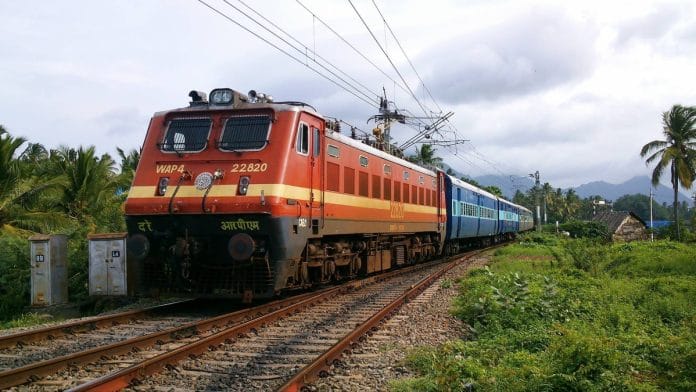



New Delhi: In a significant milestone for India’s transportation system, Indian Railways has achieved 99.2 per cent electrification of its broad gauge network. It has now surpassed the UK, Russia, China, and Japan, the Ministry of Railways said on Wednesday.
This brings India closer to a fully electrified railway system.
The milestone places India ahead of major railway networks. But, beyond global comparisons, the near total electrification is expected to significantly cut fuel costs, reduce carbon emissions, and improve the speed of trains. Broad gauge is India’s standard railway track, and almost all major passenger and freight trains in India run on them.
The Indian Railways also brought down its fuel consumption by 136 crore litres for traction purpose during 2023-24 as compared to 2018-19.
Rapid progress
Electric traction offers multiple benefits, such as greater energy efficiency, reduced fuel costs, lower greenhouse gas emissions, higher speeds, and enhanced hauling capacity for both freight and passenger services.
The trains can carry heavier loads and operate more efficiently. Electrification of the railways is part of India’s climate goals, and the Indian Railways has set a target to become a Net Zero Carbon Emitter by 2030.
According to government data, 21,801 kms of India’s railway network was electrified until 2014, while from 2014 to 2025, the railways carried out 46,900 kms of electrification.
Railway electrification in the UK stands at 39 per cent, Russia at 52 per cent, Japan at 64 per cent, and China at 82 per cent, as per the latest report of the International Union of Railways (UIC).
Fourteen railway zones, including the Central, Eastern, and Northern Railways, have achieved 100 per cent electrification. And railway networks in 25 states and Union Territories have also been electrified. Some zones, including South Western Railway and Northeast Frontier Railway, are about 95 per cent electrified.
All the new railway lines and multi-tracking projects are now being designed with electrification from the outset. It ensures that expansion and modernisation go hand in hand.
At the state level, a similar picture emerges. Most states, including Andhra Pradesh, Bihar, Jharkhand, Delhi, Gujarat, and Punjab, have electrified their railway network. While Rajasthan is at 99 per cent, Tamil Nadu at 97 per cent, Karnataka at 96 per cent, Assam at 92 per cent, and Goa is at 91 per cent.
Also read: Why India’s manufacturing-first approach to semiconductors is unsustainable
Why the milestone matters
But, beyond the numbers, the electrification drive has strategic, economic, and environmental benefits. It reduces dependence on imported diesel, lowers operational costs, and improves railways’ financial sustainability. Railways emits significantly less carbon per tonne-km than road freight. Electrification has further amplified this advantage. It has helped reduce India’s overall transport sector carbon footprint.
Indian railways has also been increasing its procurement of electricity from renewable sources like solar and wind.
According to a NITI Aayog report, titled Fast Tracking Freight In India, June 2021, CO2 emission for transportation of 1 tonne for 1 km by road is 101 gm, while by railways is 11.5 gm, which is about 89 per cent less.
(Edited by Aamaan Alam Khan)