





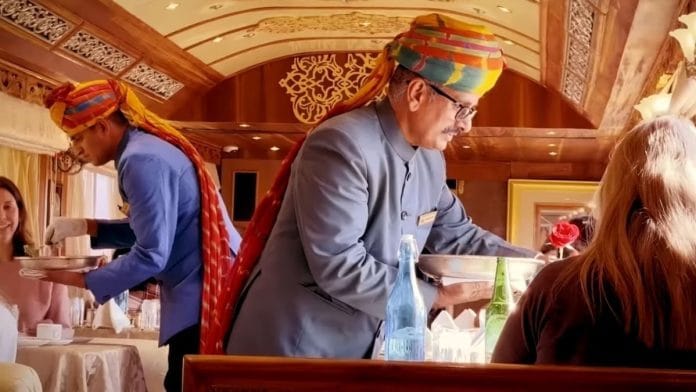



New Delhi: In a move to shed yet another colonial relic, Minister of Railways Ashwini Vaishnaw on Friday announced the discontinuation of the railway uniforms introduced by the British Raj. The black prince coat or bandhgala coat has been a staple associated with the Indian Railways since the 19th century.
“We have to find every trace of colonialism and banish it,” said Vaishnaw, speaking at an event to honour railway officials.
The bandhgala, however, has not just been a part of the railway uniform, but a quintessential favourite in Indian menswear, be it weddings, award functions, or any formal event. From Amitabh Bachchan to Shah Rukh Khan, the bandghala has been a celebrity favourite. It has also been a wardrobe staple of Prime Minister Narendra Modi for not just public appearances in India, but also diplomatic visits to various countries.
The bandhgala suit, also known as the Jodhpuri suit, literally means “closed neck.” Long before it became a uniform in the Indian Railways, it was a favourite of Indian royalty.
The fitted, tailored torso, shaped shoulders, and closed neckline of the jacket first emerged in the courts of Mughal Emperor Akbar in the 16th century.
The design evolved into a waist-length fitted jacket and was adopted in the courts of the Rajput warrior rulers and maharajas of Jodhpur. In North India, where winters were chillier, the bandhgala also became a practical sartorial choice.
The colonial connect
Bandhgalas share a relationship with the game of polo. It was introduced to India in the 12th century, and became one of the favorite sports of the British in India.
Such suits, like those worn by the Jodhpur Polo teams in the early 1930s, were produced from sweaters, most likely custom-sized abroad to fit the players. As Indian teams travelled abroad, their fashionable attire travelled with them, attracting Western curiosity. The combined outfit of jacket and breeches was called jodhpurs.
One popular anecdote is about Maharaja Pratap Singh of Jodhpur, whose luggage went missing when he was on a tour of England to attend celebrations of Queen Victoria in 1897.
He designed the new attire and had it stitched by a Savile Row tailor. The existing jacket was refined with sharper tailoring, evolving into what we now recognise as the bandhgala.
There was also Maharaja Umaid Singh, an aviator who set up the Jodhpur Flying Club in 1930 and hosted an American squadron stationed in Jodhpur. They popularised the Jodhpur boots, breeches, and also the bandhgala.
The British adaptation of the bandhgala for their own use was an example of imbibing local customs. Indian Royals and high-ranking officials wore the bandhgala when meeting the British for official and formal occasions. Soon, it became a garment adopted by the British themselves.
Also read: US Dept of Labor tweets about ‘One People. One Heritage’. People ask: Who is American?
The fashion stamp
In the era of ‘Make in India’, the bandhgala in menswear is as quintessentially desi as the sari. It can be fashioned out of silk, jute, wool, velvet, and linen.
Because of its versatility, the bandhgala jacket can be worn with jeans, styled as a formal suit, or even paired casually as a standalone piece. The Raghavendra Rathore Jodhpur brand emerged as one of India’s luxury labels, making the bandhgala a must-have piece of couture.
Other high-end designers like Tarun Tahiliani and Anita Dongre also have their take on the classic ensemble. Like in the case of the Kolhapuri chappals being used by Prada, the bandghala has long fascinated international brands.
This has also prompted international brands like Canali, Armani, and Stefano Ricci to tap into its marketable potential. It has been renamed, reshaped and sold all over the world.
But its roots are traced back to India, and more specifically, Jodhpur.
(Edited by Ratan Priya)
Tina ji. railway minister was saying its use as uniform for railway staff is colonial. Dress is obviously pre-colonial.