





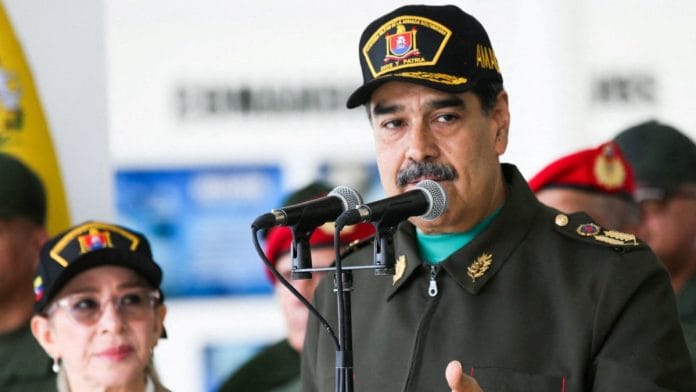



New Delhi: Before dawn on 3 January, the US launched a large-scale military operation against Venezuela, codenamed as ‘Absolute Resolve.’ During the operation, President Nicolas Maduro and his wife, Cilia Flores, were seized and removed from the country.
Images of damage at La Carlota air base and other sites quickly dominated newspapers, TV broadcasts and social media feeds.
Internationally, the response has been largely critical of Washington. Governments including Russia, China, Cuba and Brazil condemned the operation as a violation of the UN Charter, and an emergency UN Security Council meeting was convened to address the strikes.
Venezuelan media has highlighted not only foreign opposition but also deep divisions inside the US itself. Statements from Democratic lawmakers like Senator Bernie Sanders, who said Trump has “no right” to take the country to war unilaterally, are widely circulated in Venezuela. These comments are used to reinforce the argument that the operation is illegal even by US constitutional standards.
Also read:
What is pro-government media saying
In pro-government and state-aligned outlets such as Ultimas Notician, the dominant framing is uncompromising. Headlines describe a “gravisima agresion militar (very serious military aggression)” and a “criminal imperialist attack,” insisting that Venezuela’s elected president has been “secuestradon (kidnapped).”
Coverage situates the attack within a broader narrative of 28 weeks of escalating US military presence in the Caribbean, which Venezuelan officials argue was falsely justified as an anti-narcotics campaign.
Trump’s own remarks about “getting the oil back” are repeatedly cited as confirmation of long-standing Bolivarian claims that US policy toward Venezuela is driven by resource extraction, not democracy or human rights.
State-aligned papers have devoted extensive space to regional and global condemnations, including emergency meetings of the Community of Latin American and Caribbean States (CELAC), statements from allies such as Cuba and Honduras, and denunciations from Caribbean civil-society organisations, which have condemned the operation as a blatant violation of sovereignty.
Opinion pages lean heavily on international law, citing Article 2(4) of the UN Charter on the prohibition of force and Article 51 on the right to self-defence. These arguments are paired with calls for popular mobilisation and a “defensa integral de la nacion (Integral defence of the nation)”
What is Independent media saying
In contrast, independent and Opposition-leaning outlets—including TalCual, human-rights platforms and diaspora-run sites—are going with a more cautious tone. Their reporting depicts a Caracas in tense calm: Empty streets, queues for fuel and food, and a population torn between relief that Maduro’s rule might be ending and fear that the US intervention will unleash greater violence or repression.
These outlets focus on the opacity on both sides. They note Trump’s refusal to provide detailed information about the operation or civilian casualties, while also criticising what they describe as evasive or bombastic responses from Maduro’s inner circle in the hours before his capture.
Independent coverage also stresses the institutional vacuum now facing the country: The constitutional basis, or lack thereof, for Delcy Rodriguez’s acting presidency, the implications of a sitting president being removed by a foreign military, and whether this moment opens a path to negotiated transition or merely reshuffles authoritarian power under a new figurehead.
Human-right organisations such as Provea warn of two simultaneous dangers. The first is the precedent set by unilateral military intervention in Latin America. The second is internal: The risk that Venezuela’s security apparatus will use the narrative of external aggression to justify harsher repression against dissidents and protesters.
(Edited by Theres Sudeep)