





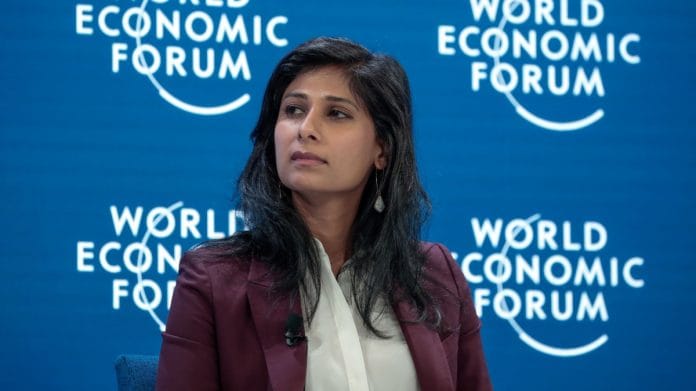



New Delhi: Former IMF economist Gita Gopinath thinks that air pollution is the biggest challenge to India’s economy right now, far surpassing global tariffs. Speaking at a session during the World Economic Forum meeting at Davos, Switzerland Wednesday, Gopinath said that India’s pollution levels incur very high costs both to India’s GDP and to the total lives lost in the country.
“About 1.7 million lives are lost every year in India because of pollution. That’s 18 per cent of the total deaths in India,” Gopinath said, quoting a World Bank study. “Even from an international investor’s perspective … the pollution holds you back.”
The air quality index (AQI) in Delhi reached 400 this week, indicating severe air pollution levels. Her pointers indicate what researchers in India have been trying to highlight for years—the impact of deteriorating air quality on social and economic life.
How exactly does air pollution affect Indian society, and how are these metrics calculated by Indian and global studies? ThePrint explains.
$339 billion lost to air pollution
Author, clean air advocate, and former financial journalist Jyoti Pande Lavakare is relieved that the conversation has reached a global stage.
“I’m very glad that someone as intelligent, respected and credible as Gita Gopinath has finally stated what is hidden in plain sight—pollution is a bigger challenge than tariffs are for India,” said Lavakare told ThePrint?.
Global studies—including the Lancet Countdown Report on Health and Climate Change, the Global Burden of Diseases, Injuries and Risk Factors Study, and the State of Global Air Study—have quoted the 1.7 million figure when it comes to air pollution mortality in India.
According to the 2025 Lancet Countdown Report, the monetised value of the lives lost prematurely to air pollution in India is close to $339 billion, or 9.5 per cent of the country’s GDP.
“Economic growth and environmental sustainability are seen in conflict—but they are not. It is about time pollution is taken seriously by the Indian government. When the economy is growing, but the growth comes from the sale of nebulisers, air purifiers, and chemotherapies and surgeries, then we’re heading in the wrong direction,” Lavakare said.
Also read: The world’s issues took a back seat at Davos. WEF was all about satiating Trump
Pollution deaths in India
The Global Burden of Disease (GBD) study, originally commissioned by the World Bank, was one of the first projects to calculate deaths from outdoor pollution, especially PM2.5 pollution, in India. GBD is a monumental global exercise that uses data from PM2.5 exposure levels, satellite data, demographic surveys, and disease registries in different countries.
The organisation then creates a mathematical model that estimates the pollution risk for different populations, and the mortality rate relevant to that risk.
In 2010, GBD estimated that there were almost 627,000 deaths in India annually because of ambient outdoor air pollution. It was the first time that global data attributed deaths in India directly to air pollution. The GBD database remains the backbone of most studies looking at air pollution mortality.
However, not all of these deaths are from exposure to air pollution. The GBD report estimates the different health outcomes related to exposure to air pollution, such as heart disease, lung cancer, obstructive pulmonary disease, pneumonia, and stroke. The risk of death and disability from these diseases has been statistically proven to increase due to long-term exposure to air pollution.
GBD calculates how many of these disease-related deaths would not have occurred if pollution was minimal, which then leads to the final estimate of pollution-related deaths in a country.
GBD’s estimates evolved over the years, with India’s air pollution mortality estimate increasing to 1.67 million deaths in 2019. The latest iteration of the report, in 2023, estimated that India and China both had over 2 million deaths annually due to air pollution, making India one of the few countries with the largest burden of air pollution deaths. These results were also published in the State of Global Air report in 2025.
“Most deaths attributed to air pollution actually stem from air pollution’s role in the development and exacerbation of other, non-communicable diseases,” said the report.
Another report on air pollution deaths in India, published in 2024 in The Lancet Planetary Health, pegs the attributable deaths even higher than the GBD numbers.
The researchers estimated that based on India’s own National Ambient Air Quality Standards (NAAQS), a total of 3.8 million deaths could be attributed to air pollution in 2000-2019. However, based on the WHO’s air quality standards, the number rises to 16.6 million in the same time period.
While the NAAQS have a permissible limit of 40 𝜇𝑔/m³, the WHO limit is much lower at 5𝜇𝑔/m³. Using different standards for what qualifies as exposure to bad air quality leads to different results on how many deaths can be attributed to air pollution.
Conducted by researchers from India and Sweden, the study said that GBD might underestimate the number of pollution deaths in India because it uses a mortality-risk model built on data from other countries, while the burden of risk in India is different. These researchers decided to use district-level death registration data and satellite air pollution data at a 1km x 1km resolution to estimate deaths due to exposure to PM2.5 in India from 2000 to 2019.
“Our results indicated that previous data of disease burden from ambient PM2·5 exposure in India are considerably underestimated, stressing the imperative to make progress rapidly towards reducing population exposure to air pollution,” read the study.
Also read: New hope for osteoarthritis patients — Stanford study finds ways to regenerate cartilage
GDP and economic impact
Using GBD data, studies and estimates have also examined the economic impact of air pollution and air pollution-related deaths on the Indian economy. In 2019, when GBD estimated 1.67 million deaths annually due to air pollution, a report by scientists from the Indian Council of Medical Research (ICMR) estimated that the Indian economy lost around $36.8 billion due to these deaths.
The ICMR scientists calculated the figure as the “cost of lost output” because of the premature deaths and pollution mortality—basically, the loss of productive human hours due to illness and death caused by air pollution. Based on this study’s calculations, India lost 1.36 per cent of its GDP to air pollution-related health impacts.
This ‘cost-of-illness’ measure is also what Gopinath was referring to in her comments in Davos.
“Pollution is a challenge in India … look at its impact on the Indian economy,” said Gopinath. “Look at the annual cost to India’s GDP of the level of pollution that you have—it’s not just the loss of economic activity, but also the loss of lives.”
There are also other estimates of GDP loss due to pollution, such as a 2020 analysis by Greenpeace SouthAsia. Greenpeace estimated that India bears $150 billion worth of losses from fossil fuel air pollution annually, which accounts for 5 per cent of the country’s GDP. Greenpeace also uses a methodology based on deaths and pre-term births due to air pollution.
Meanwhile, an analysis by the World Bank in 2023 said that India’s GDP was also growing slower because of the increasing air pollution.
“We estimate that Indian GDP would have been 4.51% higher in 2023 if pollution had been reduced by 50% in the last 25 years,” read the report.
(Edited by Prasanna Bachchhav)