


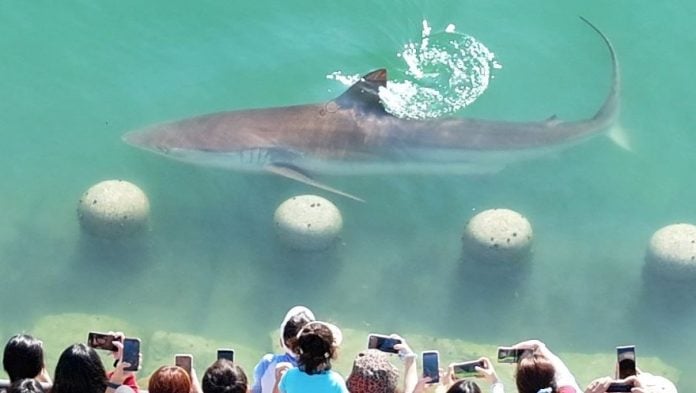
A 3.5-metre shark has become an unlikely tourist attraction in Busan, South Korea, after getting trapped in a narrow canal at a waterfront park.
More than 600,000 people visited the North Port area between 19 and 28 September, according to Busan city officials, after the shark was first spotted on 18 September. The number is striking because the park normally attracts only a few thousand visitors on a typical holiday day.
The shark, nicknamed “Bukang-i” after Busan’s North Port, has remained in the waterway for nearly two weeks despite repeated attempts to guide it back to the sea.
How did the shark get into the canal?
The waterway where Bukang-i was found is not an isolated pool. It is an artificial canal connected to the sea at Busan’s North Port.
It entered the canal from the Korea Strait (the body of water connecting the East China Sea and the East Sea/Sea of Japan), which surrounds the coastal city.
South Korean fisheries officials believe the shark likely entered through this connection while following prey. Local reports said warm-water fish species have become more common around Korea’s coast as sea temperatures rise, potentially bringing predators closer to shore.
The exact route the shark took has not been established. Officials have therefore described the prey explanation as a likelihood rather than a confirmed account of what happened.
Once inside the narrow waterway, however, the shark apparently did not find its way back to the open sea.
The animal has been identified in reports as a likely bronze whaler shark, although earlier Korean reporting also described it more broadly based on its appearance. It is about 3.5 metres long, or roughly 11.5 feet.
추석연휴 마지막날.
북항친수공원.
북항이 레전드 턴.
북항아 건강해라.#부캉이#북항친수공원 https://t.co/FZaAUtp4M4 pic.twitter.com/ux3smCikim
— Space1030 (@space1030m) September 27, 2026
Why can’t it simply swim back out?
That is what authorities initially expected.
When the shark was first spotted on 18 September, the Korea Coast Guard sent vessels to try to guide it towards the sea. The operation was stopped after about six hours following advice from fisheries experts, who warned that forcing the animal could stress it or trigger aggressive behaviour.
Authorities then monitored the shark, hoping it would leave on its own.
It did not.
With no feeding activity observed since its arrival, officials became increasingly concerned about how long the shark could remain in the canal.
The National Institute of Fisheries Science said the animal appeared stable, but its ability to feed and move freely was restricted.
On 29 September, authorities tried a different approach. Five vessels used streams of water to push the shark towards the canal’s exit and into the open sea.
The attempt failed.
The shark repeatedly avoided the boats and water jets and returned to the canal. Authorities subsequently decided to prepare a net-based operation instead. A specially designed net at least 50 metres long is being prepared to help channel the animal towards the exit, with another boat expected to assist from behind.
Why have 600,000 people come to see it?
The shark quickly became a social-media sensation.
Videos and photographs of the animal swimming close to the waterfront spread online, drawing thousands of people to the park. By 28 September, the city said 607,000 visits had been recorded since 19 September. Nearly 500,000 came during the Chuseok holiday period alone, according to AP.
The scale of the crowds transformed the area around the canal. People gathered along railings and pedestrian bridges, waiting for the shark to surface. Some travelled from other parts of South Korea specifically to see it.
The shark was soon given the affectionate nickname Bukang-i. Busan later went further, naming it an honorary promotional ambassador after a city Instagram poll received strong support from respondents.
Is this unusual for South Korea?
Sharks are not unknown in South Korean waters, but their presence close to heavily populated urban areas is unusual.
The National Institute of Fisheries Science recorded 46 large sharks off South Korea’s east coast during the first half of 2026, nearly four times the number recorded during the same period a year earlier. The increase was attributed by the institute to warmer seawater and greater availability of prey.
That does not establish that climate change caused Bukang-i to enter the Busan canal. But warmer waters and changing distributions of marine species can affect where both prey and predators are found.
For now, the immediate concern is more straightforward: getting the shark out safely.
The authorities’ latest plan is to use the large net to guide Bukang-i towards the sea, after the water-jet operation failed. Until then, a marine predator that probably entered the canal while chasing food remains in an artificial waterway, while hundreds of thousands of people have turned up to watch it.