





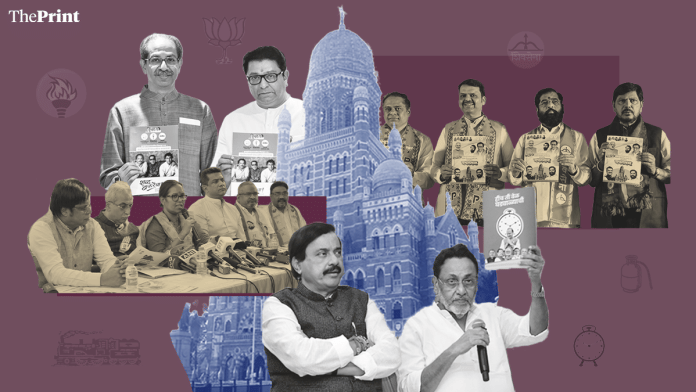



Mumbai: The 15 January Brihanmumbai Municipal Corporation (BMC) elections, coming after prolonged litigation, administrator’s rule, and political realignments in Maharashtra, have prompted major political alliances to release expansive, high-stakes manifestos.
These blueprints for India’s richest civic body address critical urban problems, blending ambitious infrastructure goals with populist appeals of free power and tax waivers, and send out unmistakable political signals, be it about pursuing “infiltrators” or upholding Marathi interests.
In a city without elected corporators since 2022, all the competing parties have attempted to solidify their core bases through their manifestos.
The Brihanmumbai Municipal Corporation (BMC) elections will be held across 227 wards in the city Thursday.
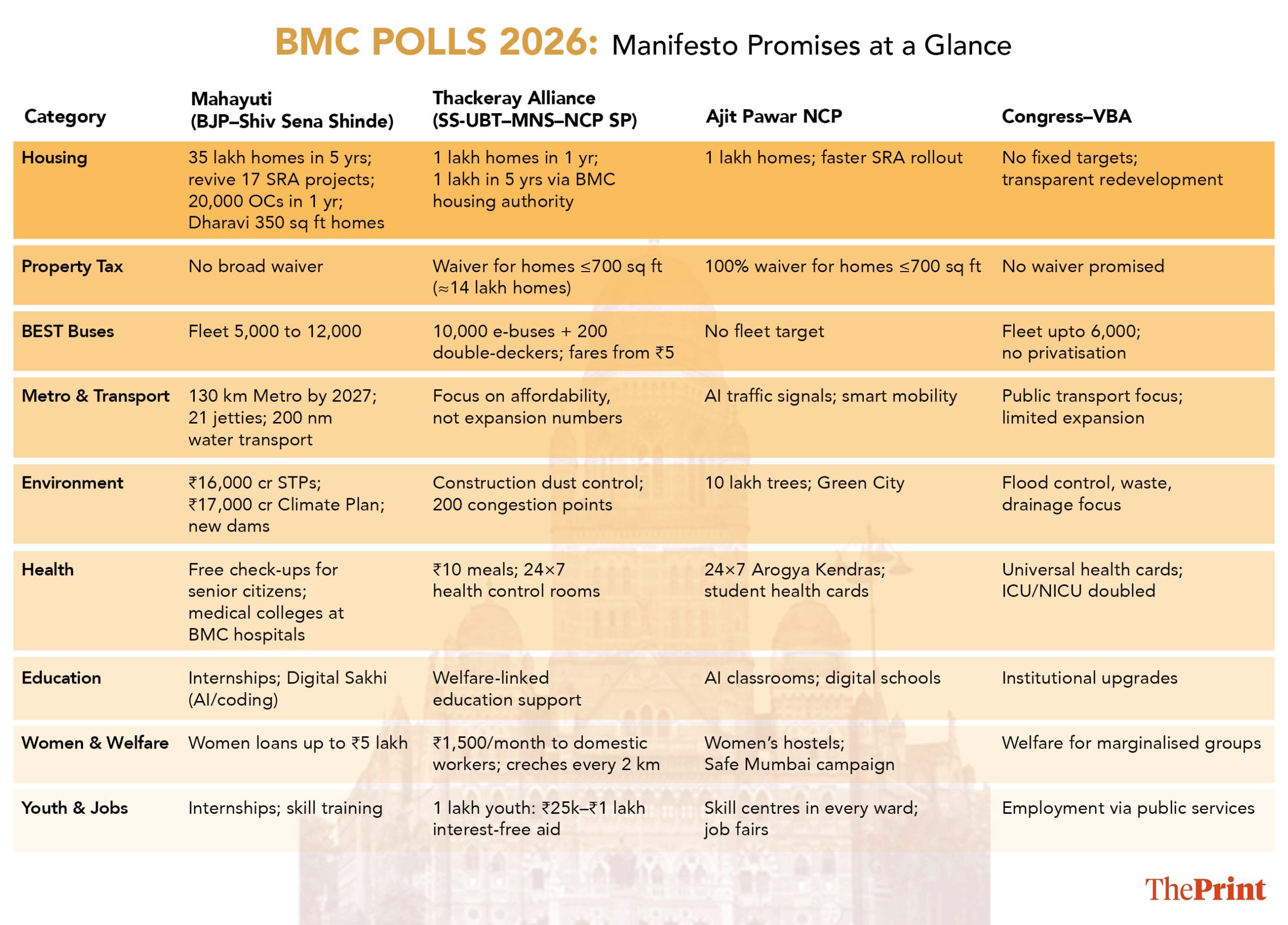
Eyeing Hindu vote consolidation, the Mahayuti, comprising the BJP and Eknath Shinde’s Shiv Sena, promise to drive out “illegal Bangladeshis and Rohingya Muslims” from Mumbai. Coupled with its ambitious promise of delivering 3.5 million new, affordable homes in five years, through the redevelopment of chawls, slums, and dilapidated buildings, it has designed an arresting manifesto.
Running solo, Ajit Pawar’s NCP pitched itself as a technocratic and development-first party in its manifesto, which is focused on an AI-powered ‘smart traffic signal’ and the expansion of CCTV and WiFi networks under the ‘Smart City’ initiative. AI-enabled education and women’s safety have also been promised in what is a tech-driven, security-focused manifesto.
The Thackeray brothers’ alliance of Uddhav Balasaheb Thackeray’s Shiv Sena and Raj Thackeray’s Maharashtra Navnirman Sena, along with Sharad Pawar’s NCP, has made the middle-class Mumbai residents the center of their manifesto, promising financial support up to Rs 1 lakh for the youth as well as relief from property tax and cost-of-living tax for houses under 700 sq ft.
Last but not least, the Congress-Vanchit Bahujan Aaghadi’s manifesto has made a pitch for good governance and inclusivity.
Also Read: From violent protests to majority consent, how opposition to Pune’s Purandar airport thawed
Housing & urban infrastructure
Housing is the most politically charged issue in Mumbai, where affordability, stalled redevelopment, and displacement have defined civic debates for decades.
In this backdrop, the pitch that’s most resounding in Mahayuti’s manifesto—released on 11 January (Sunday) by Chief Minister Devendra Fadnavis and Deputy CM Eknath Shinde—is the delivery of 3.5 million affordable homes in five years. This, along with the revival of stalled Slum Rehabilitation Authority (SRA) projects across 17 locations in the city, and the issuance of occupation certificates to 20,000 buildings within a year, brings the state’s ruling parties’ housing plan to a full circle.
During the manifesto release in Mumbai, Eknath Shinde, declaring that the manifesto is “a step towards fulfilling Bal Thackeray’s dream”, explained, “To facilitate redevelopment of the buildings, we have tweaked our policies and MHADA (Maharashtra Housing and Area Development Authority) rules.”
He added: “We have approved 17 cluster projects, including Cheeta Camp and Ketaki Pada to make Mumbai slum-free.”
Arguing that redevelopment is the only way to unlock housing potential in South Mumbai, the Mahayuti also promises a “pagdi-mukta” programme, which will dismantle a century-old rent arrangement. Under the existing system, tenants pay a large lump sum to the landlord upfront (the pagdi), and in return, get the right to stay in the property at a very low rent—often for decades. However, many homes rented under the arrangement are now old, unsafe, and not generating enough income for either party to upgrade them.
Shinde framed the party’s housing promises as corrective measures to reverse the migration of the original Mumbaikars to distant suburbs, such as Vasai-Virar and Badlapur, insisting that redevelopment would ensure that the ‘Marathi manoos’ are not forced to live outside Mumbai.
“Our aim is to respectfully bring them back,” Shinde said.
CM Fadnavis supported large-scale redevelopment projects, including in Dharavi, pledging that “residents of Dharavi will be given a minimum 350 sq ft. house in Dharavi itself”.
The Thackerays’ past concerns over land use, displacement, and transparency around the proposed Dharavi redevelopment project shaped their emphasis on smaller-scale, time-bound housing delivery in their manifesto. Opposing opaque, “developer-driven” mega-projects, the Thackerays instead promise a centralised approval and execution of housing projects under a new BMC Housing Authority, facilitating the construction of affordable housing units for one lakh Mumbaikaars within a year.
Dharavi is more than just a slum, Udhhav earlier said. His alliance’s manifesto says that Dharavi’s thriving leather and pottery businesses will continue in the area under the Sena-run BMC. Reviving an earlier proposal, A new International Finance Centre is also promised in Dharavi.
The alliance, which includes Sharad Pawar’s NCP too, has promised affordable housing for employees of the BMC, the government, BEST, and mill workers.
“The BMC will have its own housing authority, and one lakh affordable houses will be built in the next five years,” the manifesto states. Free electricity up to 100 units for all households, and a property tax waiver for homes measuring up to 700 square feet are other proposals for nearly 14 lakh Mumbaikars.
Ajit Pawar’s NCP has promised one lakh new affordable homes while calling for faster implementation of SRA schemes, and a complete waiver of property tax for homes up to 700 square feet, positioning itself as a pragmatic middle ground between big-scale redevelopment and incremental reform.
The Congress-VBA alliance has focused on fair and transparent redevelopment policies and affordable housing for low-income and middle-income groups. It also aims to focus on improving civic governance, public services, and quality of life for citizens, with an emphasis on inclusivity and transparency.
Its manifesto presents a “people-centric roadmap for Mumbai’s civic development and aims to restore efficient, compassionate and responsive municipal governance”.
Transport and BEST
Public transport features prominently across manifestos, reflecting growing commuter frustration over overcrowding, unreliable buses, and ever-rising costs.
The Mahayuti has promised to expand the Brihanmumbai Electric Supply and Transport Undertaking ‘BEST’ fleet from 5000 to 12,000 buses, along with the introduction of closed-door, air-conditioned suburban locals, without any fare hikes.
It has also promised to accelerate metro construction, while adding 50 km of new lines in 2026-27 and 80 km the following year.
Its ambitious coastal transport plan comprises 21 jetties and water taxi services, covering around 200 nautical miles.
The Thackerays, meanwhile, have focused on affordability, proposing a flat BEST fare structure, starting at Rs 5, and expanding the fleet with 10,000 electric buses and 200 double-decker e-buses.
Public transport, it argues, must remain a welfare service rather than a revenue-driven utility.
The Mumbai Vikas Aghadi (MVA), as the Congress-VBA named itself, released its manifesto on 6 January.
In it, the MVA proposes increasing the BEST bus fleet to 6,000 vehicles and opposing any form of privatisation. The manifesto also promises to bring suburban power supply back under the BEST’s control and use profits to cross-subsidise bus fares.
Ajit Pawar’s NCP has leaned into technology, promising AI-enabled traffic management and smarter signalling to ease congestion, though there are fewer fare commitments in its manifesto.
Pollution and environment
Air quality and environment have found their way in all the manifestos.
Under the state-appointed administrator, the Brihanmumbai Municipal Corporation opened two new bio-toilets last year on the Mumbai Coastal Road promenade, reflecting ongoing efforts to improve public sanitation facilities in the city.
Fadnavis Sunday emphasised the Mahayuti’s plans to invest Rs 16,000 crore in building iconic infrastructure of Sewage Treatment Plants (STPs), which, he claimed, will be completed within two years, along with an investment of Rs 17,000 crore to improve water and air quality, reduce carbon emissions, and make Mumbai a sustainable city.
He also stated that the Mahayuti plans to meet the city’s growing drinking water demand and has already passed a tender for the creation of the Gargai dam, though the forest department had denied the permissions for the project.
“We will also work on dams like Damanganga and Pinjal, which will be ready in the next five years, and by 2060, the water requirements of the then population of Mumbai will be met with these measures,” Fadnavis said.
To tackle Mumbai’s pollution woes, the Mahayuti plans to install real-time Air Quality Index (AQI) display boards at major traffic junctions and double the number of AQI monitoring stations in the city.
The NCP (Ajit Pawar) has branded its plan as a “Green City” initiative, committing to plant 10 lakh trees.
The Thackeray alliance has plans of implementing what they call “Mumbai Climate Action Plan” (MCAP), under which they would focus on urban afforestation, protection of forests like Aarey, Sanjay Gandhi National Park in the city and protecting the endangered mangroves. They also plan to formulate a construction management programme to curb suspended particulate matter and improve the city’s worsening AQI.
Congress-VBA has also focused on climate action, prioritising better water supply, sanitation, road maintenance, drainage and solid waste management across all parts of Mumbai, including suburbs and slum areas.
Under its “Green Mumbai 2030” plan, the new alliance highlights measures to protect Mumbai’s environment, including safeguarding open spaces, improving air quality, and strengthening climate resilience against floods. They also plan to have stricter controls on construction activities across the city and real-time AQI monitoring.
Health and education
The Thackeray brothers have proposed 24×7 health control rooms, low-cost community kitchens offering meals at Rs 10, and free electricity up to 100 units per household, framing these as essential buffers against rising urban costs.
The NCP (AP) has focused on institutional upgrades, promising to convert municipal hospitals into 24×7 Arogya Kalyan Kendras, with tele-consultation facilities, and health cards to municipal school students.
It has also proposed modernised schools with digital classrooms, AI-based learning tools, and ward-level study rooms.
The Mahayuti manifesto targets Gen Z voters with a promise of internship programmes. Under ‘Mumbai Digital Sakhi’, it proposes to train women in AI and coding courses.
Under the health infrastructure, it has proposed free health check-ups for senior citizens at all municipal hospitals, along with the establishment of medical colleges at every municipal hospital.
In the case of the Congress-MVA alliance, strengthening municipal hospitals, expanding primary health centres, and ensuring affordable healthcare services for the poor and middle-class residents emerge as a major focus in the manifesto.
Taking a stance against the privatisation of BMC hospitals, the MVA promises include universal health cards to provide free essential medicines to all citizens, converting Seven Hills Hospital into a premier critical care centre, and doubling the capacity of ICU/NICU units. The manifesto also lists the introduction of real-time online bed tracking and the adoption of international medical education standards across all BMC facilities.
Also Read: BJP’s sweep, boost for Shinde, MVA’s fall—what local body polls say about power play in Maharashtra
Social infrastructure and policies
The Thackerays have pledged ‘Swabhiman Nidhi’, a plan providing monthly assistance of Rs 1,500 for domestic workers, ‘Maa Saheb Kitchens’ for providing breakfast and lunch for labourers at a nominal cost of Rs 10, and high-quality creches and clean toilets every two kilometres for women.
A lakh young people will get interest-free financial support—ranging from Rs 25,000 to Rs 1 lakh—under the Balasaheb Thackeray Self-Employment Scheme, along with interest-free loans for e-bikes, which will be provided to 25,000 gig workers and Dabbawalas, according to the manifesto.
The Mahayuti has pitched a women-centric interest-free loan facility of up to Rs five lakh under the state-run ‘Ladki Bahin’ scheme, along with a discounted public transport system, but avoided broad-based tax waivers.
The NCP (Ajit Pawar) has focused on safety and inclusion, with promises under the ‘Safe Mumbai’ campaign for women, featuring increased police patrolling, dedicated helplines, and the construction of working women’s hostels. For the youth, it intends to establish skill development centres in every ward and organise municipal-level job fairs and apprenticeship programmes.
The Congress-VBA alliance has promised special attention to women, senior citizens, youth and marginalised communities through welfare schemes and social support initiatives.
“Five percent each of the BMC budget will be allocated for the welfare of members belonging to the Scheduled Castes (SC) and Scheduled Tribes (ST) communities,” the manifesto states.
Security & identity politics
Beyond civic issues, the manifestos reflect the sharp political divides under the umbrella of ‘Marathi manoos’.
The Mahayuti has explicitly linked urban governance to national security, accusing rivals of Muslim appeasement and warning of Mumbai being infiltrated by illegal immigrants. Its manifesto highlights the development of an AI-based tool in coordination with IIT Bombay to identify “illegal Bangladesh nationals and Rohingyas”, a promise that aligns closely with its broader narrative.
Fadnavis claimed that “in the last year, the highest number of Bangladeshis have been found and deported, and this will continue.”
Mahayuti’s manifesto also discusses building a Marathi Kala Kendra and introducing the history of Marathi and the ‘Samyukta Maharashtra’ movement in the school syllabus.
Shinde said, “In three and a half years, we have worked in Mumbai, and this work is in front of you. This is for the well-being of Mumbai’s Marathi people and the protection of the Marathi language and Marathi culture.”
MNS chief Raj Thackeray, unveiling their manifesto, revived the emotive issue of migration from North India. Framing the civic polls as a decisive moment for the ‘Marathi manoos’, Thackeray warned them against the tide of migrants from Uttar Pradesh and Bihar and against “the imposition of Hindi and the erosion of Maharashtra’s linguistic and cultural identity”.
“I don’t hate the language, but if you try to impose it, I will kick you. They’re coming from all sides to Maharashtra and snatching away your share. If land and language are gone, you will be finished. Today, this crisis has arrived at your doorstep,” he said, adding that the upcoming civic elections could be the “last election for the Marathi man”.
Considering the ‘Marathi manoos’ agenda is one of its significant poll planks, the MVA’s manifesto said, “On BMC-owned land, dignified and affordable housing within the city will be ensured for Marathi residents and long-term settlers.”
While avoiding explicit identity-based rhetoric, the MVA has reiterated its commitment to the Marathi language, providing employment to the locals, and cultural preservation through governance rather than surveillance.
Ajit Pawar’s NCP, on the other hand, has not made any promises that are solely based on Marathi identity.
(Edited by Madhurita Goswami)
Also Read: Internal fighting saw Mahayuti & MVA form unlikely ties in some seats. How they fared in Maharashtra