



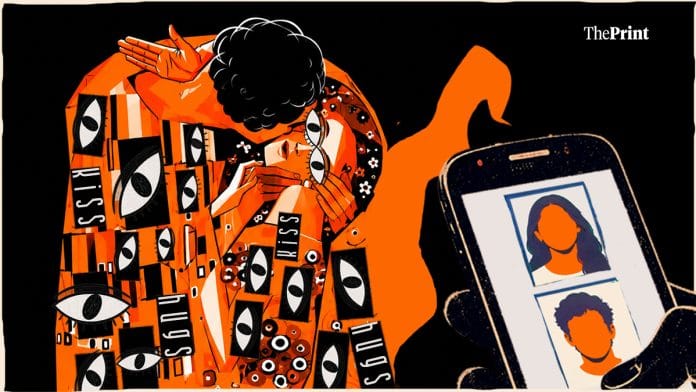
New Delhi: The screen shows a couple kissing on a sunlit street, a single button beneath them: ‘Accept terms & conditions’. Click on it, and an app called AI Video Generator asks whether you want to generate a video of one person or, on a second tab, a ‘Couple’. Choose ‘Couple’, and it offers two boxes, ‘Upload your Image’ and ‘Upload your partner image’.
While a note on the screen advises users to upload ‘only photos of yourself or people who have given permission’, there is no mechanism to ensure that the person in question has agreed to anything.
In another app, the home screen opens like a video-streaming service, its rows headed ‘AI Videos’, ‘Valentine’s Day videos’ and ‘FaceSwap Videos’, the last a grid of sexualised images of women. Browsing through, a full-screen ad breaks in to sell a rival called ‘Kiss AI’ over a single promise—‘Now you can kiss your crush’—its two panels, marked ‘ME’ and ‘My crush’, dissolving into a kiss. Upload a stranger’s face, the ad suggested, and the app would generate a picture or a video of that person kissing you.
These are but two of the dozens of ‘AI kiss and hug’ apps available on Google Play in India, several of them downloaded more than a million times. They sell a harmless-sounding novelty—a hug with a distant relative, a kiss with a partner—but work the same way: feed in one or two real faces, and the app generates an intimate video built from what is effectively biometric data, without ever checking whose face it is.
The same apps feature sexualised imagery, carry store ratings that clear them for children as young as three, charge for subscriptions users say they never approved, and allegedly pass photographs to unnamed third parties. Complaints fill their review pages. Yet the apps stay up, in part because India’s new rules on AI-generated content and non-consensual imagery were written with social media platforms in mind, and it is unsettled whether they bind a standalone app that only generates the video. This, according to technology lawyers, essentially means that the industry is operating in a vacuum.
ThePrint reached Google by email with detailed questions on the age ratings, consent checks, data practices and labelling of these apps, and on whether it had removed any of them. ThePrint also wrote to Hangover Studios and other developers behind the apps, but the emails bounced back. This report will be updated if a response is received.
ThePrint explains what those apps do, who builds them, and where they stand against the law.
Also Read: AI is helping biodiversity research. Scientists can’t see behind the algorithms
How it works, and what it costs
The first app, called AI Video Generator, works quickly. Upload two photographs, spend 30 credits, and it returns a short clip of the two faces kissing, stamped only with a ‘PhotoMagic’ watermark. A note on the screen tells users to upload ‘only photos of yourself or people who have given permission’, and says the app is ‘intended for users aged 18 and older’.
Generating a video costs credits, and the app works to keep users spending them. Once a clip is ready, a banner offers five credits to save and share it, which turns each user into a small distributor of the next batch. To stop the advertising it floods onto the screen, the app sells what it calls ‘Ad-free Mode’: Rs 449 a week, Rs 699 a month, or Rs 2,999 a year, with the yearly plan pre-selected and promising a bonus of 8,000 credits.
The subscription renews on its own at the end of each period, a line below saying it can be cancelled at any time.
Reviews of these apps are full of users who say cancelling did not stop the charges, and of smaller amounts, Rs 399 or Rs 799, deducted without warning.
The finished video carries nothing to indicate it was generated. There is no label marking it as artificial, only the app’s own branding.
How many, and who makes them
A search of the Play Store returns dozens of these apps, a good number built in India. AI Video Generator: kiss & Hug, among the most downloaded, is published by Hangover Studios, a Hyderabad developer registered as Yalavarthi Software Solutions Pvt Ltd.
Others are registered to individual developers across Gujarat, most of them around Surat, with more in Amreli and Ahmedabad. A separate set is based offshore: Heyo: Fun AI Video Maker and its siblings trace their origins to a company in Singapore linked to a platform called a1.art.
The line-up does not stay still. Google has been removing apps in this category—it earlier pulled a batch flagged by regulators abroad and said it had suspended hundreds of apps with similar features—and several that were available at the beginning of August, among them a Hyderabad kiss-and-hug generator, have since disappeared from the store. Others remain, and new ones continue to surface under different names.
‘Potential for misuse is high’
Whether any of this is unlawful is not straightforward, said Dhruv Garg, a technology lawyer and founder of the Indian Governance and Policy Project (IGAP). “None of this is illegal in itself,” Garg told ThePrint.
A tool that turns a still into motion, including a hug or a kiss between two people who upload their own photographs, is a legitimate use, no different in principle from an app that restyles a portrait. The concern, he said, lies in what the same tool can do next. “It begins the moment a product can produce a non-consensual intimate image.” Whether a hug or a kiss amounts to an intimate image, he added, is a matter of context and degree.
He compared the apps to Photoshop, which has been used to alter images for two decades without serious calls for a ban, and then drew the distinction himself. “These apps reduce the effort and skill needed to create that content to almost nothing,” he said. That, in his view, is why the marketing matters. “A general video generator does not need to advertise hugging and kissing. When an app puts those words first, it is reaching, at least in part, for people who want to do this to someone else.” Such a tool can remain within the law until it is misused, he said, “but the potential for misuse is high”.
“The best case is a joke at a friend’s expense. The worst is a non-consensual image made to damage a person.” Where a woman is the target, he said, the act can amount to outraging her modesty, a distinct offence.
Also Read: Yahoo wants to woo Gen Z with AI now. It doesn’t want to be ‘uncool’ anymore
Watermark is not an AI label
One exposure is on the screen the moment a video is generated. It carries no sign it was generated—no notice that the clip is synthetic, and no marker beyond the app’s own ‘PhotoMagic’ branding, which identifies the maker rather than the method.
A branding watermark is not an AI label.
This runs against the framework India adopted this year. The Information Technology Rules, amended in February and in force from 20 February, created a legal category called synthetically-generated information, or SGI, covering AI-generated images, audio and video, and aimed at fakes used for impersonation, defamation and non-consensual sexual imagery.
Under the amended Rule 3(3), such content must be clearly and prominently labelled—a visible label on images and video, with permanent metadata or a unique identifier embedded, where feasible, to trace the tool that generated it—and platforms may not offer any feature that lets a user remove or hide that label. An earlier draft required the label to cover a tenth of the frame; that fixed size was dropped, but the duty to label clearly stayed.
Garg said the rules sort synthetic content into categories, with the image of a real person the most sensitive, and its creation without consent the most restricted. The realistic couple videos these apps generate, he said, sit close to the centre of what the rules were written for. A labelling duty, he added, is only as good as the checks behind it.
“The questions to ask are whether the output is labelled, and whether the app checks that the photograph belongs to the user,” he said. “Even where that check exists, it is usually easy to get around.” The tested app did neither: it applied no label, and accepted a second face as a “partner” without asking whose it was. Where a real person’s image is used without consent, he said, the result can amount to non-consensual intimate imagery, an offence under both the IT Act and the Bharatiya Nyaya Sanhita.
Whether the labelling applies to apps that fall under this category is itself a grey zone. The rules were written mainly for social-media platforms and other intermediaries, and it is contested whether a standalone generator of this kind must label what it produces—part of why these videos leave the app unmarked.
Age rating, privacy & deletion
For Garg, the clearest problem is who the apps are sold to. The one ThePrint tested told users on its own landing page that it was meant for adults, while the store rated it for children of 12, and others in the category for children as young as three. “The ratings are very hard to defend,” he said. A person below 18 should not be using an app that openly offers to generate romantic videos of couples, he argued, and parental controls count for little if the rating they rely on is wrong. “Those controls only work if the rating is accurate.”
He set the issue in a wider gap. “The conversation on children’s safety has narrowed to social media and gaming,” he said. “There are many other apps a child can reach, and each of them should be assessed for child safety, by the developer and by the store.”
The apps exist to take in close photographs of real faces, among the most sensitive data a person can give up, and they treat it very differently from one listing to the next. On the Play Store, the kiss & Hug app says in its data-safety section that it may share users’ personal information, photos and videos, and device identifiers with third parties. Heyo says it shares nothing. The Surat app KiHu says its data is not encrypted and cannot be deleted, and is rated for ages three and up. None of the listings names the third parties that might receive a user’s photographs, or the servers where a face is processed once it leaves the phone.
The reviews return to the same fear. One user called the product an adult app that “misuses users data”, warned it could be used to generate deepfakes, and said Google should take it down. Another, who said he had used it for harmless hug photos with a long-distance partner, wrote that it was “not safe” and could leak a user’s privacy, after finding sexualised templates inside.
To one such complaint, the developer replied in public that images in a user’s account are visible only to that user and “will never be viewed, used, or leaked by others,” and assured the reviewer that their data would be kept private—an assurance that sits awkwardly beside its own listing, which says it may share photos and personal information with outside parties.
The paperwork is thin in other ways. Several of these apps carry privacy-policy links that lead nowhere, and some publish their terms on free blogging pages rather than a company site. When ThePrint tried to open one app’s privacy policy, the link did not resolve.
India’s Digital Personal Data Protection (DPDP) rules are not yet in force, Garg noted, which leaves a gap while the apps continue to operate. “But if a person deletes their account and their images remain accessible, that is a serious problem,” he said. “Deletion should mean deletion, and more so for this kind of material.” Some users have complained that pictures they uploaded stayed online after they closed their accounts.
The advertising machine
The apps do not wait to be found. Google’s Ads Transparency Center, which records ads served across Search, YouTube and Google’s in-app network, lists Yalavarthi Software Solutions as a verified advertiser running on the order of 1,000 ad creatives in India, among them ads for the kiss-and-hug app.
The number counts variations of a creative rather than separate campaigns, but it indicates steady, high-volume spending. Google grants a profile of this kind only to advertisers that have verified their identity and served ads.
Inside the apps, the ads run the other way, and most point to more of the same.
For instance, alongside the ‘kiss your crush’ pitch for a rival, one promoted a product called VIDI.AI on the promise of ‘Cinematic Videos, AI Kiss, AI Photo’. Between them ran ads with no link to the category at all: a companion-chat app, a short-drama service offering shows for a rupee, and, in the same slot, a promotion for Google’s Gemini. The kiss apps and one of Google’s flagship AI products were reaching users through the same channels.
(Edited by Nardeep Singh Dahiya)
Also Read: India less exposed to AI job risks than others, Goldman says
AI in the wrong hands is really dangerous. I don’t see any discussions done by the government
Faceless profiles FTW.
Always safe from this virus.