





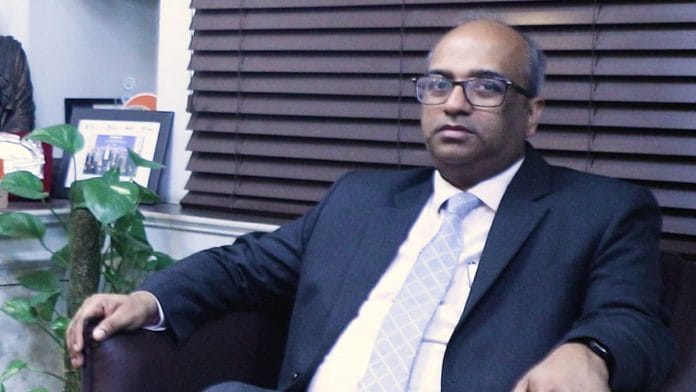



New Delhi: “AI doesn’t take away anybody’s jobs. People with AI skills will take away jobs from people without AI skills.” With that line, Abhishek Singh, Additional Secretary at the Ministry of Electronics and Information Technology and CEO of the India AI Mission, sought to reframe mounting anxiety over artificial intelligence and employment in India.
Singh, in an exclusive interview with ThePrint was responding to comments by Mustafa Suleyman, CEO of Microsoft AI, who told the Financial Times Thursday that lawyers, accountants and other white-collar professionals could see most of their routine tasks automated within 12 to 18 months. While acknowledging that the timeline may be aggressive, Singh did not dispute the broader direction of change.
“Any technological innovation historically does lead to disruption of some jobs,” he said, drawing parallels with earlier economic shifts. When automobiles arrived, those operating horse-drawn carriages lost work. India’s once-ubiquitous STD booths disappeared with the spread of mobile phones. Film photography labs collapsed as digital cameras became universal, he said.
“Similarly AI will impact some jobs, but AI will also create new jobs,” Singh said. “I strongly believe that the opportunities that AI will create, like any other technology historically has, will be much more than the jobs that will be impacted.”
Entry-level jobs under pressure
Singh conceded that certain roles, particularly at the lower end of the software services chain, may face immediate pressure. “There will be some jobs like entry-level software jobs that might be competing with $20 bots. Those jobs will be impacted,” he said.
But he argued that the solution lies in adaptation rather than protectionism. Developers who “arm themselves with these coding agents and become better versions of themselves” could unlock higher productivity and better-paying roles, he said.
The emphasis, he stressed, must be on skilling, reskilling and curriculum reform. “We will need to focus very strongly on skilling, reskilling, upskilling, upgrading the curriculum in our colleges not only in engineering colleges but across disciplines,” Singh said. AI, he added, cuts across medicine, law, commerce and liberal arts, and cannot be treated as a niche engineering tool.
He pointed to emerging job categories in agentic AI systems (autonomous entities that take multi-step actions to achieve goals with minimal human supervision), physical AI, data science, data annotation and tagging, and forward deployment engineering. India, he suggested, could position itself as a global hub for such roles, provided “business cannot be as usual”.
Global alarm, domestic debate
Suleyman’s remarks to the Financial Times have intensified global debate over AI-led labour disruption. He said most tasks performed “sitting in front of computers” could soon be automated as AI agents evolve from assistants into systems capable of independently managing complex workflows.
The warning has resonance in India, where the IT and business services sector employs millions and underpins urban middle-class growth. Industry studies and policy analyses have flagged the dual impact of AI, with routine roles in coding, customer support and analytics exposed to automation even as demand surges for higher-order AI capabilities.
A report by NITI Aayog released in October last year has suggested that AI adoption could affect up to 2 million jobs in India’s tech sector even as it creates several million new roles over the next five years.
The political discourse has also sharpened. Rahul Gandhi, Leader of the Opposition, in Parliament this week cautioned that India’s IT and services sector could face serious disruption if the country fails to prepare for the AI transition. He warned that thousands of professionals could see their livelihoods threatened and described data as a strategic national asset in the emerging AI economy.
For Abhishek Singh, however, the central dividing line is not between man and machine, but between skill and obsolescence. AI, he argued, will not eliminate work wholesale. It will reorder it.
(Edited by Viny Mishra)
Also read: India’s AI rules risk curbing lawful content. Three-hour takedown policy is unprecedented