





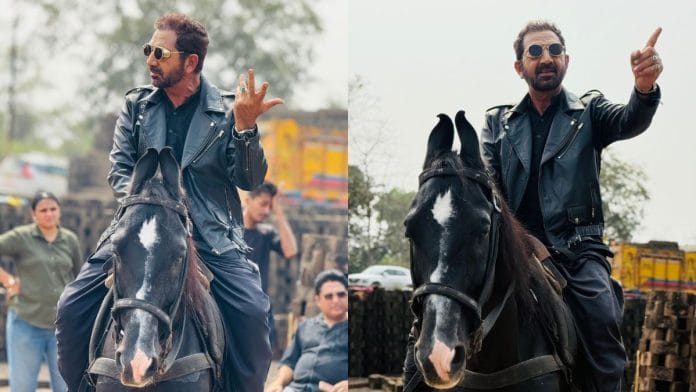



New Delhi: A white horse stands nervously still in a dark frame. A bearded man in a crisp white kurta-pyjama swaggers into the picture, funky dark sunglasses completing the gangsta look. “Humse takrane ki koshish kari, toh kaand bada hoga. Agar maut se bachke bhage bhi toh samne chaudhary khada hoga (anyone who dares to cross Chaudhary will face serious consequences),” a powerful voice intones.
This is the beginning of a hit new music video, Goli Toh Chalegi. It goes on to lean fully into Haryanvi machismo, with guns and gunshots punctuating the screen-straddling persona of the main character. At a million views on YouTube already, Anil Chaudhary has made his acting debut with a bang, literally.
Par for the course? Not really, because the star of this video is International Cricket Council umpire Anil Chaudhary. This is his new avatar, and he’s made the switch at all of 61. Directed by Suman Guha, the track is sung by Diamond and produced by Naresh Jha under Epic Films.
Chaudhary is counted among some of the most respected names in international umpiring, up there with Kumar Dharmasena, Nitin Menon and Richard Kettleborough. Known for his calm demeanor, Chaudhary has handled high-pressure situations with ease, including the infamous on-field clash between Virat Kohli and Gautam Gambhir during the 2013 Indian Premier League.
Over the years, Chaudhary has worn many hats, rising to the ICC’s international panel of umpires, taking up commentary, and even launching an online training school. And at a stage in life when most slow down or opt for comfort, the 61-year-old has chosen to explore yet another avenue.
Jha revealed that the idea to cast Chaudhary came to him spontaneously on New Year’s Eve, and on January 1, he pitched the project. Describing him in a single word, borrowed from Chaudhary’s elder son Aryan, Jha called him “professional.” “He has that old Sanjay Dutt swag,” Jha said.
According to Jha, Chaudhary’s natural personality, his seriousness and understated authority aligned perfectly with the ‘dabang’ style the video demanded. At the same time, casting someone so well-known from a different field added a layer of curiosity and buzz.
Natural actor
Apparently, Chaudhary is a natural. “He hardly needed retakes. It felt like working with a seasoned actor. There was no camera hesitation. He was confident and composed,” Jha said.
With such natural power came responsibility, naturally. With over three decades of credibility behind him, Jha was careful not to present Chaudhary in a way that could undermine the three decades of credibility his main actor came with.
“I told him, ‘Sir, just trust me. I’ll make sure this adds positively to your journey. I won’t ask you to do anything that harms your image.’ And he trusted me,” Jha said, adding that they consciously avoided showing Chaudhary engaging in any wrongdoing despite the gangsta setting.
That said, the video features Chaudhary smoking a cigar. He later clarified that it was merely a chocolate cigar because in real life, he doesn’t even smoke cigarettes.
The video took the cricketing world by surprise. Several players, including Suresh Raina, Virendra Sehwag, Shikhar Dhawan, and Yuzvendra Chahal, congratulated Chaudhary and applauded his unexpected new innings. Even his own family had little idea about the project. In fact, his son had initially advised against it.
“It felt a bit odd at first. I told him it might not suit his image,” Aryan admitted. “But once the video came out, my friends were asking me where he trained because he looked like a professional actor.”
Chaudhary himself was hesitant to watch the final cut. Despite an outgoing nature, seeing himself in such a dramatically different role made Chaudhary self-conscious. “I couldn’t believe it was me. My first reaction was, ‘Baap re baap, yeh main hoon? (is that really me?)’,” he said, before breaking into laughter.
But Goli Toh Chalegi isn’t just a shot in the dark. Chaudhary revealed that he already has more projects lined up, including cameo appearances. “In one upcoming South Indian film, I’m playing a judge. So yes, you’ll be seeing more of me on the entertainment front,” he said.
Also Read: ‘Krishna played cricket first’— Sanatan Premier League gives the game a Hindu makeover
Twist of fate
Chaudhary’s story begins with a one-off favour, stepping in for a friend as an umpire for a cricket match. That innocuous decision unexpectedly opened the doors to a new whole career path for Anil Chaudhary. He earned Rs 100 for that match, but the spark lit was destined to grow far bigger.
That money meant small but meaningful freedoms: catching a movie or getting petrol for his bike without depending on the family. It was this combination of financial independence and love for the game that ultimately inspired Chaudhary to pursue umpiring more seriously and shape a career out of it.
“Umpiring isn’t an easy job,” Anil Chaudhary told ThePrint. “Today, the laws of cricket are just a tap away, but that doesn’t mean everyone can do it. I have been fortunate to officiate at every level, from village matches to the World Cup. I never tried to cram the rulebook, instead, I focused on simplifying it and understanding it. Now, they are part of my instinct.”
More than anything, Chaudhary stresses that umpiring is a test of composure under pressure.
“Standing in the heat for hours is tough. Beyond that, an umpire must know how to handle pressure, when to step in, what to say, when to say it, and just as importantly, when to remain silent,” he said. For Chaudhary, however, endurance was never a major hurdle, having grown up in a family of farmers.
A mechanical engineer by qualification, his passion always lay with cricket. While he never pursued the game as a player at the highest level, he has no regrets, umpiring, he said, kept him connected to the sport.
Chaudhary continues to juggle multiple roles with remarkable ease, a trait that, according to Aryan, can be summed up in one word: “professional.”
“You won’t come across many professionals like him. If he is working and there is chaos around, even something as extreme as a fire nearby, he would finish his work first before turning to anything else,” Aryan said. He added that while most people tend to slow down after a certain age, his father is wired differently.
“He simply cannot sit idle. His day begins at 8 in the morning and goes on till midnight. Even at 61, he’s constantly on the move,” the 25-year-old shared. “If I had even 10 per cent of his energy, I would be sorted.”
Long march
Becoming an umpire is typically a long and structured journey, starting from local tournaments, progressing through state associations, and clearing multiple examinations conducted by the BCCI and ICC. But for Chaudhary, the path was anything but conventional.
He began by officiating in local matches, but a turning point came with his trips to Thailand in the 1990s for the Thailand Sixes tournament. During one such visit, he was unexpectedly asked to umpire. The offer, 2,000 baht per day along with paid accommodation, was hard to ignore.
“Honestly, the money attracted me again,” he admitted. “After that, they kept inviting me every year, sending tickets and payment. That’s how I became a professional umpire in Thailand, without even clearing any BCCI exam at the time.”
It wasn’t until 1998 that he formally cleared the BCCI examination. From there, he went on to tick every major box in his umpiring career. He has been associated with the IPL since its inception, officiating across all 17 seasons. The IPL also paved the way for his rise to the international stage, where he has umpired 12 Tests, 49 ODIs, and 64 T20Is, in addition to youth and women’s matches.
Cricket referee Shakti Singh describes Anil Chaudhary as “someone who is above excellent”. According to Singh, while most umpires can make routine calls like run-outs or boundaries, what truly set Chaudhary apart was his exceptional man-management skills.
“His ability to handle players, knowing how much to speak, when to step in, and how to defuse situations, was remarkable. He always knew where to draw the line. And when it comes to skill, there’s never been any doubt about him,” he said.
Over the years, Chaudhary has witnessed the evolution of umpiring, from minimal technological support to an era defined by broadcast scrutiny, the third umpire, and the Decision Review System (DRS). In his view, the role has become somewhat easier compared to the 1990s and early 2000s.
“With DRS and advanced broadcasting, umpiring is slightly easier now,” he said. “Earlier, the toughest calls were leg-before decisions and bat-pad catches, especially in Asian conditions where the ball turns sharply, it was hard to tell whether it hit the bat or pad.”
He also pointed to how rule changes and innovations—like the automatic no-ball system and expanded use of DRS for wides and no-balls in leagues like the IPL, have streamlined decision-making. However, he noted that the margin for error has shrunk. “Even the smallest mistake gets picked up now,” he added.
Financially, too, umpiring has become far more rewarding.
“The BCCI pays very well, even for domestic cricket,” he said. This growing appeal is reflected in the increasing number of aspiring umpires enrolling in his online course via his YouTube platform, Umpire’s Call by Anil Chaudhary, which currently has 20–25 active students.
Interestingly, the profile of aspiring umpires has also changed. While the role was once dominated by former cricketers, today’s learners include young aspirants keen to start early, corporate professionals who couldn’t pursue cricket as a career, and even women showing strong interest in the field. Some students, as young as 18, approach him, determined to become umpires right away despite his advice to first spend a couple of years playing the game.
Yet, there is one aspect of modern umpiring that concerns him. “They don’t seem to enjoy it,” he said. “They look too serious, as if they’re going into a battle. You need to smile, stay relaxed.”
His advice is simple, “Players won’t eat you up. Keep communicating. Be empathetic, not sympathetic. And above all, be consistent and honest in your work.”
Chaudhary has also seen cricket navigate turbulent phases, from the 2010 Pakistan spot-fixing scandal involving Salman Butt, Mohammad Asif, and Mohammad Amir, to the 2013 IPL spot-fixing case that implicated players like S. Sreesanth, Ajit Chandila, and Ankeet Chavan.
These incidents triggered significant reforms within the system.
According to him, education and awareness have played a crucial role in strengthening integrity over the past decade. “Every team now has an anti-corruption unit, and even team buses have designated officers. Earlier, umpires weren’t as aware of these risks,” he explained.
Chaudhary highlighted how even seemingly harmless interactions can be problematic. “If someone casually asks about the weather and I say it might rain, that’s key information being passed on. Sometimes people offer gifts without reason, and there are even honey traps. That’s why the BCCI has intensified training in this area,” he said.
Also Read: BCCI began supporting Indian blind women’s cricket team only after T20 WC win: Priti Prasad
More than a cricketer
Anil Chaudhary may be known as an umpire, commentator, and coach, but in his ancestral village in Muzaffarnagar, Uttar Pradesh, he is regarded as something far greater, a local hero. During the COVID-19 pandemic, he played a key role in resolving a long-standing issue of connectivity that had affected daily life in the village.
Chaudhary travelled to his native village Dangrol on 15 March 2020 for a week or so. However, the sudden nationwide lockdown forced him to remain there. With no mobile network in the village, staying connected to the fraternity and his family in Delhi became nearly impossible. He had to walk over half a kilometre into fields and climb a tree to catch a signal.
However, after learning about his situation, a telecom company stepped in and installed a mobile tower in the village, bringing connectivity not only to him but everyone in the village. For locals like Nathu Lal, Chaudhary’s contribution goes far beyond cricket. “He’s not just a cricket figure for us, he’s a saviour,” he said.
Five years on, the impact is still evident. “Both my sons now have access to the internet. They are learning so much. Even I can transfer money and look up farming-related information. Life has completely changed for us,” he said. “Sometimes, I even play Candy Crush.”
For Aryan, Chaudhary is not just a source of inspiration for his cricketing knowledge and skills, but also for his unwavering ethics. Aryan, who once played cricket himself before moving on to set up a sports complex at a school in Indirapuram, acknowledged that being the son of a well-known umpire could have made things easier. However, he emphasized that his father never used his influence.
“He doesn’t believe in seeking favours. He always told us, (him and his younger brother Akshay Chaudhary), to achieve everything on our own merit,” Aryan said. “I take pride every day in how he carries himself and sticks to his principles, especially in a world where people often get distracted by the spotlight.”
Growing up, Aryan admitted that his father’s frequent tours meant he wasn’t always around. “I missed him a lot, of course.” Their mother, who worked in a government school, had to take on both parental roles. “Umpiring is a thankless job, and the family has to make sacrifices. But we have never made him feel guilty. We have always supported him,” Aryan said.
He recalled how, in his early years, he would even skip school just to watch his father officiate on television. “Now, we can barely keep track of his schedule,” he added with a smile. “It’s become a bit like ghar ki murgi daal barabar.”
(Edited by Nardeep Singh Dahiya)
Also Read: Why are Pakistanis angry with David Warner now? He called PSL captains ‘school kids’