





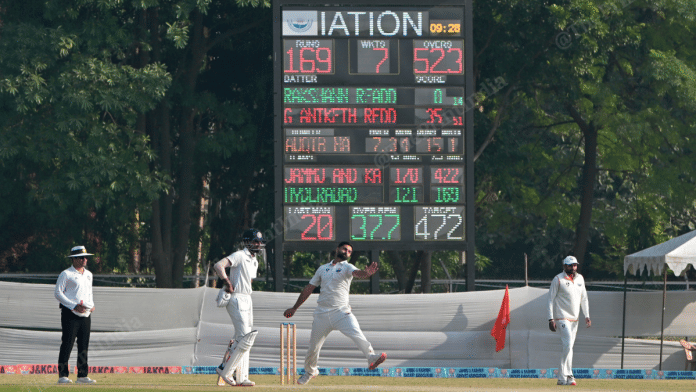



Jammu/Srinagar: The ball raced to the boundary after hitting Jammu and Kashmir opener Qamran Iqbal’s bat, setting off celebration among the visiting side at Delhi’s Arun Jaitley Stadium.
No, this was not an ordinary result in a Ranji Trophy match. It was J&K’s maiden win over Delhi in 65 years. A week later, the Paras Dogra-led cricket team notched its third straight win of the Ranji season, defeating Hyderabad by a massive 281 runs.
For those who follow the game, the rise is a result of hard work put in the last four-five years, far from those days when the Jammu & Kashmir Cricket Association (JKCA) faced probe by central agencies. But, more on that later.
The team once best known for all-rounder Parvez Rasool and pace sensation Umran Malik is now second in Ranji Group D, trailing only domestic heavyweight Mumbai. In their last 13 Ranji matches, J&K have lost just once.
In the 2024-25 Ranji season, J&K lost the quarterfinal to Kerala in a heartbreak match. The team defeated heavyweights Mumbai and Baroda en route to storming into the knockouts for only the third time ever. Before this resurgence, their last knockout appearance came in 2019.
The change did not come overnight. It took sweat, discipline, patience and above all, belief. One name comes up repeatedly when ThePrint reached out to selectors, groundsmen and cricketers: former cricketer-turned-administrator Mithun Manhas.
For a little over four years, a committee, headed by the now Board of Control for Cricket in India (BCCI) president Manhas, quietly pulled the strings behind the scenes, rebuilding J&K cricket brick by brick, dragging it out of the sidelines, and transforming it into a team that cannot be taken lightly.
But, the challenges were not just related to cricket alone. The Jammu & Kashmir Cricket Association (JKCA) itself was mired in controversy. So much so that the J&K High Court intervened in 2021.
Poor governance, multi-crore ‘scam’
The JKCA was struggling with poor governance, financial instability, a lack of infrastructure, and an alleged multi-crore scam. Private leagues collapsed due to unpaid dues and players’ concerns about selection and facilities mounted.
“Forget the practice pitches and financial support to travel across for matches, players didn’t even have proper kits,” Majid Dar, incharge, J&K cricket, tells ThePrint.
Recalling the old days, he claims that cricket was entirely neglected in J&K. The condition of the stadiums and pitches were poor and the JKCA management lacked transparency, he adds.
“All that because JKCA had only few talented people; majority people in decision-making positions came in through recommendations.”
Dar played for J&K till 2014, before he became the assistant coach of the senior squad in 2015-16.
In 2015, Dar and former cricketer Nissar Ahmad Khan filed a Public Interest Litigation (PIL) in the High Court seeking a thorough investigation into a ‘multi-crore scam’ in JKCA.
Between 2002 and 2012, they petitioned, large amounts of BCCI funds and grants meant for promoting cricket, were either misused or siphoned off. The cricket association was headed by former chief minister Farooq Abdullah at that time.
The amount under scrutiny was around Rs 113 crore, according to the J&K HC order in 2015.
That year, the HC directed the Central Bureau of Investigation (CBI) to take over the case which was being handled by the police for nearly three years. The Enforcement Directorate (ED) was roped in as well. Both the agencies filed charge sheets. Last year, the HC quashed the ED charge sheet lodged against Abdullah and others.
But, the petition shook up decades of alleged misgovernance, sparking a debate about transparency in sports administration.
In March 2021, the HC directed the BCCI to take over the JKCA interim management, control, and administration until a new set of administrators were elected.
Jammu-born Manhas arrived in June that year as one of the three members of a sub-committee, along with Brig. Anil Gupta (retired) (administration) and Sunil Sethi (legal affairs).
“JKCA’s audit was pending since 2011,” Gupta tells ThePrint, highlighting that it was the first thing he got done after starting work. “There was no website. Multiple bills were unpaid; no structure and system.”
“You cannot run a cricket association on ad hoc basis,” he asserts.
Practice wickets, kookaburra balls & more
Slowly and steadily, changes became visible in cricket infrastructure. The JKCA hostel ground was revamped to feature multiple practice wickets, turf pitches, indoor nets, dressing rooms, sight-screens, boundary ropes and more—amenities unheard of in earlier times.
Across all age groups, Kookaburra and SG balls are the norm at practice sessions. The players check into four- and five-star hotels, a far cry from the past when they stayed in dormitories. The state team gets top-quality cricket gear, travel extensively for tournaments, and get the exposure that helps them grow.
The results are showing: In January, J&K felled defending Ranji champions and 42-time winners Mumbai that boasted of Rohit Sharma, Ajinkya Rahane, Shreyas Iyer, Yashasvi Jaiswal and Shardul Thakur. Notably, the five-wicket win came in Mumbai’s backyard.
Both Dar and Gupta credit this breakthrough to Manhas’s bold call to introduce red-soil pitches at Jammu’s GGM Science College ground.
Today, the GGM Science College ground has eight pitches: four layered with red soil to mirror conditions outside the region, and an equal number of black soil tailored to J&K’s natural playing style. Additionally, dome covers shield the pitches from weather elements.
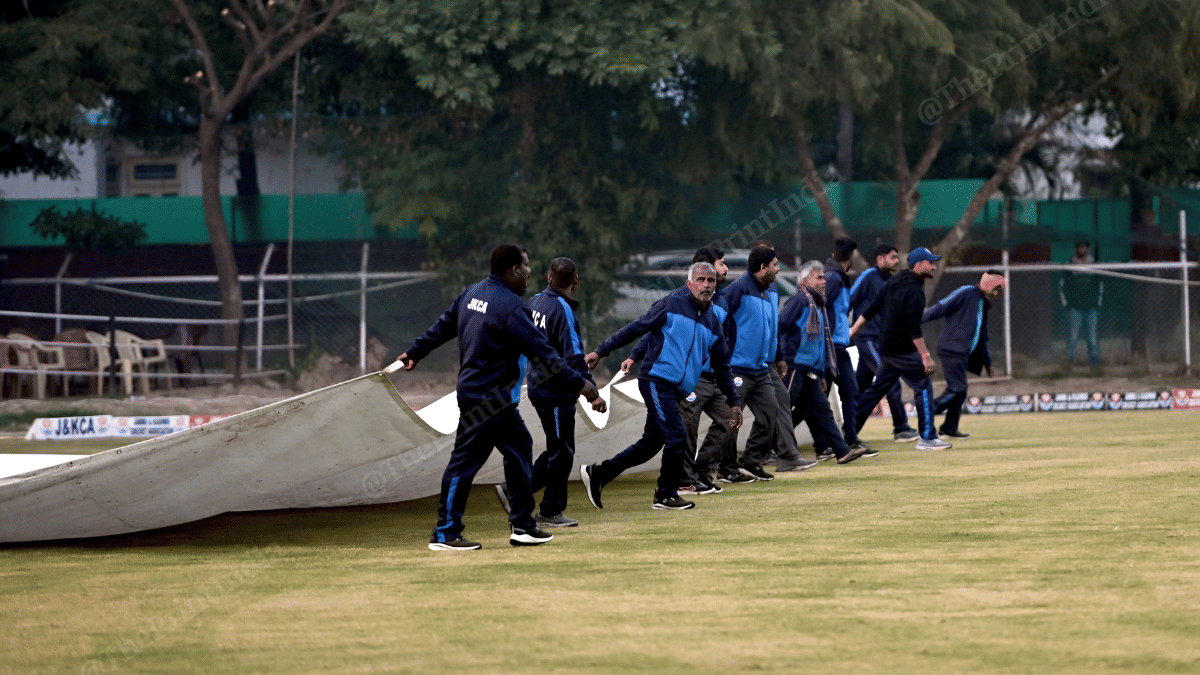
“The idea was to make sure our boys wouldn’t struggle on the red-soil tracks used in the western and southern parts of India,” Gupta explains.
Fast bowler Auqib Nabi, who made his first-class debut in 2020, has seen the transition come. “Earlier our camps would last 10-15 days, and fitness wasn’t even a part of it. Today we have a variety of camps from fielding, batting, bowling as well as fitness,” he tells ThePrint.
From being looked after by a single coach, the team is supported by head coach Ajay Sharma, bowling coach P. Krishna Kumar, fielding coach Dishant Yagnik, trainer Sunny Verma, physiotherapist Chirag Pandya, video analyst Susheel Pajnu, and masseur Naresh Kumar.
Nabi recalls that he didn’t even know how, where and when the trials for the cricket team were happening. Today, the cricketer from Baramulla says, things are far better for young players in remote regions.
“The talent is in villages. There is so much potential at the grassroots. Now, the JKCA is reaching those far-flung areas and setting up camps.”
Talent hunts are conducted across districts of Jammu and Kashmir, starting in March. After two months, a conditioning and fitness camp is set up which runs till July, followed by a medical camp.
“We shortlist players after every camp. By September, we have 30 players, out of which, we pick and create our pool of 20,” Gupta explains.
Solib Tariq, a rising left-arm fast bowler from Anantnag who was selected for the U-19 team in November, was unearthed in one of these camps. Shruti Thakur from Doda is another talent selected for the U-15 age group along with Ayushi Ambardar (Srinagar), and Smriti Majotra (Jammu).
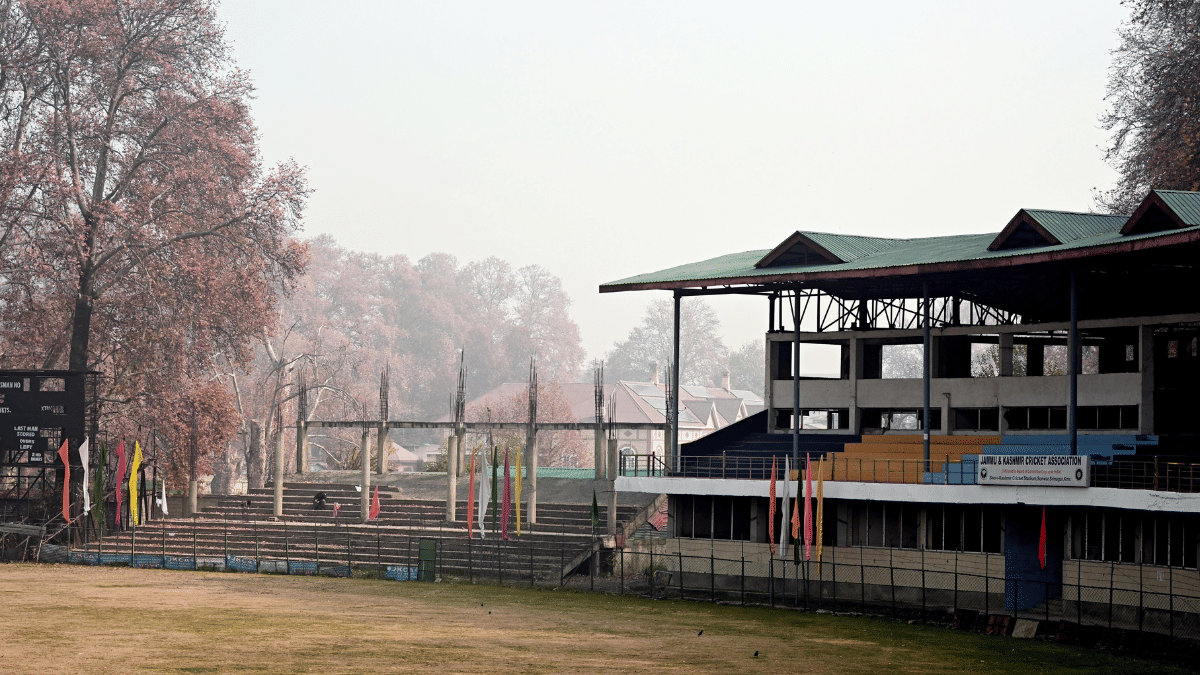
However, when it comes to stadiums, J&K has only two major venues: the Sher-e-Kashmir Cricket Stadium in Srinagar and the Maulana Azad Stadium in Jammu.
Mohammed Khalid, a groundsman at Sher-e-Kashmir for the past 15 years, says that the administrative changes have been substantial and that the positive impact has reached every level.
But, he also urges the management to focus on upgrading the stadium’s infrastructure itself. “We want IPL (Indian Premier League) as well as international tournaments to be held in J&K. Mithun sir can only make it happen.”
Also Read: Unexpected call-up to World Cup glory: Harini Muralidharan’s journey as women’s cricket team doctor
Mithun Manhas: the catalyst
To call Mithun Manhas, the “backbone” of J&K cricket’s revival will not be an overstatement, a point made by several stakeholders.
With a 18-year career in first-class cricket, wherein he captained Delhi to Ranji Trophy title in the 2007-08 season, Manhas has long carried an ambition: to give back to the game, especially where cricket had been neglected.
When Manhas, who worked with IPL franchises and youth teams (including as a consultant for a U-19 side abroad), took up the JKCA role, the challenges were aplenty.
The task in hand was to administer a troubled association in a region long plagued by neglect, limited infrastructure, uneven talent outreach, and meagre resources.
But, more than bricks and mortar, Manhas’s influence lies in restoring belief. For decades, many young J&K cricketers felt that geography was their limit. By pushing for better training facilities, transparent selection, and exposure to tournaments, Manhas worked to dismantle that mindset.
This, according to Dar, built a culture that shifted the team’s mindset from “participation” to “winning.”
“The upgraded pitches and consistent practice schedules have helped players adapt to conditions, something critical for success on the national circuit.”
“He attends every match and stays until 5 pm, a level of commitment you rarely see. But his focus is clear: rebuilding J&K cricket. Having moved from Jammu to Delhi during his playing days due to limited opportunities, he is determined to ensure that no young talent has to face the same struggle,” Dar adds.
Manhas oversaw the establishment of a proper Cricket Advisory Committee (CAC), staffed by former cricketers of repute. While JKCA had less than a dozen certified coaches/umpires previously, the number is said to be 40-plus at this time.
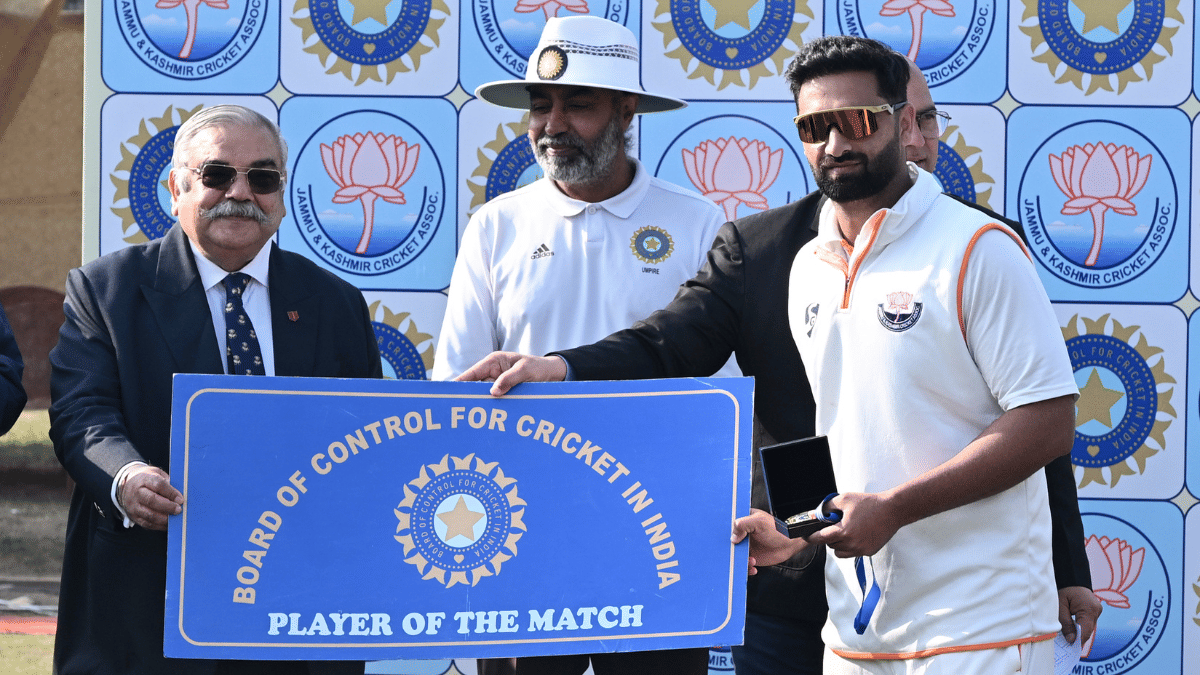
“He didn’t just park the money in banks. He spent it where it was needed most. Ensuring the cricket staff get paid on time was a top priority,” Gupta explains.
The masterstroke, according to Dar and Gupta, was bringing the then 39-year-old Paras Dogra from Puducherry and making him the skipper.
“All he (Manhas) told me was, ‘You should come and share your journey with the kids.’ That’s it. And, I took up the challenge,” Dogra recalls.
The 41-year-old has been a regular in Ranji, included in the India A squad, as well as featured in IPL.
At JKCA, many considered Dogra “too old” to join a fairly young squad. But, the former Himachal and Puducherry skipper turned out to be the right leader for the team caught between region and regional differences.
There was a lack of cohesiveness in the dressing room atmosphere. “Dogra brought stability to the team,” Nabi admits.
Gupta credits Dogra with making the team focus on one sole goal, cricket, “just like a horse with blinkers”.
Boost to women cricket
The winds of change came into J&K’s women cricket as well after years of neglect. From kits and camps to coaching and competitive outings, women’s cricket was given real attention.
Anuradha Sharma, the first woman cricketer from J&K to make it to the India U-19 camp in 1993, becomes emotional recalling her early days in the sport.
Back then, she recalls, the women’s team had nothing: no proper ground, equipment, structured training, and barely any opportunities to play against other teams.
The former cricketer, who is connected with JKCA for nearly two decades, remembers traveling by buses and trains, staying in shabby hotels, and paying for the journeys from their own pockets.
“We didn’t know anything else, we just wanted to play at any cost,” she tells ThePrint. “And, it was a taboo back then. We fought society, we fought poor administration and worse facilities, just to keep the sport alive.”
Today, Anuradha serves as a selector for the J&K senior women’s team.
Standing next to her, Meenu Slathia, a CAC member for women’s cricket for the past two years, listens with admiration.
Meenu began her career around the time Anuradha retired in 2005, yet she says the challenges remained similar even when she hung her boots in 2019. “Nothing really changed during our time either; the same grievances.”
Apart from representing J&K and Punjab, Meenu once shared dressing rooms with stars like Indian women’s cricket team former captain Mithali Raj. “They flourished because they had better opportunities and exposure.”
Some notable J&K women cricketers currently playing include Jasia Akhtar, who has played for several state teams. Similarly, Chitra Singh Jamwal and Ananya Sharma were selected for the BCCI Challenger Trophy this year. Other talented players include young fast bowler Mariya Noorain and all-rounder Shambhavi Rajput who have represented J&K at various age groups.
“From accommodation and training sessions to travel, practice matches, and grounds, everything is provided now. When we played, we never even had a single practice match against another team,” says Meenu, who served as head coach for J&K’s women’s U-15 and U-23 sides.
She acknowledges that the J&K women’s cricket has transformed dramatically over the last five years.
Like the men’s side, the CAC member says, women cricketers get specialised camps, for batting, bowling, wicketkeeping, fitness, and fielding. The Cricket Advisory Committee, she adds, plans to take it a step further next year by holding separate wicketkeeping camps tailored for spinners and pacers.
In the 2021–22 season, the women’s team qualified for the knockout stage of the Senior Women’s One-Day Trophy. On the youth front too, the U‑15 women’s side made the One Day Trophy knockouts in 2023–24, signaling that the next generation is alive, competitive, and hopeful.
Also Read: Not 2025, it began in 1973. Women’s World Cup win was culmination of a dream 50 years in the making
Stone age, or road to riches?
For many girls from remote districts and small towns, Meenu says, it is their first real shot at a professional sport and the dream is no longer far‑fetched.
Anuradha recalls that in her playing days, it was mostly girls from “high society” who had the freedom to take up cricket. But, today, the shift is evident. What once seemed “unusual” or “impractical”, be it travelling long distances for practice, challenging traditional expectations, or simply wearing cricket whites, is gradually becoming normal.
Families that once hesitated are now supportive. Communities watch with pride, instead of judging. Even the modest media attention has helped normalise the idea of women pursuing sport. And, India’s recent Women’s ODI World Cup victory has only strengthened this wave.
“I have received so many calls from parents asking how their daughters can join cricket. They now realise it can open doors, not just to playing for India but also to secure jobs,” Anuradha says.
The former cricketer believes women’s cricket still has a long road ahead before it can hope to mirror the dominance the men’s team has begun to show. “There has to be commitment, from both JKCA and the players.”
And just as the women’s game gains momentum, a shift looms over the association itself. In October, the Supreme Court ordered that JKCA elections be conducted within 12 weeks, under the supervision of former chief election commissioner Achal Kumar Jyoti.
In November, JKCA member Sunil Sethi resigned from his post. Meanwhile, former player, captain, selector, and coach Vidya Bhaskar succeeded Manhas, who was elected as the BCCI president in September.
“It is possible that the development model he (Manhas) initiated at JKCA can be applied nationally: better grassroots scouting, improved infra in neglected regions, and stronger institutional support for cricketers from far-flung areas,” Dar says.
While the association will continue to operate under the new constitution drafted by the sub-committee, a new leadership and management team will soon take charge.
“We have done our job. It’s now in their hands,” Gupta says. “They can either push J&K cricket back to the stone age, or help it flourish from here.”
(Edited by Tony Rai)
Also Read: When Cheteshwar Pujara stood between the Australians and the 2021 Border-Gavaskar Trophy