





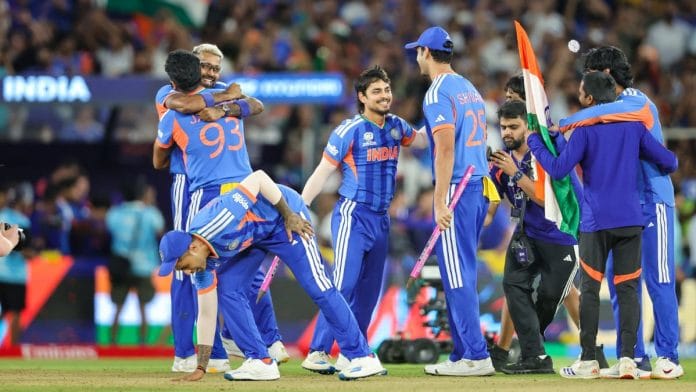



New Delhi: India scripted history Sunday. It became the first team to successfully defend the ICC Men’s T20 World Cup and win the title three times, after earlier triumphs in 2007 and 2024.
The Suryakumar Yadav-led side defeated New Zealand by 96 runs in the final—one of the largest winning margins in the tournament’s history—at the Narendra Modi Stadium in Ahmedabad. India posted a massive 255/5, the highest total in a men’s T20 World Cup final, before bowling New Zealand out for 159.
With the win, India ended its ‘cursed’ run at the Narendra Modi Stadium, a venue where it had lost several high-stakes games, including the ODI World Cup final against Australia, and also suffered a defeat to South Africa earlier in the tournament. The victory also helped India snap its frustrating run against New Zealand in ICC knockout contests.
Bumrah & Samson take home top honours
Jasprit Bumrah was named Player of the Match—for his four-wicket haul in the final. He conceded 15 runs in four overs, achieving an economy rate of 3.75.
“I couldn’t be happier. I started my cricket career here. I have played most of my cricket here, so I used all my experience today. And now winning the World Cup here and earning Man of the Match, makes it special. God has been really kind…,” Bumrah said at the post-match presentation.
Sanju Samson became player of the tournament. Samson scored 321 runs in five innings of the T20 World Cup. He maintained an average of 80.25 and a strike rate of 199.37, finishing as one of the top run-scorers and breaking the record for most runs by an Indian in a single T20 World Cup edition.
“It feels like a dream. Very happy and grateful. Out of words and emotions. Feels surreal. After the NZ series, I was completely shattered; I thought everything had ended. But I was courageous enough to dream about it. This is what I wanted to achieve,” he said, pointing towards his Player of the Tournament award.
Samson, Sharma powered India to record total
Mitchell Santner won the toss and elected to bowl first, sending India into bat. The decision backfired as the opening pair of Sanju Samson and Abhishek Sharma stitched together a solid 98-run partnership for the first wicket.
Samson, continuing his impressive form, played a blistering knock of 89 off 46 balls, narrowly missing out on a century.
He received strong support from Sharma, whose form had been under scrutiny throughout the tournament. Rising to the occasion, Sharma delivered a fiery innings, silencing critics with a blistering 52 off just 21 balls, striking at an impressive 247.62.
“I have never experienced anything like this before. Everyone in the team backed me, saying that ‘I will contribute in one of the significant matches’ and I am glad it was today,” Sharma said after the match.
Ishan Kishan added further momentum with a quick half-century off 25 balls, helping India maintain an extraordinary scoring rate.
However, James Neesham’s 16th over momentarily turned the game in New Zealand’s favour. In a dramatic spell, he dismissed Sanju Samson (89), Ishan Kishan (54), and Suryakumar Yadav (0), denting India’s middle order.
Despite the setback, Shivam Dube finished the innings strongly. In the final over, he took on Neesham and hammered an unbeaten 26 runs off just eight balls, pushing India to an imposing total of 255/5.
Bumrah led India’s bowling charge
When New Zealand began their chase, the spotlight was firmly on their opening duo, Tim Seifert and Finn Allen, especially after Allen’s explosive 100 off 33 balls against South Africa earlier in the tournament.
Allen even got an early lifeline when Shivam Dube dropped him on zero off the fifth ball of Arshdeep Singh’s first over—a moment that briefly raised concerns for India.
However, Axar Patel soon made amends for the missed chance, dismissing Allen for just nine runs off seven balls in the third over. He then clean bowled Glenn Phillips—five off five. And, even though Daryl Mitchell smashed him for two sixes, Patel made a comeback, bowling a full toss on middle stump on the last ball of the 13th over. Mitchell, attempting a big shot, mistimed the delivery and hit it straight to deep mid-wicket, where Ishan Kishan completed a simple catch. This wicket left New Zealand at 124/6.
Apart from Tim Seifert’s aggressive half-century, 52 off 26 balls, featuring two fours and five sixes, none of the New Zealand batters managed to make a significant impact. The much-talked-about Kiwi batting line-up crumbled under pressure, collapsing like a pack of cards. Six of the New Zealand batters were dismissed for single-digit scores.
Jasprit Bumrah, as always, brought his A game with the slower balls and was unplayable. He first sent back Rachin Ravindra—1 off 2 balls—on the first ball of his first over.
And then picked two wickets in two balls—of Neesham and Matt Henry—in the 16th over, finishing off with four wickets and an economy of 3.75.
With that, Bumrah finished the tournament with 14 wickets, emerging as the joint-highest wicket-taker, alongside Varun Chakravarthy, who claimed Seifert’s wicket.
At no point during the chase did New Zealand appear to take control of the game. While the scoreboard kept moving, wickets fell at regular intervals, preventing them from building any meaningful momentum.
Also Read: Kiwis have dominated India in every encounter in T20 World Cup history. What could change in 2026