








New Delhi: Making water from ‘thin air’ is now a distinct possibility, thanks to Nobel Laureate Omar Yaghi’s ‘atmospheric water harvesting’ technology. In an interview with The Guardian in February, Yaghi described how his invention could bring relief to drought-stricken and desert areas by harvesting water from the air with humidity as low as 20 per cent.
“On climate, the hour for collective action has already arrived. The science is here. What we need now is courage – courage scaled to the enormity of the task – so we may gift the next generation not only carbon capture, but a planet worthy of their hopes,” he told The Guardian.
Yaghi, a professor of chemistry at the University of California, Berkeley, also announced in The Guardian that his company, Atoco, is developing large-scale units, about the size of a 20ft shipping container, to harvest water from the atmosphere in arid regions. The best part — these units can generate up to 1000 litres of water a day, and do not need electricity to run, instead work on energy from temperature changes in the atmosphere. This means that the entire setup works based on the energy cycle of the environment—it absorbs water vapour from the air during the night when it is cooler, and it releases liquid water during the day due to the sunlight.
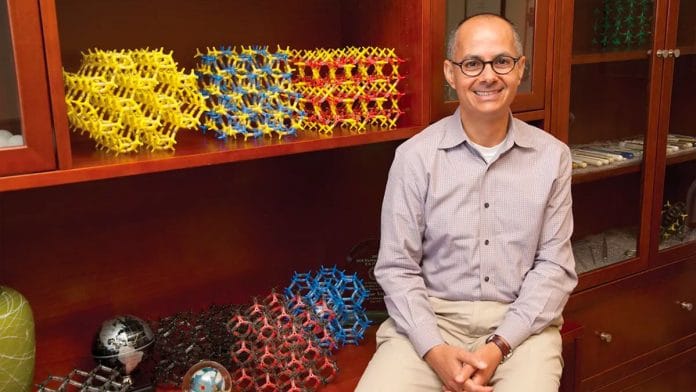
The key to his technology is metal-organic frameworks (MOFs), which won Yaghi a Nobel Prize in Chemistry last year, alongside chemists Susumu Kitagawa of Kyoto University and Richard Robson of the University of Melbourne. MOFs are a new kind of crystalline material that combines properties of metals and organic compounds for a variety of applications.
While Kitagawa, Robson and Yaghi were working at the same time at different universities, Yaghi was the first to coin the term ‘metal-organic framework’ to refer to the material he had created. It had base properties of metal, i.e. it was solid and had metal ions, but these ions were linked together using organic molecules like carbon, which allowed for a flexible porous structure through which gases could pass.
These compounds have a variety of applications, from removing toxic substances and carbon dioxide from the air to converting atmospheric vapour to liquid water. Yaghi’s company, Atoco, founded in 2020, is working on these two main applications.
The company has already conducted trials using handheld prototypes in the deserts of California and Nevada. It has shown that they can produce between 180 and 250 ml of water daily. Theoretical projections show that with the right setup, Yaghi’s technology could generate 1000 litres of clean water every day.
Ataco has announced it is scaling up operations to make large-scale units, but there have been no announcements on where these will be deployed.
Who is Omar Yaghi?
Born in 1965, Omar Yaghi belongs to a family of Palestinian refugees living in Jordan. His early education was in Amman, and in his Nobel speech, he recalled facing water shortages in the arid Middle Eastern country as a child.
“I grew up in Amman, Jordan, in a refugee family of ten children, in a home with no running water and no electricity, sharing our space with livestock, our family’s livelihood,” he said during his Nobel banquet speech. “I remember the whisper through our neighbourhood, ‘the water is coming’, and the urgency as I rushed to fill every container I could find before the flow stopped,” he added.
This shaped Yaghi’s interest in molecular chemistry and led to almost three decades’ worth of research into metal-organic frameworks that now form the bedrock of Atoco’s technological offerings.
Also read: Fatehpur Sikri was extraordinarily well-provided with water. Lessons for modern India
What is an atmospheric water harvester?
Yaghi is not the first person to try to create water from air. It’s one of humankind’s oldest projects. The natural hydrological cycle of condensation and evaporation, which leads to rainfall, is based on the underlying concept of air containing some amount of water. However, Yaghi and Atoco’s technology approaches this method from a completely different perspective.
Earlier methods to convert air into water relied on principles of condensation, which means cooling the air and then collecting the water that forms from it.
When air conditioners at home collect pools of water underneath them, it is condensation at work. It essentially lowers the temperature of the atmosphere, making water particles lose energy, cool down and gather on available surfaces.
Another method is by collecting moisture from the air using dessicants like silica gel, which is an extremely porous material that absorbs water from the environment. Silica is then heated up to release the water from its surface.
Both of these methods require a lot of energy, and also need around 50 per cent water vapour or humidity in the air to work efficiently. This means that they cannot be scaled up in larger settings without high costs and specific environmental factors in place.
Yaghi’s technology uses ‘reticular’ materials that work on a molecular level to trap gas particles in their huge, porous surfaces. The AWH technology can work even when atmospheric humidity is at 10-20 per cent, meaning it can work in dry and desert-like conditions. According to a white paper released by Atoco, it tested the tech in California’s Death Valley, one of the hottest places on the planet.
“This solution is 100% decentralized and works off the grid. A solar panel integrated into the roof of the station is sufficient to power the control systems, fans, and pumps,” said the white paper. “… potentially millions of litres of drinking water can be produced in a 100% sustainable way, which can help mitigate the global problem of water scarcity.”
(Edited by Theres Sudeep)