







New Delhi: Drones that depend on GPS can struggle when the signal is weak or unavailable. Bees can travel kilometres and still find their way home. Now, researchers in the Netherlands have used honeybees’ navigation method to teach lightweight drones to do the same.
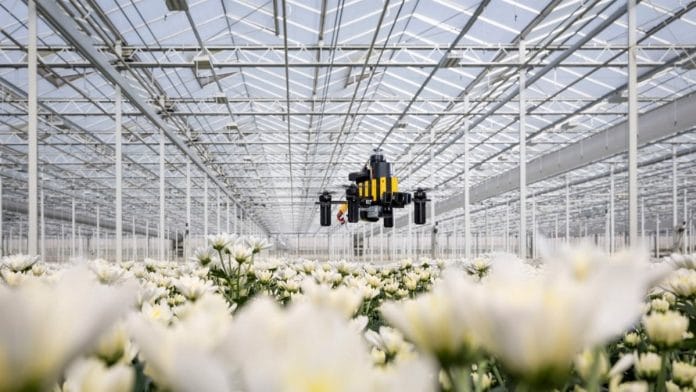
The result is Bee-Nav, a robot navigation strategy that helped a 30g drone fitted with a 42-kilobyte computer return home without the heavy computational infrastructure that most drones require. The study could help develop tiny drones for greenhouse monitoring and other indoor spaces where GPS is unreliable or unavailable.
The study, ‘Efficient robot navigation inspired by honeybee learning flights’, by roboticists at Delft University of Technology and biologists at Wageningen University in the Netherlands, was published in Nature on 13 May.
Also Read: Neanderthals are world’s oldest dentists. They performed tooth surgeries 60,000 years ago
What do bees teach?
In the world of robotics, and drones in particular, researchers face a dilemma. State-of-the-art robot navigation systems exist, but they are computationally expensive and quite literally heavy. Lightweight drones just can’t lug around that burden.
And yet, just outside modern labs, in fields of flowers and fruit, nature shows science that resource-efficient, long-range navigation is feasible. Even the tiniest of insects, like our protagonist, the bee, travel several kilometres from their hive using two important techniques.
The first is path integration. As a bee takes flight, it keeps track of the direction and the speed of its movement. When it needs to return, it retraces its path based on its earlier steps. However, path integration is prone to tiny errors over time, so the bee has another trick up its sleeve to make sure it can return home safely.
“A honeybee leaving the hive first takes a short learning flight to memorize nearby landmarks,” the study’s lead author Guido de Croon, an artificial intelligence and robotics researcher at the Delft University of Technology, told Scientific American. These landmarks help the bee correct its course and make its way back.
Researchers applied this two-step process to lightweight drones. First, the drone was taught to carry out a learning flight to capture its surroundings using a tiny omnidirectional camera. Then, as it left the starting point, an onboard neural network would register vectors linked to the familiar images.
The study shows that the drone can then be sent far off and return using path integration. Once it nears the familiar scenery where its flight began, the drone’s navigation system, in an abstract sense, guides it using tiny invisible arrows pointing home.
Also Read: 1 in every 277 biomedical papers worldwide has a fake citation, says study in ‘The Lancet’
What can Bee-Nav do?
Bee-Nav uses Raspberry Pi 4, a tiny computer, and can run with neural networks of 3.4 and 42.3 kilobytes, several thousand times smaller than those larger drones use.
In one of the tests, a drone fitted with the Bee-Nav system flew more than 600 metres and still returned home using a neural network of just 42 kilobytes. In indoor spaces, like hangars, the system was extremely successful. With windy conditions, the success rate dropped to 70 per cent because the wind tilted the drone, making it harder to use images for navigation.
“The experiments are very encouraging, but they also show that our current system needs to become more robust in real-world conditions,” said Dequan Ou, PhD candidate at Delft University of Technology and first author of the paper.
The technology is still in its nascent stages, and eventually it will also have to tackle challenges such as navigating between multiple areas, avoiding obstacles, or even moving through cluttered spaces.
But one arena where such technology could be particularly helpful is in agriculture or greenhouse monitoring.
“Lightweight drones could inspect crops and detect diseases or pests at an early stage, helping growers increase yield while reducing waste. Bee-Nav is especially suitable for such drones, because they need to be lightweight and safe for people working nearby,” said a Delft University release.
(Edited by Asavari Singh)