





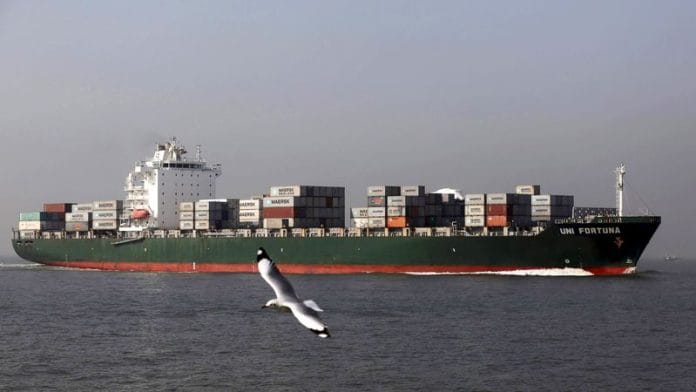



New Delhi: Satellite observations show that ship-tracks, a cloud signature of modern trade, significantly dropped since the IMO2020—the rule by the International Maritime Organization that mandated a sharp reduction in sulphur content in marine fuels.
Before the rule, most ships burned Heavy Fuel Oil (HFO) that left a high-sulphur residue from crude oil refining. Today, the majority of vessels use very low sulphur fuel oil (VLSFO), leading to a sharp drop in sulfate emissions.
Research published in Atmospheric Chemistry and Physics states that since IMO2020 implemented the use of cleaner shipping fuel, marine clouds have become less reflective, weakening their cooling effect.
The study, led by Florida State University atmospheric scientist Michael Diamond and Florida State University graduate student Lilli Boss, analysed satellite data following the major rerouting of global shipping beginning in November 2023.
A series of Houthi attacks disrupted global trade routes in the Bab al-Mandab Strait—a critical gateway between the Red Sea and the Indian Ocean. Since then, ships avoided the region and detoured around the Cape of Good Hope, where the Atlantic and the Indian Ocean meet. The region, known for persistent low-level marine clouds that respond strongly to pollution, saw an abrupt increase in traffic
This conflict offered researchers, who were looking at ship-tracks, rather than weather or policy changes, a rare opportunity to observe cause-and-effect relationships in the atmosphere.
The findings help constrain one of the largest uncertainties in climate science: How aerosols affect clouds.
When a ship’s fuel is burnt, it emits tiny sulphate aerosols. When these particles are abundant, clouds develop many small droplets, making them brighter and more reflective. This increases the amount of sunlight reflected back into space, producing a cooling effect at the surface. With less sulphur in fuel, ships emit fewer aerosol particles, making ship-tracks harder to form and detect.
For decades, this pollution-driven cloud brightening has offset global warming on a day-to-day basis, masking roughly one-third of the heat trapped by greenhouse gases. These effects were often visible in satellite imagery as bright linear cloud features known as “ship-tracks” following major shipping lanes.
Also read: The twist no one saw coming — comet 3I/ATLAS is older than the Sun
A complex trade-off
The recent shipping detour helped resolve how aerosols affect clouds. Researchers tracked nitrogen dioxide (NO₂), a pollutant emitted by ship engines that is unaffected by sulphur regulations, to confirm changes in shipping intensity. Even though ship traffic in parts of the South Atlantic nearly doubled in 2024, cloud droplet formation remained far weaker than it would have been before the fuel rules took effect.
By comparing NO₂ levels with cloud droplet numbers, the researchers found that the ships’ ability to modify clouds has fallen by about two-thirds since cleaner fuels were introduced.
While sulphate aerosols temporarily cool the planet, they are also harmful air pollutants linked to respiratory and cardiovascular disease. The IMO estimates that the sulphur cap has already prevented tens of thousands of premature deaths.
The study highlights a complex trade-off: Improving air quality reduces cloud-induced cooling, potentially revealing warming that was previously hidden, but it delivers major public health benefits. By better quantifying how clouds respond to cleaner fuels, scientists hope to improve climate projections and inform future environmental policy.
(Edited by Theres Sudeep)