





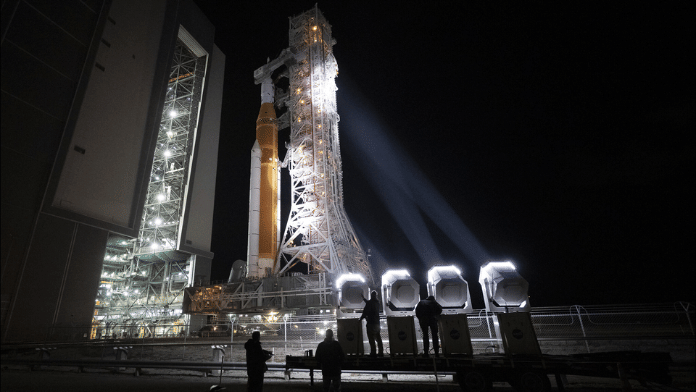



New Delhi: Mankind is ready to reach for the Moon again after a gap of over 53 years, through the Artemis II Mission. Scheduled to launch on 1 April by the United States’ National Aeronautics and Space Administration, the Artemis II will take three American astronauts and one Canadian astronaut on a 10-day mission to “fly by” the Moon. Along the way, the astronauts will research on the far side of the Moon, which always faces away from the Earth.
Named after the Greek Goddess of the Moon, the mission will get closer to the lunar surface than any crewed mission has in the last 50 years. It aims to test the Orion Spacecraft’s ability to support a crewed mission and assess its readiness for future missions to the Moon and Mars.
The 1 April mission marks a significant milestone for NASA since it’s the Orion’s first crewed mission. During their mission to the Moon, the scientists plan to carry out multiple scientific studies, such as on human health and well-being in deep space, as well as observing the geological features of the lunar surface. The Artemis II will also carry CubeSats from Germany, South Korea, Saudi Arabia, and Argentina, which will be deployed near the low-Earth orbit.
On 18 March, the four astronauts entered quarantine facilities in Houston to begin limiting exposure before their scheduled flight. Meanwhile, NASA rolled out the Space Launch System (SLS) rocket and Orion spacecraft to the launch pad on 19 March, setting the gears in motion for the upcoming mission. Launch windows are available at the Kennedy Space Centre in Florida through 6 April for Artemis II.
“Under Artemis, NASA will send astronauts on increasingly difficult missions to explore more of the Moon for scientific discovery, economic benefits, and to build on our foundation for the first crewed missions to Mars,” read NASA’s website.
Also Read: ISRO’s PSLV debris found near Tamil Nadu. Scientists unclear on which mission it belonged to
Significance of Artemis II
Originally scheduled for 2024, the lunar mission was postponed multiple times after Artemis I (2022) completed its mission because of kinks in the heat protection system. Since then, NASA has also announced changes to the Artemis’s schedule — while originally, Artemis III was supposed to be the mission where humans landed on the Moon, in February this year, NASA decided that Artemis III, scheduled for 2027, would remain in low-Earth orbit instead the Artemis IV would attempt a lunar landing in 2028.
Artemis II remains a milestone mission in NASA’s history. According to the schedule shared on the website, after launch, the Orion spacecraft will enter an orbit around the Earth, where the astronauts will check whether all systems are in place before beginning their journey to the Moon. The Orion will then be ejected towards Earth’s only natural satellite by the SLS rocket.
This trans-lunar injection, based on a precise plan made by the scientists, would put Orion in a free return trajectory. And so even if something were to fail in the mission, Orion would still make its way back to Earth automatically. The trajectory would allow the astronauts to get as close as 7000 miles to the Moon, precisely observing its surface and geological features, as well as taking accurate photographs.
At the same time, both NASA and the National Oceanic and Atmospheric Administration (NOAA) will be monitoring the space weather and especially the Sun, to provide the astronauts with real-time information about solar flares. This will help minimise the risk of the Artemis II astronauts to potentially deadly solar ejections.
After an eight-shaped loop around the Moon, Orion will head home on the 9th day, and will re-enter the atmosphere while facing almost 1600 degrees Celsius heat. The spacecraft is scheduled to splash down in the Pacific Ocean, where systems for recovery are already in place by NASA.
Also Read: India’s NavIC is not fully functional even after 27 years—military loses the most
What is the mission?
The Artemis II is the second Moon mission by NASA on the Orion spacecraft, and the first crewed mission in the series. Artemis I, which launched in November 2022, was an uncrewed Moon mission that lasted over 25 days and travelled more than 1.4 million miles from the Earth to the Moon and back.
Equipped with cameras, radiation detectors and even mannequins — called Moonikins — the 2022 mission was essentially a test flight for when Orion and the SLS would carry humans on the same flight path. From the amount of heat exposure to the radiation levels to even the performance of the life support systems, Artemis I checked all the facets of the flight for the crew to finally undertake the journey.
“NASA is investing in a long-term exploration campaign of the Moon, which will lead to Mars, connecting near-term achievements with the technologies, science, and partnerships necessary for sending the first people to another planet. Artemis returns American astronauts to the Moon to stay,” reads a NASA brief on the Artemis missions.
(Edited by Insha Jalil Waziri)