





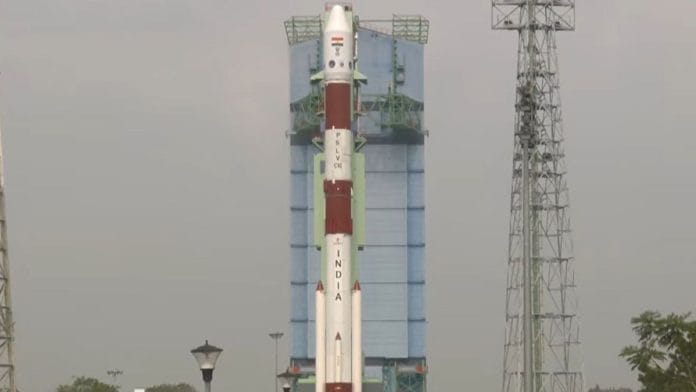



New Delhi: The Indian Space Research Organisation failed to place its strategic satellite, EOS-N1 — also known as ‘Anvesha’ — in its intended orbit on Monday, making this the third failure of a strategic satellite mission in the past year. With India building its defence capabilities through space surveillance, these back-to-back failures mark a setback, experts said.
EOS-N1, the primary satellite on board ISRO’s PSLV-C62, was a 150-kg earth observation satellite built by the Defence Research and Development Organisation (DRDO).
It was designed as a hyperspectral imaging satellite, equipped to identify materials beneath multiple layers, such as camouflaged weapons and tanks, and to detect illegal movements along national borders. These details are often missed by the human eye and even by conventional optical-imaging satellites.
A senior official from DRDO told ThePrint that this was a setback for India’s defence ambitions.
“Of course, it is disappointing. We were hoping for a more positive outcome. But such things happen in space missions, and we will bounce back,” the official said.
India has been focusing on strengthening its space surveillance for defence applications, especially after Operation Sindoor. The Department of Space and DRDO are undertaking projects to enhance border monitoring and better track enemy assets and movement near Indian territory. Apart from sanctioning new projects, the timelines of existing ones have also been fast-tracked in the past few months.
However, the recent failures have marred its ambitions.
Back-to-back disappointments
In May last year, ISRO’s PSLV-C61mission failed to place the EOS-09 satellite (RISAT-1B) in its intended orbit.
“On 18th May 2025, the 101st launch was attempted. PSLV-C61 performance was normal till the 2nd stage. Due to an observation in the 3rd stage, the mission could not be accomplished,” ISRO said in a statement after the failure.
EOS-09, also an earth observation satellite weighing around 1,710 kg, was equipped with a C-band synthetic aperture radar (SAR). It was designed to provide high-resolution imaging, even under adverse weather conditions such as heavy rain, cloud cover, etc.
Earlier, in January 2025, ISRO faced a setback after its navigation satellite NavIC was announced as a “partial failure”.
The NVS-02 mission, which was ISRO’s 100th launch, also failed to reach its orbit.
The string of failures prompted a flood of criticism from experts and space enthusiasts.
“Usually, after a failure, ISRO forms something called the Failure Analysis Committee (FAC or similar). Competency doubts need to be raised on FAC, because after the last failure, they would have raised changes to be made. These clearly didn’t work or created some other problem down the line,” a space communicator, who goes by the pseudonym Gareeb Scientist, posted on X.
The user added, “Time to put head down, accept there are problems, be transparent and fix them.”
(Edited by Prashant Dixit)