





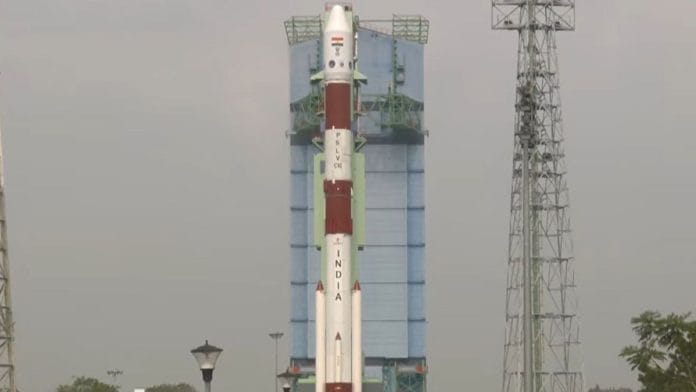



New Delhi: The first launch of 2026 by the Indian Space Research Organisation was unsuccessful, as it failed to send the Earth Observation Satellite—EOS-N1—and 15 other co-passenger satellites to their intended orbit.
Thirty minutes after the launch, ISRO took to X to say that the mission PSLV-C62 encountered an ‘anomaly’ and that they have initiated a detailed analysis.
This is the second time in a row that the Polar Satellite Launch Vehicle (PSLV) failed to launch, which is termed the ‘workhorse’ of ISRO because of the number of missions it has undertaken. This was the ninth commercial mission of New Space India Limited (NSIL), which is ISRO’s commercial arm. It involves collaborations with Indian and international start-ups.
“Today, we attempted the PSLV-C62 EOS-N1 Mission. The PSLV is a four-stage vehicle. It performed as expected up to the end of the 3rd stage,” said V Narayanan, ISRO Chairman, during the live stream. “At the end of the 3rd stage, we saw a disturbance in the vehicle, and then there was a deviation from the flight path. We’re analysing the data, and will come back at the earliest.”
Manipur to Brazil
The last PSLV Mission was on 19 May, carrying the Earth Observation Satellite-9 mission, which also failed due to an observation in the third stage of the rocket. Now, for the second time in a row, a third-stage configuration issue has led to an Earth Observation Satellite mission failure in the PSLV.
PSLV has launched 63 previous missions, including Chandrayaan-1, Mangalyaan, and Aditya-L1. This launch, however, was using a variant of PSLV known as PSLV-DL, which had dual strap-on motors. During the launch, both motors seemed to work fine, according to the live-stream of the launch by ISRO.
The Earth Observation Satellite (EOS-N1) Anvesha was designed jointly by DRDO and ISRO, and along with it, there were also 15 satellites from four other countries, Indian start-ups, and Indian university students. The launch, which came 19 days after the BlueBird launch on 24 December, had garnered national and international spectators at Sriharikota, ISRO’s launch site.
Importantly, this mission was supposed to carry the KID Capsule by the Spanish Orbital Paradigm start-up, to demonstrate re-entry into the Earth’s atmosphere. This capsule was supposed to re-enter along with the PS-4 stage of the PSLV, and they were both expected to impact in the South Pacific Ocean.
Other satellites and payloads on this mission were going to serve a variety of purposes, including agriculture data collection, IoT sensors demonstration, in-orbit fuelling and even in-orbit AI computing and data processing in space. There were satellites from four Indian states – Odisha, Manipur, Assam, and Karnataka, all developed by university students, carried on aerospace company Dhruva Space’s payloads. According to sources, all payloads are most likely lost.
Among international satellites, the mission included Theos-2, an Earth observation satellite by the UK and Thailand, and a tech demonstration satellite by Antharkshya Pratishtan, a non-profit in Nepal. There were also five satellites from Brazilian start-up AlltoSpace, and the KID Capsule from Spain.
Also read: With only 5 launches in 2025. What’s behind ISRO’s project delays
Previous failures
ISRO has had a string of failures and delays lately, with three out of five missions being unsuccessful in the last year. In 2025, the first launch of the year – SpaDEx – experienced major delays with the docking and undocking technology demonstration. Originally scheduled for January 2025, the demonstration only happened in March 2025. The second mission of 2025 was the PSLV launch in May, which was a failure.
Apart from the current PSLV launch, there are five more missions planned by ISRO for 2026, including the uncrewed test flight of Gaganyaan, to demonstrate end-to-end mission dynamics, as well as the first industry-built PSLV launch.
However, ISRO is yet to confirm whether the payloads of the current PSLV-C62 mission can be retrieved or not, and whether the mission will be re-attempted.
(Edited by Ratan Priya)