





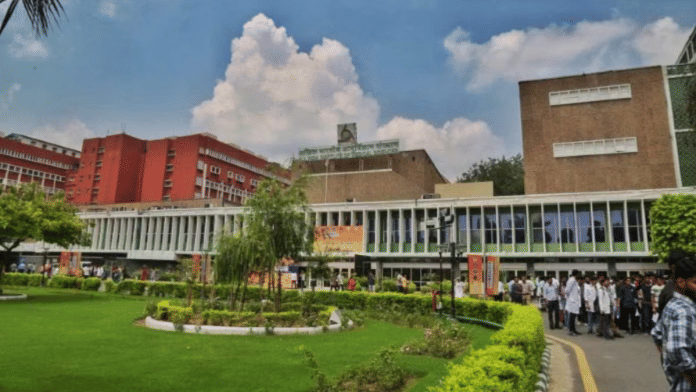


New Delhi: The top 50 non-medical college hospitals in India produce an average of just 48 research papers a year, according to a new study in the Journal of Medical Evidence. The top 50 hospitals with medical colleges, led by AIIMS Delhi, produce around 338 papers a year, which is still far lower than hospitals in the US, UK, and China.
A single US medical college—Harvard Medical School—produces an average of 3,870 papers a year, higher than any Indian medical college or non-medical college hospital.
The paper, published on 15 June, is authored by surgeons Dr Samiran Nundy and Dr Parmanand Tiwari, both associated with the Gangaram Hospital in New Delhi.
Dr Nundy is also the President of All India Institute of Medical Sciences (AIIMS) Rishikesh, and is a gastrointestinal surgeon who was awarded the Padma Shri in 1985. He was also the founding editor of two Indian journals—National Medical Journal of India and Tropical Gastroenterology.
“There are now 49,000 Indian medical institutions, of which 800 are attached to medical colleges, but the vast majority are not attached to any teaching systems,” said the paper. “This latter group of hospitals, for various reasons, did very little research or publications.”
Institutions such as AIIMS New Delhi, Christian Medical College (CMC) Vellore, and Jawaharlal Institute of Postgraduate Medical Education and Research in Pondicherry feature in the list of Indian hospitals with medical colleges attached to them. However, there are over 48,000 other hospitals, mainly private ones such as Gangaram Hospital, Medanta City, and Apollo Hospitals, which function solely as healthcare centres without medical colleges.
The paper used data from publicly available scientific journal databases to assess the total number of publications in the top 50 Indian hospitals and medical colleges from 2021 to 2025. These include PubMed, Scopus, and Google Scholar. At the same time, it found the total publications in the top 10 medical institutions in the US, UK and China for the same time period, for comparison.
India’s top 10 hospitals without colleges produce 133 papers a year on average—Gangaram tops the list at 253 papers a year. The top 10 hospitals with medical colleges produce seven times more research, at 740 papers a year on average.
However, the top 10 institutions in the UK produce 2,701 papers a year, in the US, the number is 2,898, and China has the highest average publications a year at 3,220.
“To place our research output in some sort of perspective, we must remember that the Mayo Clinic (in the US) produces 8,000 papers annually, which is more than the entire Indian private sector,” reads the study.
Also read: LiverDoc is out to bust cow urine research by IITs. He’s made foreign journals investigate
Why so few research papers?
Despite its 1.4 billion population and 1 lakh doctors, the study observed that India’s research output is “very low”.
“Probably the main reason for this is that there is very little incentive to do research in most Indian institutions,” said the study.
According to the study, private sector medical institutions generally consider research publications a “waste of time and money”. Meanwhile, in the public sector, publications are not seen to add much to a faculty member’s credentials since promotions depend more on seniority and networks.
“The barriers to producing good research include the absence of good patient records,” added the study. “Few doctors take a long history and put it to paper and, more rarely, upload it online.”
Other reasons for this include the Indian education system’s focus on ‘rote learning’ as opposed to the spirit of enquiry, given centuries of British colonial rule. This, too, said the authors, discourages original thinking, which is essential for research.
The study recommended financial and other incentives for increasing research output, similar to China’s model. The authors explained that beyond hospital revenue and patient numbers, medical institutions should understand the value of research publications for displaying excellence in clinical practices, as well as global institutional branding.
(Edited by Theres Sudeep)