





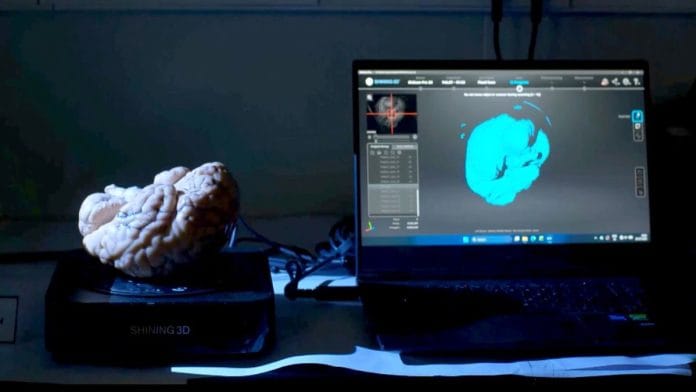


New Delhi: Scientists have studied the brain for decades, but never before have they mapped the human brainstem in such detail. That is now changing, as the Indian Institute of Technology Madras has released the world’s most detailed 3D atlas of the human brainstem.
ANCHOR, the ‘Atlas of Neurochemical Characterization of the Human Brainstem with 3D Reconstruction’, was developed by researchers at the Sudha Gopalakrishnan Brain Centre (SGBC) at IIT-M and was released during the 3rd BRICS Neuroscience Symposium 2026, held from 5 to 7 June.
“The brain is the reason we are called intelligent and complex beings. If you think about it, it is quite stunning that we actually have not seen this organ up close,” Professor Mohansankar Sivaprakasam, head of SGBC, told ThePrint.
The brainstem sits at the base of the brain and connects the cerebrum to the spinal cord. It is not the part of the brain that makes us ‘intelligent’; instead, it is vital in a different way. It controls breathing, regulates heart rate and body temperature, and guides movement. Evolutionarily, it is one of the oldest structures in the brain.
It is here that ANCHOR begins. The maps encompass more than 200 brainstem nuclei and fiber tracts, reconstructed into 3D models using hundreds of extremely high-resolution images. If an MRI allows scientists to look at the brain at the millimetre level, ANCHOR has zoomed in nearly 1,000 times, allowing researchers to look at cells at the micron level.
“You can take a detailed photo of Delhi, but it will be different from a map. A map has regions. You can mark out the Yamuna, you can find the mountains and the roads. That is what we have done,” Sivaprakasam said.
Building a Google Maps for the brain
Researchers describe ANCHOR as a navigational map of the brain, one that could allow scientists to explore the landscape of neural networks and cellular clusters and study how the brain changes from the fetal stage to old age.
The atlas could eventually help reveal how diseases affect different regions of the brain, allowing clinical practitioners a faster way to catch neurodegenerative diseases and potentially help develop new treatments.
The team behind ANCHOR doesn’t want to just stop there. They want to map the entire brain—and not just one brain. The team has already procured hundreds of brains across the human lifespan, representing several diseases, infections, developmental disorders, and even multiple countries.
“We are almost halfway through the mission. We have a network of several medical institutions, and we are starting to get post-mortem brains from the US and Canada too,” said Sivaprakasam, highlighting that their centre has received global attention for being the only one of its kind involved in such a large-scale brain-mapping project.
Computing power and AI at the core
Building ANCHOR, however, requires more than just sophisticated imaging technology. The story begins at medical institutions like CMC Vellore, Kilpauk Medical College, and MediScan Systems. When families consent to donate the brain of their loved ones to medical research, a standard legal process begins. These brains then arrive at IIT-M, where they are carefully preserved until it is their turn to step in front of the camera.
The team at SGBC is made up of more than 200 scientists and engineers. Of these, nearly one-fourth belong to a team of computing and AI experts.
“We generate extremely high-resolution images at nearly 4 TB per hour,” Keerthi Ram, lead for computing and AI at SGBC, told ThePrint. “Each section of the brain that is photographed can be as large as 20 GB, and the imagery of an adult brain can add up to nearly 200 GB.”
Ram explained that several research institutions have taken up the task of photographing the brain. But what makes ANCHOR unique is that it uses computing power to combine 2D and 3D images, as well as images of different magnifications obtained through MRI, blockface technology, and histology—all different methods of photographing the brain.
Such vast amounts of data can remain within the machines for only a day at most. Instead, the images have to be transferred to the central AWS server, which has the capacity to store 10 petabytes—10,000 TB or 10,485,760,000 MB.
“The data needs to flow like water. If there is any kind of failure, whether it is hardware or software, it needs to be rapidly resolved; otherwise, we lose data. It keeps getting generated, but it has nowhere to go,” said Ram.
This is where automation plays an important role. Ram heads a team that has, over the past few years, streamlined the process from photographing the brain to converting those photos into an eventual 3D model. He explains that in the automated process, AI helps create metadata for the images to identify tissues, cells, and other structures.
“We have researchers who proofread that metadata. This is a scientific endeavour; we don’t want to rely on just AI,” he said.
The road ahead
Behind the tedious task of first procuring brains, then scanning them and eventually turning high-resolution images into a combined 3D map, is the goal of ultimately building “statistically robust models”.
“So far, we have mapped nearly 70 brains. We want to map 100 more in the coming year, but we would need to map at least over 300 to give us the kind of data that could give clinicians clues about how diseases progress, how they can be spotted early, and even treated in time,” said Ram.
He and his team have also created AI models, which are being trained on these images with no particular prompts or tasks. Unsupervised, the AI observes the data, and as the models grow smarter, Ram hopes they will find patterns and correlations, allowing clinicians to make new discoveries.
Having worked with medical image analysis for nearly 20 years, Ram knows the limitations of millimetre-level imaging—in medical treatment, it often just confirms what the patient is already feeling. But with photographs at a cellular level, the data opens new vistas for analysis.
“Millimetres just didn’t seem enough; we wanted to go smaller,” he said.
It is not yet clear just how this technology will impact medical treatment, but Ram says that ANCHOR could help practitioners develop targeted tools or at least deliver medication in a more targeted manner.
“It is because the world is mapped that delivery people can drop goods off at a particular address. Someday, ANCHOR might also help clinicians deliver drugs to specific cell clusters.”
For now, ANCHOR is a map of the brainstem. But as researchers prepare to take the project forward, they hope to map hundreds of brains and allow doctors to someday navigate the brain with the same confidence with which Google Maps allows people to navigate cities.
(Edited by Prashant Dixit)