






New Delhi: Thousands of years ago, the dry sands of Egypt were submerged under nutrient rich oceans which were home to all sorts of ancient aquatic creatures. Today, buried under layers of dust and desert heat, paleontologists have uncovered the remains of an ancient shark.
A team of researchers led by Tarek Yassin, a geologist at the Cairo University, found what they have called an “Egyptian shark graveyard” that dates back to the Cretaceous period, nearly 145 to 66 million years ago.
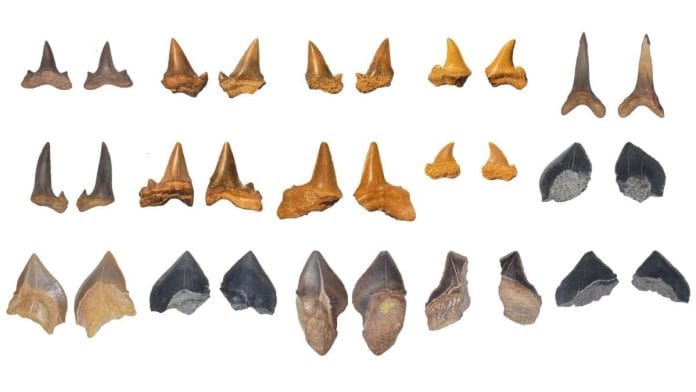
Their excavations revealed teeth of at least seven different species of sharks, proving that the dry Abu-Tartur Plateau was once home to a rich marine ecosystem.
“Collectively, this assemblage highlights a nutrient-enriched, high-productivity marine ecosystem along a phosphogenic shelf margin,” wrote the team in a paper published on 18 August in Cretaceous Research.
During the Cretaceous period, the Earth was warmer, there was hardly any polar ice, and much of today’s inhabited land was under water. The proof of this lies in phosphate deposits in several parts of the world. As nutrients rose from deep waters, plankton grew, and marine life fed on the plankton. When these organisms died and sank, phosphorus was released, recycled, and eventually trapped in sediments.
Also read: Sea surface temperature rose to 21.1°C. It is a new record, scientists are worried
Archives of the ancient seas
These phosphate deposits are archives of the ancient seas. Yassin and his colleagues had already identified two other shark species in the region in 2024. When they returned for more, the black and yellow layers of phosphate did not disappoint them. They found at least 14 shark teeth, belonging to five species which had never been found in the region before.
The extinct species were Cretalamna cf. maroccana, Scapanorhynchus cf. raphiodon, Squalicorax pristodontus, Serratolamna cf. serrata, and Squalicorax bassanii, of which the last two had not been spotted in Egypt before.
“The presence of Squalicorax could suggest an input from nearshore/inner shelf settings, while the occurrence of Scapanorhynchus reflects deeper-water conditions on the outer shelf and slope,” the researchers wrote.
While their findings are titled “shark graveyard”, the term could be misleading. These were not sharks that were likely to have been alive at the same time in the same area. What led to such a “graveyard” is the lack of sediment accumulation at the time.
The phosphate bed that the researchers are looking into is a far more condensed picture of history than scientists might find at another spot where many more layers of mud or grime would have accumulated over the years.