





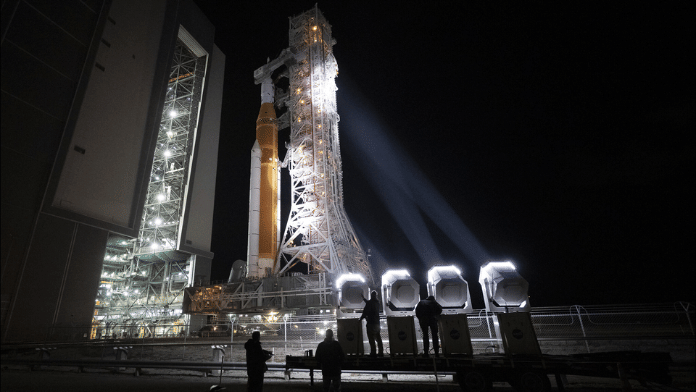



New Delhi: Shortly after the historic take off of NASA’s Artemis II Mission, the Orion spacecraft experienced some trouble—not with thrust, or air or temperature, but with the toilet on board. The Artemis II Mission took off at 3:54 am on 2 April from Florida’s Kennedy Space Center, as the world watched.
Around two hours after takeoff, the crew needed to settle into their space and ensure all mission operations were working fine. One of these tasks included checking the onboard toilet. It was during this routine checkup that they noticed a problem.
Christina Koch, the Artemis II mission specialist and the only woman on board, noted that there was a technical glitch with the toilet designed for the crew, visible through a “blinking fault light.” While NASA did not release full details of the exact issue with the toilet, American news outlet Space reported that the crew would still be able to poop, but not pee.
After flagging the issue to ground services, both teams began working on fixing the toilet trouble. About six hours into the flight journey, NASA released an official statement saying that the toilet issue had been resolved.
“The Artemis II crew, working closely with mission control in Houston, were able to restore the Orion spacecraft’s toilet to normal operations following the proximity operations demonstration,” said the official NASA statement.
A strappable toilet with a door might seem common on Earth, but for the space-bound astronauts, it is a luxury. The Artemis II Mission is the first time NASA has installed a fully functional toilet, which can process both urine and faeces, and even has a door for added privacy.
The toilet was a project that was decades in the making—and it began right after the Apollo 11 mission, when Neil Armstrong and Buzz Aldrin had to defecate in plastic bags. Long-haul spaceflight has long contended with the question of waste management and disposal, with stories abound of “distasteful” flying bags of urine and faeces inside some of the Apollo space missions.
Also read: To the Moon and beyond—NASA gears up for first Moon mission in 50 years with Artemis II
Years in the making
The Universal Waste Management System, designed for this mission, was first sent to the International Space Station in 2020. It looks like a rudimentary Earth toilet, with a lid and metal parts, including a vacuum hose for urine and faeces transfer.
On the ISS, the toilet treats the urine into wastewater, to be treated further. The famous rumour that astronauts drink treated urine is indeed true, but it came to be only in the last decade after the UWMS was functional and could be integrated with complex filtration systems.
“We recycle almost 90 per cent of all water-based liquids in space,” said NASA astronaut Jessica Meir in a press release in 2020. “And when it comes to our urine on the ISS, today’s coffee is tomorrow’s coffee.”
The Artemis II Mission, which is a 10-day flyby of the Moon, is the farthest distance humans have ever been in space. However, it is a relatively short-haul flight compared to the time ISS astronauts spend in space, and therefore, none of the four Artemis II astronauts will be drinking their own recycled urine.
Artemis II’s toilet, since it is for a shorter mission, will only store waste matter for disposal. It is specially designed to work in a low-gravity environment and built using 3-D printed titanium.
The Artemis II Mission is the second in a series of Artemis Missions that are aimed at establishing a long-term human presence on the Moon. Every element of the mission, from the rocket to the spacecraft to the life support systems, has been designed to one day support missions to land on the Moon, and maybe even Mars.
The UWMS has been designed to one day calibrate with other systems on spacecraft and recycle the waste for future long-haul missions to explore deep space.
(Edited by Theres Sudeep)