





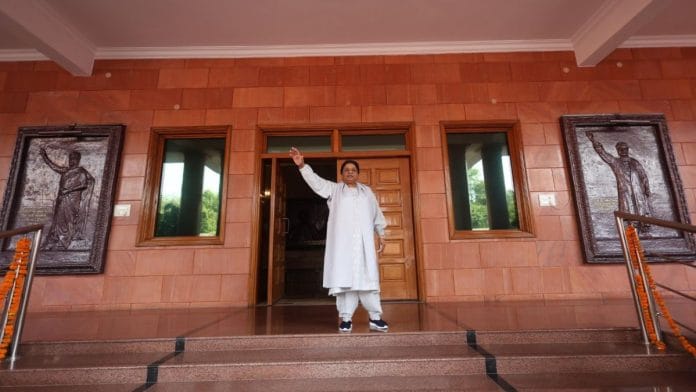



Lucknow: As Uttar Pradesh gears up for Assembly elections next year, Bahujan Samaj Party (BSP) supremo Mayawati has revived an old demand for a separate state of Western Uttar Pradesh.
The timing of the demand is significant. It comes just days after rival and Samajwadi Party chief Akhilesh Yadav launched his formal election campaign from Dadri in the westernmost part of the state.
Earlier in 2024, Mayawati reiterated her commitment to work towards creating a separate Western Uttar Pradesh state comprising districts from the region. Although she did not repeat this demand last year, she has revived it now as Assembly elections are approaching.
BSP leaders say western Uttar Pradesh has traditionally been the party’s stronghold, and despite current political challenges, it continues to have a solid organisational base there.
Dalits and Muslims together account for over 45 percent of the population in the region, with Dalits making up nearly 20 percent. A significant proportion of the Dalit population belongs to the Jatav community, which is considered a core voter of the BSP.
A senior BSP leader told ThePrint that if Muslims consolidate with Dalits in western Uttar Pradesh, along with even a small share of Gurjar votes, it would be enough to form a government in the region.
The leader added that if western Uttar Pradesh were to become a separate state, the BSP would emerge as a key player, as the Samajwadi Party is considered relatively weak in parts of the region, particularly in areas dominated by Jats and Gurjars.
“We will continue to raise this issue in our meetings across western UP,” he said.
The politics of western UP
Western Uttar Pradesh accounts for roughly 130 of the state’s 403 Assembly seats, with its politics largely revolving around the Muslim-Jat-Dalit equation, alongside significant Gurjar, Saini and Rajput populations.
Following the 2013 Muzaffarnagar riots, the region witnessed strong Hindu consolidation, which benefited the Bharatiya Janata Party (BJP) electorally. However, the 2020-21 farmers’ protests dented the BJP’s dominance and helped revive the alliance between the Rashtriya Lok Dal (RLD) and Samajwadi Party.
Even after RLD exited the alliance in 2024, the Samajwadi Party and Congress still managed to put up a strong performance, aided by the consolidation of a significant section of OBCs, a segment of Dalits, and Muslim voters in their favour.
Aas Mohammad Kaif, a political observer based in western Uttar Pradesh, says, “If the state is divided in the future, it may not significantly impact the BJP, as the party has a strong cadre and a stable core vote base across regions.”
However, he argues, regional parties could face challenges.
According to him, the BSP is relatively weaker in the Awadh belt (central UP) and has also lost ground in Purvanchal.
He said the Samajwadi Party cannot be termed weak in any specific region, but its caste coalition is more effective in Awadh and Purvanchal, where sections of Extremely Backward Classes (EBCs), along with Yadavs and Muslims, tend to support it. Additionally, a segment of Pasi (non-Jatav Dalit) voters also leans towards the party.
In contrast, the Yadav population is relatively smaller in western Uttar Pradesh, barring a few districts. As a result, the SP is heavily dependent on Muslim voters in the region, whose votes may also get divided in some constituencies, affecting the party’s overall prospects, Kaif added.
When asked about the Samajwadi Party’s stand on a separate Western Uttar Pradesh state, party spokesperson Amiq Jamai said the party would take a call on the issue only after 2027, once it comes to power.
“At the moment, we do not want to be distracted by the BSP’s narrative. We respect Behan ji and wish her well, but our entire focus is on the 2027 elections. After our successful rally in western UP, we expected that some parties would feel uneasy,” he said.
Meanwhile, Bhupendra Chaudhary, former BJP state president in Uttar Pradesh and a leader from western UP, said the creation of a new state is solely the Centre’s prerogative.
“We have not made any such demand so far. The BSP supremo has earlier supported the idea of a separate state; so that is her position. As for us, we will go by whatever the party leadership decides,” he said.
Dr Shilp Shikha Singh, a UP-based political analyst and assistant professor at Lucknow’s Giri Institute of Development Studies, said that Mayawati’s deep connection with the region stems from the fact that she hails from western Uttar Pradesh and was first elected to Parliament from Bijnor in 1989. Moreover, her core voter base has significant stakes there.
“Yadavs are relatively fewer in the Jat-dominated belt compared to Jatavs. So any formation of social coalitions, whether Jats plus Muslims, Jatavs plus Muslims, or a broader alliance of general and OBC castes, can gain an edge in this region. This makes her demand politically important for the BSP’s prospects,” Singh said.
“However, in the current scenario, without an alliance with parties like the Rashtriya Lok Dal or Congress, or without securing Muslim votes, the BSP is unlikely to perform strongly in western UP,” she added.
(Edited by Sugita Katyal)
Also Read: Why BJP is worried about SIR in Uttar Pradesh