





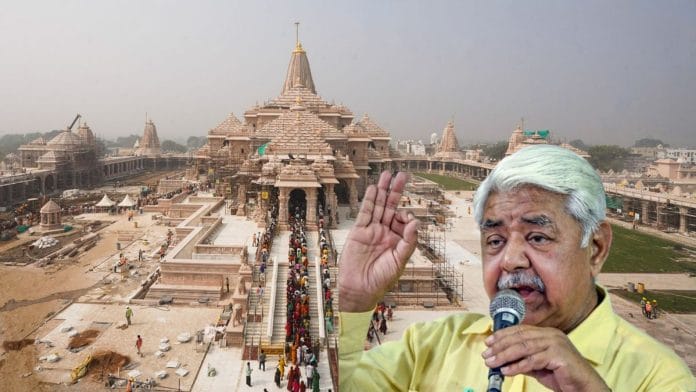


New Delhi: A day after the Ayodhya Bar Association declared that no lawyer will represent the accused in the Ram Temple donation theft case, Vishva Hindu Parishad (VHP) chief Alok Kumar said the resolution violates constitutional principles and professional ethics.
The Bar had also warned that any advocate who does decide to defend the accused will face a Rs 5 lakh fine. On Monday, a local court in Ayodhya had remanded all eight accused in the Ram temple case to 14-day judicial custody.
In a post on X, the VHP chief, an advocate in the Supreme Court and Delhi High Court, wrote that the apex court had examined whether an advocate can decline a case when a client is ready to pay their fee, while hearing a 2011 matter—A.S. Mohammed Rafi vs State of Tamil Nadu—and ruled that Bar Associations cannot pass such resolutions.
In the 2011 case, he wrote: “The Supreme Court noticed that ‘the Bar Association of Coimbatore passed a resolution that no member of the Coimbatore Bar will defend the accused policemen in the criminal case against them in this case’.”
Kumar went on to write that the court had observed that several Bar associations all over India, including high court and district court, have passed similar resolutions. “Sometimes there are clashes between policemen and lawyers, and the Bar association passes a resolution that no one will defend the policemen in the criminal case in court. Similarly, sometimes the Bar association passes a resolution that they will not defend a person who is alleged to be a terrorist or a person accused of a brutal or heinous crime or involved in a rape case.”
The Supreme Court, he added, has “considered this to be ‘a matter of great legal and constitutional importance which has caused us (the court) deep distress…’.”
Kumar wrote that such resolutions, the apex court had held, “are wholly illegal, against all traditions of the bar, and against professional ethics. Every person, however, wicked, depraved, vile, degenerate, perverted, loathsome, execrable, vicious or repulsive he may be regarded by society has a right to be defended in a court of law and correspondingly it is the duty of the lawyer to defend him.”
The VHP chief told ThePrint: “We have no sympathy for anyone accused of stealing offerings; they deserve punishment but can a lawyer refuse to take up a case in the court where they practice? I believe the Ayodhya Bar Association should examine that Supreme Court judgment.”
The Ayodhya Bar Association has resolved to explore initiation of proceedings against Ram temple trust members Champat Rai, Gopal Rao and Anil Mishra under Section 175 of the Bharatiya Nagarik Suraksha Sanhita (BNSS), which empowers a judicial magistrate to order the police to register an FIR and investigate a cognizable offence.
Rai, who is also VHP vice-president, is general secretary of the Shri Ram Janmabhoomi Teerth Kshetra Trust, and Mishra is a trustee. Both have offered to resign.
VHP chief Alok Kumar further wrote in his X post that he has no sympathy “for any person accused of the heinous offence of chadava chori in the Ram Janmbhumi Mandir”.
“We would earnestly press that the investigation is quickly completed, the matter tried in a fast-track court and the guilty persons go behind the bars, say within four-five months from now. However, this does not persuade me to support a position that is both unethical and unlawful. I would hope that the Ayodhya Bar Association shall consider the judgment,” he added.
Kumar cited Article 21 of the Constitution to further buttress his contention: “No person who is arrested shall be detained in custody without being informed, as soon as may be, of the grounds for which arrest nor shall he be denied the right to consult, and to be defended by, a legal practitioner of his choice.”
He also referred to Chapter II of the rules framed by the Bar Council of India on ‘Standards of Professional Conduct and Etiquette’, that state “an advocate is bound to accept any brief in the courts or tribunals or before any other authorities in or before which he proposes to practice at a fee consistent with his standing at the Bar and the nature of the case”.
The Supreme Court, he said, had declared in the 2011 matter that: “all such resolutions of Bar Associations in India are null and void and the right-minded lawyers should ignore and defy such resolutions if they want democracy and rule of law to be upheld in this country. It is the duty of a lawyer to defend no matter what the consequences, and a lawyer who refuses to do so is not following the message of the Gita.”
(Edited by Gitanjali Das)
Also Read: A trust divided? How rivalries within management blew lid off Ram temple donation ‘theft’ scandal