





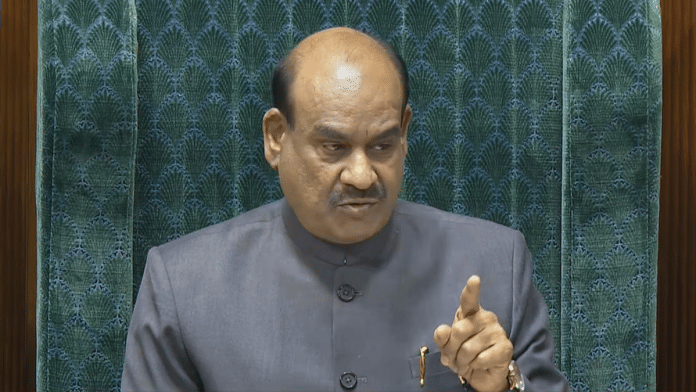



New Delhi: The Lok Sabha Tuesday took up for discussion a resolution seeking the removal of Speaker Om Birla—a rare step taken only twice before in the House—with Congress MP Gaurav Gogoi opening the debate, asserting that the Opposition had been compelled to pursue the extraordinary step not out of personal enmity but to uphold the decorum and dignity of Parliament.
The debate began on a highly contentious note as soon as the notice to move the resolution was taken up by BJP MP Jagdambika Pal, who is presiding over the debate with Birla staying away voluntarily until the House arrives at a decision on the matter.
In its notice, the Congress-led Opposition sought to indict Om Birla on four counts: Disallowing the LoP from finishing his speech on the motion of thanks to the President’s address, suspending eight Congress MPs, allowing a BJP MP’s objectionable attacks on Jawaharlal Nehru and Indira Gandhi, and accusing Congress MPs of planning an attack on Prime Minister Narendra Modi.
The Opposition benches used the opportunity to question the continued absence of a Deputy Speaker, a post which conventionally goes to the rival benches. The post of Deputy Speaker has been vacant since June 2019, when the term of the previous occupant of the office, M. Thambidurai, ended with the dissolution of the 16th Lok Sabha. The post lay vacant during the entire duration of the 17th Lok Sabha, for the first time in independent India, and has remained unoccupied in the 18th Lok Sabha so far.
AIMIM MP Asaduddin Owaisi, citing Article 95 of the Constitution of India, said Pal had no authority to preside over the proceedings.
Owaisi argued that the “sense of the House” had not been taken to determine whether Pal could preside over the debate to remove Om Birla under Article 95(2) of the Constitution.
Article 95(1) of the Constitution states that while the office of Speaker is vacant, the duties of the office shall be performed by the Deputy Speaker or, if the office of Deputy Speaker is also vacant, “by such member of the House of the People as the President may appoint for the purpose”.
Article 95(2), on the other hand, states that during the “absence of the Speaker from any sitting of the Lok Sabha, the Deputy Speaker shall fill the chair. And if the Deputy Speaker is also absent, a person will be picked to be in the chair based on the rules of procedure of the House.”
While BJP MPs Nishikant Dubey and Ravi Shankar Prasad said Pal draws authority from Article 95(2), the Opposition argued that it may not apply in the present situation as it deals with circumstances where the Speaker and Deputy Speaker are “absent”, whereas the current case involves a motion for the Speaker’s removal and a vacancy in the office of the Deputy Speaker.
Congress MP K. C. Venugopal accused the government of creating a “constitutional vacuum” by leaving the post of Deputy Speaker vacant for years now. Eventually, Pal brushed aside the objections of the Opposition and put the notice to move the resolution to vote, asking at least 50 MPs to stand up in support, a criterion that was met, with more than the required number of legislators endorsing it.
In his opening remarks, Gogoi mentioned arguments—including excerpts from the unpublished memoir of former army chief Manoj Mukund Naravane, the pending probe against an Indian business conglomerate in the United States, and the Epstein files—that Leader of Opposition Rahul Gandhi had sought to make while participating in the motion of thanks to the President’s address during the first half of the Budget session in February.
“In the month of February, when the LoP tried to speak during the motion of thanks on the President’s address, he was interrupted 20 times. It was done in a coordinated manner by the Speaker, Home Minister and Defence Minister just because he wanted to point out that when the head of the country was required to take a crucial call, he abdicated saying do what you deem fit. But India is not run by a military leadership. Our army waits for the instructions of the political leadership. His remarks amounted to saying either surrender, or start a war, or engage in talks,” Gogoi said.
Pal objected to Gogoi’s remarks saying the matter has already been dealt with by Speaker Birla. Gogoi said the Opposition was not particularly happy about moving to impeach Birla, “who has personal good relations with everyone”.
“That’s why we are sad that we had to bring a no-trust motion against him. It’s our dharma and duty to protect the decorum and dignity of Parliament. We do not wish to attack Birla personally,” said the Congress Deputy Leader in the Lok Sabha. Rahul was not present in the House when the discussion commenced.
Resolutions seeking the removal of a Lok Sabha Speaker have been moved twice in the past—in 1954 against G. V. Mavalankar and in 1987 against Balram Jakhar. An attempt in 1966 to bring one against Sardar Hukam Singh did not fructify as the Opposition failed to rustle up the minimum support required on the floor.
(Edited by Viny Mishra)
Also read: Congress, TMC find common ground—motions to remove LS Speaker Om Birla, CEC Gyanesh Kumar