





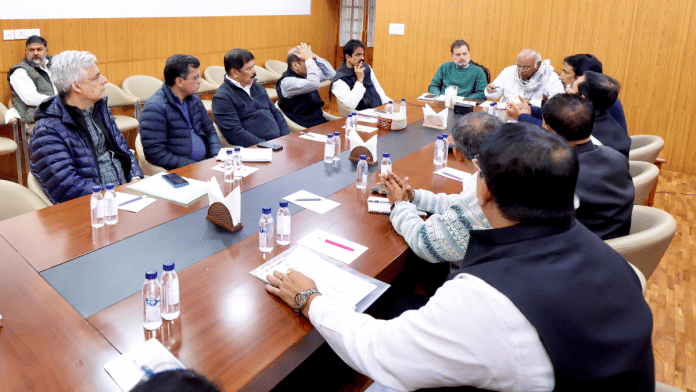



New Delhi: It is not very often that the chief of a state unit of the Congress airs his “personal opinion” on potential alliances with other parties minutes before a meeting with the high command, including president Mallikarjun Kharge and Leader of Opposition Rahul Gandhi.
On Thursday, however, West Bengal Pradesh Congress Committee (WBPCC) president Subhankar Sarkar did just that—announcing, as he walked into Kharge’s residence, that given a choice he would want the Congress to go alone in the 2026 Bengal assembly polls.
Sarkar derived confidence from the fact that virtually the entire state unit, barring the exception of leaders like Adhir Ranjan Chowdhury and Pradeep Bhattacharya, were in favour of going solo for the first time since 2006, the last assembly election in Bengal which the Congress fought as not a constituent of any alliance.
In 2011, the Congress was in a coalition with the Trinamool Congress (TMC), which ended the Left’s 34-year-old run in Bengal that year. The Congress fought the 2016 and 2021 assembly polls in partnership with the Left.
Ranajit Mukherjee, a member of the Political Affairs Committee of the West Bengal unit of the Congress, said the reaction of the workers and leaders of the party to the announcement has been “very positive”.
“In the Congress stronghold areas of Malda, Murshidabad and Uttar Dinajpur, we are the leading opposition party, and we will win our seats on our own might. In South Bengal, where the Congress has been decimated due to the policy of doing alliances over the last 20 years, now we are finally able to present ourselves as an option. We expect to get the support of the Congress ecosystem back and build on it. It will be a four way contest and the Congress will do well in 2026 assembly elections,” Mukherjee told ThePrint.
Party insiders said that this time, the Congress central leadership was also not in favour of tying up with the Left owing to its limited electoral returns in the previous elections, as also the impending poll in Kerala. The Congress-led United Democratic Front (UDF) is going all out to dislodge the Left Democratic Front (LDF) from power in the upcoming polls.
On the question of a potential tie-up with the ruling TMC, the central leadership was not as averse. According to a senior leader present at Thursday’s review meeting at Kharge’s residence, Rahul asked Bengal leaders if there has been any attempt by the TMC to establish contact.
“When they said ‘no’, Rahul endorsed Sarkar’s proposal right away,” the leader told ThePrint.
The sources said that Sarkar’s stance on the alliance questions have been shaped by feedback that he received from a large majority of the Bengal Congress office-bearers, including its district presidents.
“The dominant thinking among the Bengal unit is that the Congress does not stand to gain anything in an alliance. If it goes along, at least its organisational machinery will activate itself in areas where it has not contested for years. It will also enable the party to frame its campaign on an anti-incumbency plank,” the Congress functionary said.
Another factor that weighed in the mind of the leaders was the “trend of Left votes not getting transferred to the Congress, thus rendering the whole idea of an alliance futile”.
In the meeting, Chowdhury, despite finding himself in the minority, batted for an alliance with the Left, pointing out the Congress was unable to deploy Booth Level Agents (BLAs) in most booths during the Special Intensive Revision of voter rolls in the eastern state.
Since 2016, the Congress has fought two Assembly elections and one Lok Sabha election in alliance with the Left, yet it has remained a marginal and struggling force in West Bengal politics.
Back in 2011, when the Trinamool Congress (TMC) was part of the United Progressive Alliance (UPA), it won 184 seats in the 294-member Assembly, while the Congress secured 42.
In 2016, the Congress joined hands with the Left in an attempt to unseat the TMC. While the Congress won 44 seats—more than the CPI(M)’s 26—it lagged significantly in vote share, polling just 12.25 percent against the CPI(M)’s 19.75 percent. The TMC swept the election, winning 211 seats with a commanding vote share of 44.9 percent.
Efforts to revive a Left-Congress alliance for the 2019 Lok Sabha elections failed, forcing the Congress to contest alone for the first time since 2006. The result underlined the party’s eroded organisational strength: it won only two of the 40 seats it contested, with a vote share of just 5.67 percent.
The alliance was revived for the 2021 Assembly elections, this time with the inclusion of the Indian Secular Front (ISF), led by an Islamic cleric. The outcome was disastrous for both partners. Neither the Congress nor the Left won a single seat, while the Bharatiya Janata Party (BJP) emerged as the principal opposition to the TMC.
The Congress, which contested 91 seats, managed a mere 2.93 percent vote share. The Left Front, contesting 138 constituencies, secured 9.32 percent. The pattern repeated in the 2024 general elections: the alliance drew a blank for the Left and delivered just one seat for the Congress, as the political contest in the state became firmly bipolar between the TMC and the BJP.
This is an updated version of the report.
(Edited by Tony Rai)
The decision of the Congress Party is a good and brave decision for West Bengal. There will more choice for people of West Bengal during election. This will ensure improved performance of elected MLAs. There will definitely be improved governance and decrease in corruption level. The rule of law will prevail.