





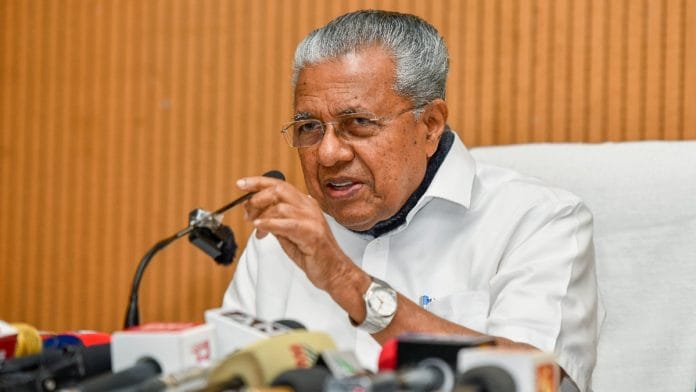



Thiruvananthapuram: The Kerala government is positioning a new Nativity Card Bill—which provides a card certifying a person’s Kerala origin—as its response to the Centre’s alleged exclusionary approach towards the minority Muslim community through laws such as the Citizenship Amendment Act.
According to the Kerala Nativity Card Bill, 2026, passed in the assembly on 24 February, the new card will replace nativity certificates obtained from tahsildars and serve as an official document for accessing Kerala government services as well as for social and administrative purposes.
The new card doesn’t confer citizenship and unlike a nativity certificate, it will be valid for a lifetime. People with foreign citizenship are not eligible for the card.
The move, which the ruling Left Democratic Front (LDF) is using to project itself as the protector of minority communities, is significant as it comes as the state heads for a crucial assembly battle.
It also follows the ruling CPI(M)’s defeat in recent local body polls, which saw minority voters consolidate in favour of the opposition United Democratic Front (UDF).
The bill also assumes significance as it comes amid the central government’s ongoing efforts to implement the CAA.
The CAA, passed in 2019, facilitates Indian citizenship to undocumented migrants from Pakistan, Bangladesh and Afghanistan who belong to Hindu, Sikh, Buddhist, Jain, Parsi, and Christian communities. However, it excludes Muslims from these countries. The Bill faced criticism for making religion the basis for citizenship and for excluding Muslims.
Critics say that when combined with the National Register of Citizens (NRC), which aims to register illegal Indian residents, the Bill can be used to marginalise Muslims.
Calling the nativity card Bill a rare moment in Kerala’s history, Revenue Minister K. Rajan said citizenship and nativity are different concepts. He added that the state’s move aims to provide proof of its citizens and instil a sense of pride among its state’s “natives”.
“To be accepted as a citizen of the country is the basic right of every individual. The equality, fraternity, and justice provided by the Constitution are based on citizenship,” Rajan said.
“But our country has witnessed lawmaking that denies citizenship in the country where we are born. The administration has misused the lawmaking of this country to implement a specific agenda targeting a section of communities, and the Citizenship Amendment Act is the greatest example of that. The minority communities in our state are concerned about its implementation,” Rajan said.
Chief Minister Pinarayi Vijayan echoed the same sentiment.
“In our country, there is a huge concern among one section of society. For the people of Kerala, there is no need for concern. They will have the nativity card, and nobody can deny that. Our state is always safe, and when many things are happening to question that safety, this assumes huge relevance,” Chief Minister Pinarayi Vijayan said in the Assembly.
Vijayan also criticised the opposition UDF for boycotting the Assembly without engaging in discussion.
However, the BJP has hit back. BJP state president Rajeev Chandrasekhar said the state has no constitutional power to issue the card.
“Under the Constitution, the only entity in this country that can declare citizenship is the Government of India, according to the Citizenship Act,” he told the media last week.
“So this is just to hoodwink illegal immigrants into believing they can come to Kerala, and the government under Pinarayi Vijayan will protect them. But the government of India will not permit this,” he added.
A lawyer at Kerala High Court said the document was just proof to show a person’s origin, but not citizenship. She also raised concerns about the risk of a data breach.
“This is not citizenship. It’s just proof that this person is from Kerala. It doesn’t go to the scope for citizenship, and they don’t intend to do it either,” said Advocate Anjaly TA.
“But the concern is whether it would lead to a data breach similar to the concern we had surrounding Aadhaar, as it is also the digitalisation of the data,” she added.
The Bill’s provisions
The Bill establishes the nativity card as an official document that certifies a person’s origins in the state and allows people to avail services provided by the Kerala government.
According to the Bill, anyone born in Kerala as well as those born outside Kerala whose parents or ancestors were residing outside the state for employment, livelihood, or other reasons, without acquiring foreign citizenship, shall also be considered “natives”.
The Tahsildar and the local Village Office are vested with the authority to issue these cards.
The Bill states that after the act is implemented, the Tahsildar shall maintain a register that includes details of Nativity Cards issued under the act, including the names, permanent addresses, names and addresses of their parents, and the Nativity Card number.
In case of any complaints, people can approach the district collector, who has the authority to review and cancel the card after giving the complainant a chance to explain.
Similarly, individuals found to have given false information may face up to three months of imprisonment and a fine of Rs 100.
It also states that the government will issue a notification specifying the usage of the nativity card and its purposes, including use by government departments and local self-government institutions.
(Edited by Sugita Katyal)
Also Read: Does The Kerala Story 2 show God’s Own Country as centre of terrorism? Pinarayi Vijayan says so