





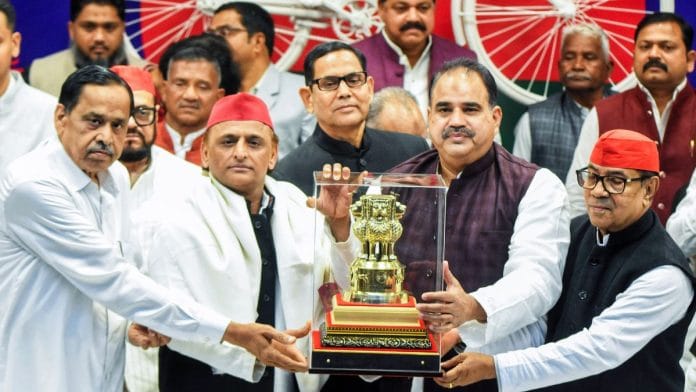



Lucknow: Former BSP ministers Naseemuddin Siddiqui and Anis Ahmad Khan have joined the SP, bringing the total number of former Mayawati cabinet ministers who have shifted to the party in the past six years to a dozen.
In the 2019 Lok Sabha election, when the Bahujan Samaj Party (BSP) and the Samajwadi Party (SP) allied, the BSP secured 10 seats while the SP could win only five. However, in the long run, the tie-up appears to have benefited the Samajwadi Party more.
The list of those who jumped from the BSP to SP includes Naseemuddin Siddiqui, Babu Singh Kushwaha, Lalji Verma, Indrajit Saroj, Veer Singh, Daddu Prasad, Ram Achal Rajbhar, Anis Ahmad Khan, Badshah Singh, Akbar Hussain, Ram Prasad Chaudhary and Swami Prasad Maurya.
Of these, Maurya and Saini have since left the SP, while the others continue to remain with the party. Besides these former ministers, more than a dozen ex- MLAs and MPs from the BSP have also joined the SP during this period.
These defections indicate that the Samajwadi Party has increasingly emerged as a new political home for several senior BSP leaders, particularly those who had been associated with BSP founder Kanshi Ram since the party’s early days.
At Sunday’s press conference, Akhilesh Yadav said that there is a close relationship between the Bahujan Samaj and the Samajwadi Party. He underlined this by referring to his PDA (Pichhda, Dalit, Alpsankhyak) plank, a call for unity among OBCs, Dalits and minorities.
Why only Samajwadi Party?
During the press conference, Siddiqui claimed that more than 15,000 BSP workers had resigned from the party and joined the Samajwadi Party along with him. Siddhqui was considered the most powerful leader in BSP after Mayawati and Satish Mishra.
While talking to ThePrint, Siddiqui said, ”The Samajwadi Party is the only party in Uttar Pradesh that is taking along the ‘sarv samaj’ (people from all communities). At a time when communal forces are getting stronger, there is a need for a strong alternative. When I was in the BSP, I played an important role in strengthening the organisation. I later resigned and joined the Congress but Congress did not utilise my organisational network.”
“Before joining the Samajwadi Party, I was assured that adequate space would be given to the workers who were coming with me. That is why more than 15,000 BSP workers have joined the Samajwadi Party along with me. In the BSP, I was in touch with workers from western Uttar Pradesh to eastern Uttar Pradesh and they all decided to join the Samajwadi Party with me,” he added.
Radhey Lal Rawat, a former BSP MLA who joined the Samajwadi Party along with Siddiqui, told ThePrint, “At present, only two political alternatives are left in Uttar Pradesh, the Samajwadi Party and the BJP. We find our ideology closer to the Samajwadi Party, which is why we have joined it. We want to remain active in the politics where get regular tasks to do.”
A senior Samajwadi Party functionary said, “If you look at the background of the BSP heavyweights who have joined the SP, you can understand their stature. Naseemuddin Siddiqui handled more than a dozen key departments, including PWD. Babu Singh Kushwaha was in charge of departments such as medical and Panchayati Raj. Similarly, Lalji Verma held important portfolios like finance and planning in the BSP government. This shows how influential they were.”
“More importantly, most of them have a personal support base of 15,000 to 20,000 voters in their respective constituencies. When that support is added to our core base of Yadavs, Muslims and other communities, it creates a winning formula. These former BSP leaders will also strengthen our outreach among non-Yadav OBCs and Dalits. We saw the impact of this strategy in the 2024 elections, and we are hopeful about repeating the success in 2027,” he added.
Most leaders who shifted from the BSP to the Samajwadi Party believe that Akhilesh Yadav’s PDA plank has been a key factor behind their decision to switch sides. Over the past few years, the SP has consciously focussed on Dalit outreach. Ahead of the 2022 Assembly polls, the party formed the ‘Baba Saheb Vahini’, a wing named after B. R. Ambedkar. It also began celebrating the birth anniversary of BSP founder Kanshi Ram.
R. K. Chaudhary, a BSP co-founder, who is now an MP from Mohanlalganj on a Samajwadi Party ticket, told ThePrint: “The joining of several BSP leaders, including many Dalits, is largely due to the SP’s PDA plank. Akhilesh Yadav’s call for Dalit-OBC unity is significant, as marginalised sections need to come together. Earlier, BSP politics was also centred around a similar formula—unity of Dalits and EBCs along with Muslims. Now the BSP has deviated from its original path. Those who were aligned with Kanshi Ram’s Bahujan mission are now considering the Samajwadi Party as their new home.”
From 30.43 per cent in 2007, the Bahujan Samaj Party’s vote share fell sharply to 12.88 per cent in the 2022 Assembly elections. The party, which once dominated Uttar Pradesh politics, now trails smaller regional outfits such as Apna Dal (Soneylal), Nishad Party and Suheldev Bharatiya Samaj Party.
At present, the BSP has just one MLA in the state Assembly and one member in the Rajya Sabha.
Choice of Bahujan mission founders
Similar to R. K. Chaudhary, many other co-founders of BSP who were associated with Kanshi Ram have joined SP in the last six years. Former BSP minister and co-founder of BSP Daddu Prasad who joined SP last year also said that SP is the only political alternative focussed on the unity of Dalits and OBCs.
Daddu Prasad said, “I have been part of the Bahujan movement since 1983-84. The movement aimed at ‘samajik badlav’ (social transformation). However, once the BSP moved away from this mission of social change and from slogans like ‘Jiski jitni sankhya bhari, utni uski hissedari’, it began to deviate from its original path. There was no space left for people like us. The movement was meant to unite Dalits, backward classes and the oppressed, not to bring together the oppressor and the oppressed. After 2012, I noticed that the BSP had started forgetting its basic objective.”
After leaving BSP in 2012, Daddu formed his own political outfit, and then joined the SP. Samajwadi party. He added, “We are from Bahujan mission, so we can not join BJP.”
Naseemuddin Siddiqui echoed the sentiment: “In the BSP, district and zonal coordinators hold the most powerful organisational positions. Many of those who have joined the Samajwadi Party along with me were coordinators. They come from Kanshi Ram’s Bahujan movement. If even they are no longer comfortable in the BSP, you can understand the internal situation of the party.”
“Now that elections in Uttar Pradesh are becoming increasingly bipolar, those who wish to remain politically active will look for viable alternatives. For people associated with the Bahujan movement, the Samajwadi Party has emerged as the first choice,” he added.
Many political observers believe that the BSP’s decline over the past decade has translated into electoral gains for the Samajwadi Party.
According to Lucknow University’s Professor Kaviraj, someone who closely tracks Dalit politics in Uttar Pradesh, “The BJP also tried to woo BSP leaders, and some of them even joined the party after it came to power in 2017. However, you will notice that those who come from the core BSP cadre or were closely associated with Kanshi Ram’s movement have largely chosen to join the Samajwadi Party, while a few have moved to the Azad Samaj Party.”
“Leaders such as R. K. Chaudhary, Daddu Prasad, Naseemuddin Siddiqui and Indrajeet Saroj were considered close to Kanshi Ram. They opted to align with the SP rather than the BJP. Perhaps they see the SP as ideologically closer after the launch of the PDA plank. Or it may be a political calculation that if the SP’s core vote bank combines with their own traditional support base, their electoral prospects would improve significantly,” he explained.
(Edited by Viny Mishra)
Also read: Half face Ambedkar, half face Akhilesh: BJP, BSP slam SP poster for ‘hurting Dalit sentiments’