








Bengaluru: First, it was Tamil Nadu. And then Kerala. Now, Karnataka has also joined the list of opposition-ruled states locked in conflict with their governors.
On Thursday, Karnataka Governor Thaawarchand Gehlot refused to read a cabinet-approved speech that criticised the central government’s decision to repeal the United Progressive Alliance-era flagship rural employment scheme, adding to the strain between the Congress government and the Lok Bhavan.
The Governor arrived at the Vidhana Soudha well before his scheduled 11 a.m. address to the special joint session convened to discuss the adverse impact of the Centre’s decision to repeal and replace the Mahatma Gandhi National Rural Employment Guarantee Act (MGNREGA) with the Viksit Bharat-Guarantee for Rozgar and Ajeevika Mission (Gramin) Bill, 2025, or the VB-G RAM G Bill.
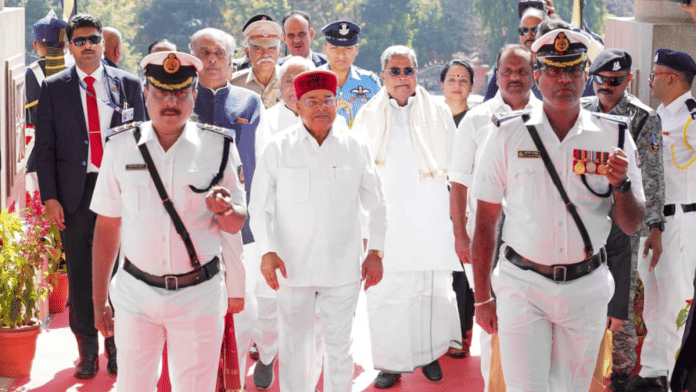
After being welcomed by Chief Minister Siddaramaiah, Assembly Speaker U.T. Khader, council chairman Basavaraj Horatti and others, Gehlot went up to the speaker’s podium and delivered a short speech.
“I welcome everyone to the joint session of the state legislature. It gives me immense pleasure to address another joint session of the state legislature. My government is fully committed to double economic, social and intellectual progress,” Gehlot said in his speech before concluding with ‘Jai Hind and Jai Karnataka’.
He then walked out amid sloganeering by Congress legislators protesting his actions. Bharatiya Janata Party (BJP) legislators countered by chanting ‘Bharat Mata Ki Jai’.
High drama followed as several Congress leaders tried to stop Gehlot and ask him to complete his speech. Senior Congress leader B.K. Hariprasad forced his way through the Governor’s security to persuade him to read the full speech.
“Today, instead of speaking the speech prepared by the cabinet, he (Gehlot) spoke the speech prepared by himself. That is against the provisions of the Indian Constitution,” Chief Minister Siddaramaiah told reporters Thursday.
He added that the Governor had “violated the Constitution”, “insulted the house of the people’s representatives”, and had acted like “the puppet of the Central government.”
“The Governor has chosen to justify this new law and act as though he lacks independence, aligning himself with the Union Government’s position,” Siddaramaiah posted on X.
My response to the Governor’s conduct in refusing to read the Cabinet-prepared address and instead delivering a speech drafted by himself, in violation of constitutional norms:
By not reading the address prepared by the Cabinet at the first joint session of the year, the Hon’ble… pic.twitter.com/kAkWkPFZe1
— Siddaramaiah (@siddaramaiah) January 22, 2026
Gehlot’s refusal mirrors recent developments in the opposition-ruled neighbouring states.
In Tamil Nadu, Governor R.N. Ravi walked out of the Assembly without reading his customary speech on Tuesday. Kerala Governor Rajendra Vishwanath Arlekar omitted parts of the speech approved by the Pinarayi Vijayan-led government earlier this week.
In Karnataka, the dispute began brewing on Wednesday afternoon when the Lok Bhavan informed the chief secretary of the Governor’s “reservations” about reading the cabinet-prepared speech.
Karnataka’s law and parliamentary minister, H.K. Patil, the chief minister’s legal advisor, A.S. Ponnana, Advocate General Shashikiran Shetty and others met with Siddaramaiah, followed by back-and-forth negotiations with the Lok Bhavan to find a “middle ground”.
The Karnataka Cabinet had approved a 28-page speech with 128 paragraphs. Patil said that Gehlot asked for the removal of 11 paragraphs from the speech (in Kannada) if he had to deliver it. The state government, including the CM, denied this request, according to at least two people directly involved in the late-night meetings.
Also Read: BMC in its grip, why BJP is now betting big on Bengaluru civic polls
‘Discarded like fallen leaves’
What are these contentious issues that Gehlot refused to read? One disputed paragraph said that Karnataka is facing an “oppressive situation” in economic and policy matters within the federal set-up.
“In areas such as tax devolution, centrally-sponsored schemes, central schemes, special schemes, etc., the state has been subjected to injustice. Karnataka occupies a driving position in the nation’s economy; if it is economically suppressed, the impact will be felt across the entire country,” according to a translation of the Kannada speech.
Another contentious section said that the central government’s decision to repeal the MNREGA “weakened” life in rural India and Karnataka and “if villages perish, India will perish”.
“Village regeneration is possible only when exploitation of villages completely ceases. All our attention must be focused on making villages self-reliant. Gandhi also believed that villages should not become cesspools, and that people should not be forced to migrate to cities in search of food and employment,” according to the official English speech copy that was approved by the Karnataka Cabinet.
The government said that the employment guarantees assured by the MNREGA had been “taken away” with the new VB-G RAM G Act.
“The demand-based employment principle has been destroyed and replaced with a supply-driven scheme. The VB Gram-G scheme has been designed to protect corporate capitalist interests, thereby sacrificing rural people’s welfare,” according to the speech copy.
It added that the government condemned the “regressive, anti-progressive step” and that the MNREGA’s objectives of asset creation and providing employment to labourers in their own regions “have been discarded like fallen leaves”.
“Under the MGNREGA, works were decided and implemented through Gram Sabhas. Under the new law, the powers of Gram Sabhas have been completely curtailed through centralised norms. These actions are not merely anti-democratic but are also anti-progressive measures that ignore the demands of the majority of citizens and push national interest towards destruction,” the speech added.
The Siddaramaiah government said that it opposed this new law, which “re-establishes a system that forces people to migrate or move to large cities” for employment and curtails the rights of “Dalits, Adivasis, women, backward classes, and farming communities that were protected under MGNREGA”.
The government, in its speech to the governor, said that the non-consultative manner in which the law was brought also amounts to an “unconstitutional act”.
The speech further states that the rights of workers have been placed under the “control of contractors” and that the security of poor wage labourers is “being eroded”.
(Edited by Sugita Katyal)
Also Read: Whose survey is it anyway? Congress, BJP lock horns over report on Karnataka voters’ trust in EVMs
Why should anyone read a speech written by someone else?