





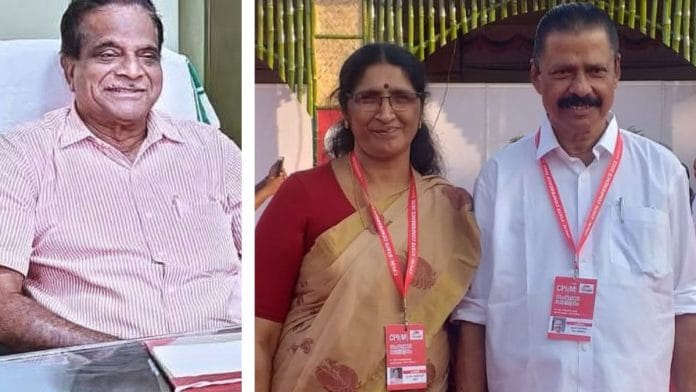



Thiruvananthapuram: In the run-up to the Assembly polls, the CPI(M) in Kerala finds itself embroiled in a rare controversy over dynasty politics, an allegation usually pointed at Congress, several regional parties and, of late, even the Bharatiya Janata Party (BJP).
It kicked off when the party named P.K. Shyamala, the wife of CPI(M) state secretary M.V. Govindan, as its candidate for Kannur district’s Thalipparambu constituency. Soon after the announcement, senior leader from the constituency T.K. Govindan alleged “tendencies against CPI(M) moralities and organisational tradition” in the party, leading to P.K. Shyamala’s selection even after criticism was raised against her candidature in the district committee. Govindan was soon expelled by the district unit of the party which justified its decision by pointing to Shyamala’s long association with the Left party.
P.K. Shyamala was the former chairperson of Anthoor municipality, a local body in the Thalipparambu constituency, and has been associated with the party’s affiliated organisations such as its women’s wing and its student and youth organisations. The CPI(M) leader had faced a backlash in 2019 over the suicide of an NRI entrepreneur who had struggled for months to get a building permit which many said was deliberately denied.
This is not the first time the party faces such allegations. PWD and Tourism Minister P.A. Muhammad Riyas has been repeatedly called ‘son-in-law’ by his political opponents. Like Shyamala, Riyas also joined the party as a teenager through the Students’ Federation India (SFI), its student organisation, rising through the ranks to become national president of the Democratic Youth Federation of India (DYFI). Riyas became a minister after he married Chief Minister Pinarayi Vijayan’s daughter Veena Vijayan in 2020.
Political analyst K.P. Sethunath said the Left doesn’t have as much political nepotism as other parties and has always been vigilant. Historically, Left leaders have mostly married women working with them in the party, but nobody accused them of nepotism, he said. The party is not immune to nepotism, he added, for they utilise political power to secure education and jobs in institutions, something all parties do. About Shyamala, Sethunath says the party should have been “careful”.
“This unnecessarily dragged her into a controversy. She has been active in politics for a long time. Even T.K. Govindan’s wife and daughter are in different roles in the district. So, per se, it’s not nepotism. But CPI(M) should have been clever in handling this. The controversy led to old controversies about her being revived. In fact, her political identity has been reduced to ‘wife of party secretary.’ Same thing with Riyas also,” he said.
A.A. Rahim, member of the CPI(M) state secretariat and Rajya Sabha member, said the controversy in Kannur arose because Govindan himself wanted to contest there, which didn’t succeed. He said reducing Shyamala’s identity, a woman leader who has worked with the party for a long time in different roles, to that of her husband goes against political morality.
“Both (M.V.) Govindan and Shyamala have their own identities and political history. Reducing a woman’s identity to that of her husband is against morality,” Rahim said, adding that the party has faced and overcome crises and criticism in the past.
Kannur story
According to T.K. Govindan, who has been with the CPI(M) for six decades, when the discussion came up about Thalipparambu, the Kannur district secretary said the candidate should be Shyamala but there was strong opposition to this in the district secretariat.
“There was an opinion that the candidate should be a woman. The opinion was raised: if it is a woman, why not Sukanya? I also raised my opinion strongly. Leaders were all there, and we agreed that we would inform the higher committee. But you should understand how much of a consecrated effort was done to just have one candidate. Because only one name was sent to the state committee, not the discussion,” Govindan said.
Sethunath said Shyamala is eminently qualified to be an MLA but the party should have avoided the controversy. He added that earlier CPI(M) candidate lists were decided entirely by district committees before being sent to the state level. Mostly, the state decided on women or independent candidates. If the same system stayed, criticism should have occurred in the district committees themselves, and they would have dealt with it there, he said.an,
“One of the two controversies in this election is nepotism. But they could have dealt with it. It will not affect their electoral prospects as the party machinery in Kannur is really organised. But it would help the Opposition campaign,” he said.
‘Nepotism’ in the Left
The issue has dragged the Left into an unusual controversy over political nepotism, traditionally been pointed towards the Congress and recently to the BJP. But Shyamala and Govindan are not the only couple in the Communist Party’s history.
The party has many couples where both are active in politics. For example, in Kerala, K.R. Gowri Amma and T.V. Thomas were one of the earliest power couples within the Left in the State, both ministers in the first Kerala cabinet in 1957. The duo, towering figures of the Left, met through the party, but in 1964, when the Communist Party split, Gowri Amma remained in CPI(M) while Thomas joined CPI. This ideological difference also led to their separation in 1967. Similarly, A.K. Gopalan and Susheela Gopalan are also seen as a powerful couple who rose through the ranks separately and claimed their place in politics. This extends to Prakash Karat and Brinda Karat, both CPI(M) Politburo members. Though these couples were seen as powerful, none of them really faced controversies of political nepotism.
In October 2016, then Industries Minister E.P. Jayarajan resigned from his post after allegations of nepotism in key public sector undertakings. Higher Education and Welfare of Minorities Minister K.T. Jaleel resigned in April 2021 after a Kerala Lok Ayukta found him guilty of favouritism and nepotism in a key appointment to the Kerala State Minorities Development Finance Corporation (KSMDFC).
Similarly, the appointment of V.A. Arun Kumar, son of former Chief Minister V. S. Achuthanandan, as Director-in-Charge of the Institute of Human Resources Development (IHRD) also raised eyebrows. A plea was filed in the Kerala High Court challenging the same after which the court sought the state’s stand on the issue in February this year.
(Edited by Nardeep Singh Dahiya)