





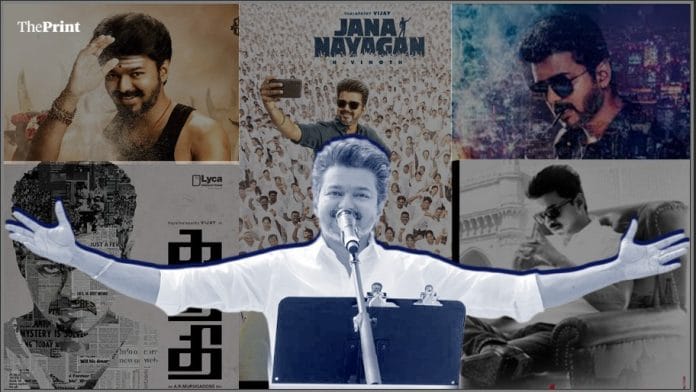



Chennai: In the backdrop of actor-turned-politician Vijay’s Jana Nayagan running into release delays over censor board issues and the Madras High Court having to step in, the star’s filmography suggesting that this episode is not a one-off, assumes significance.
There is a long line of Vijay’s films that have faced political resistance and informal pressures, even after censor board clearances were secured. Though 2013’s Thalaivaa was Vijay’s only movie whose release date was formally pushed, with the others released on schedule, several of them have faced protests either before or after hitting theatres.
As of Friday, the release of Thalapathy Vijay’s final film, Jana Nayagan, has been indefinitely postponed due to an ongoing legal battle over its certification. Commenting on the hurdles faced by Vijay’s Jana Nayagan, Tamil Nadu Chief Minister M.K. Stalin has accused the Central Board of Film Certification (CBFC) of acting as a “weapon” of the Union BJP-led government.
Against this backdrop, ThePrint looks at the controversies surrounding Vijay’s filmography and how several of them have faced roadblocks, coming from across the political spectrum.
Also Read: ‘Jana Nayagan is a soft political power’. Tamil industry questions stay on Vijay’s farewell film
A ritual
The original release date of the 2013 movie Thalaivaa, one of his most prominent films, was 9 August. The film, with its rousing tagline of “time to lead”, had received CBFC clearance, unlike Jana Nayagan. However, it was not screened on schedule, with theatre owners at the time citing “law and order issues”.
Following legal intervention and negotiations with theatre owners, as well as the then All India Anna Dravida Munnetra Kazhagam (AIADMK) government, the movie was finally released on 16 August 2013.
A year later, Vijay’s Kaththi (knife) was slated for a Diwali release on 22 October 2014. It too faced protests, but these arose not from the film’s content but from the producers’ “business associations” with former Sri Lankan president Mahinda Rajapaksa and his role at the end of the country’s civil war.
Vijay’s Mersal, which released on 18 October 2017, came under heavy fire for dialogues critical of the Union government’s goods and services tax, demonetisation, and India’s poor public healthcare system, triggering sharp reactions from Tamil Nadu BJP leaders.
The BJP even requested that a few scenes be removed from the movie. The film’s crew, however, did not cut scenes or mute dialogues post the movie release.
More recently, in 2018, Vijay’s Sarkar hit the screens on 7 November. Stiff resistance followed from both the AIADMK and the DMK, with objections voiced on scenes and dialogues that referred to the state government’s “failures” and “freebie politics”. One scene in the movie even showed people throwing away mixer grinders, TV sets, and other freebies provided by the state.
It was the AIADMK government that provided the mixer-grinders, and the DMK government that provided the TVs. Protests erupted across the state as party workers and supporters took to the streets, forcing the film’s crew to mute certain dialogues, despite the movie already having a censor board certificate.
Amid the row over Jana Nayagan, the state government—in a first—stepped in to provide police protection to Vijay while voicing its support for the timely release of his movie. The M.K. Stalin-led DMK government, as well as the Congress, have been vocal in their support for artistic freedom this time around. But one can say that the recurring pattern in Vijay’s filmography is that CBFC certifications have rarely been the final hurdle.
(Edited by Madhurita Goswami)
Also Read: Friday blockbuster: Nail-biter that played out in Madras HC over Vijay’s movie ‘Jana Nayagan’