





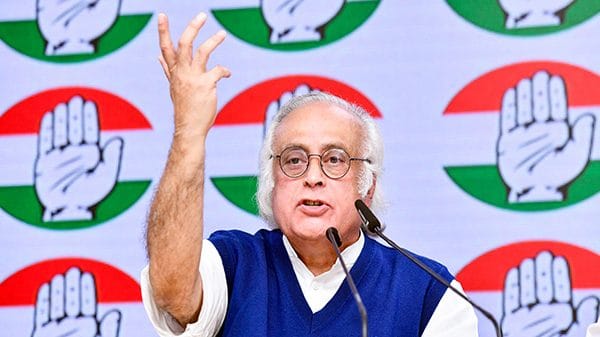


New Delhi: The Congress on Sunday made a strong pitch for making right to vote a fundamental right, saying it would be a powerful step in putting in place safeguards against voter suppression or arbitrary disqualifications that have taken place in different states in “astronomical numbers” under the SIR process.
Congress leader Jairam Ramesh said that with the “blatantly partisan functioning” of the Election Commission of India “working at the behest” of Prime Minister Narendra Modi and Union Home Minister Amit Shah having been brutally exposed, it is now time to elevate the right to vote as a fundamental right that would offer it the highest level of judicial review and protection.
Ramesh pointed out that on Friday last a two-judge bench of the Supreme Court declared the right to walk on a footpath as a fundamental right under the Constitution.
The Constituent Assembly had set up an Advisory Committee on Fundamental Rights, Minorities and Tribal and Excluded Areas under the Chairmanship of Sardar Patel. In its meeting held on April 21-22 1947, there was an animated discussion on making the right to vote a fundamental right with Dr. Ambedkar and Babu Jagjivan Ram argued strongly in its favour, he recalled.
Sardar Patel, C Rajagopalachari, and some others took the position that if the right to vote was made a fundamental right the princely states may be reluctant to join the Indian Union and that it is enough to provide for universal adult franchise in the Constitution, Ramesh said.
“Sardar Patel himself took the position that universal adult franchise was, in itself, an implicit fundamental right. This is the background to Article 326 which provides for elections based on universal adult suffrage,” he said.
Over the past seven decades there has been a continuing debate on whether the right to vote is a statutory right provided by the Representation of People Act, 1951 or is an explicit fundamental right, he said.
“Different views have been expressed. Most recently, Justice Ajay Rastogi in a dissenting opinion in the Anoop Baranwal vs Union of India judgement of March 2023 held that the right to vote is a fundamental right,” Ramesh pointed out.
The Supreme Court has itself recognised that voters have a Constitutional and fundamental right to know the criminal antecedents of candidates, their financial interests, and sources of political funding, he said.
“It has protected ballot secrecy and recognized the right to reject all candidates through NOTA. It is, therefore, all the more anomalous that the right to vote remains only a statutory right. All surrounding rights have been declared fundamental but the core without which the former cannot exist still remains statutory,” Ramesh argued.
“With the blatantly partisan functioning of the Election Commission of India working at the behest of the Prime Minister and the Union Home Minister having been brutally exposed, it is now time to elevate the right to vote as a fundamental right that would offer it the highest level of judicial review and protection,” he said.
“It would be a powerful step in putting in place safeguards against voter suppressions or arbitrary disqualifications that have taken place in different states in astronomical numbers under the SIR (special intensive revision) process. It would also mean greater Supreme Court vigilance over the functioning of the Election Commission,” Ramesh said.
On Friday, as the Supreme Court ruled that the right to walk on a demarcated footpath is a fundamental right, Ramesh had said how about declaring the Right to Vote also a fundamental right as it is of paramount importance in order to save Indian democracy from its present “death spiral”.
In a significant verdict, the top court held that this right shall have priority over motorised vehicles on demarcated paths and it forms part of the right to movement guaranteed under Article 19 (1) (d) and other fundamental rights including Article 21 (right to life and liberty).
A bench of justices P S Narasimha and A S Chandurkar held that a citizen’s fundamental right to walk on a demarcated footpath is primary and shall have priority over movement by motorised vehicles.
This report is auto-generated from PTI news service. ThePrint holds no responsibility for its content.
Also Read: Sign of a DMK-Congress thaw? Stalin’s birthday wish for Rahul stirs up speculation