





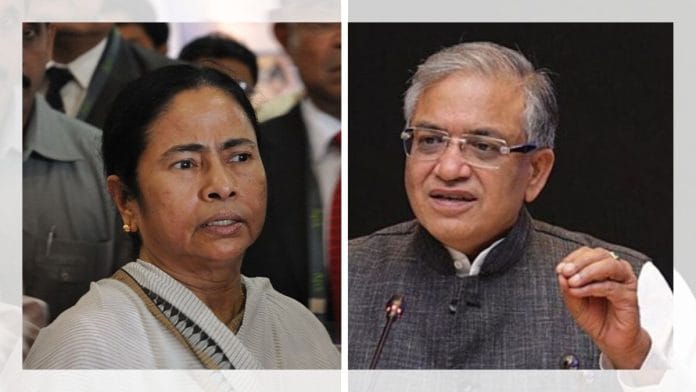



New Delhi: Prompted by the Election Commission of India’s charges of threats, violence, and forcible disruption of the Special Intensive Revision hearings in Bengal, the Supreme Court directed the director-general of state police Monday to file a personal affidavit in court.
The ECI has alleged instances of mobs barging into offices where hearings are underway, burning forms submitted by electors, and destroying official papers for recording details of the process.
Reacting to these submissions, a bench of Chief Justice of India Surya Kant and Justice Joymalya Bagchi asserted it would “not allow any impediment” in the conduct of SIR, while directing the deadline for claims scrutiny and objections to be extended by at least a week.
Issuing directions to address all apprehensions, it also ordered the Chief Minister Mamata Banerjee-led government to ensure that the over 8,500 Group-B officers report to duty at the district electoral offices by 5 pm Tuesday. The EC will have the discretion to replace existing electoral registration officers (EROs) and assistant electoral registration officers (AEROs) with Group-B officers, subject to their suitability.
Though the EC may shortlist officers from among them as micro-observers, the duty of these micro-observers, the court added, should be only to assist the district election officers (DEOs) or EROs. The final decision-making authority in the SIR process will remain with the EROs, it said.
This came after the West Bengal government questioned the role of micro-observers in the SIR process, alleging that they had been appointed from other states and central public sector undertakings (PSUs) to unconstitutionally delete voter names without authority.
During the hearing, the court also questioned the ECover sending notices to voters for name mismatches. Justice Bagchi said, “The tools that you have applied to the software are very restrictive tools. Kumar is a middle name in Bengali households. You have, Tapan Kumar Roy is there, and now you have sent notices when name is Tapan Roy.”
EC affidavit
In an affidavit filed Sunday, the EC reiterated its allegations of obstructions during the ongoing SIR exercise. It alleged that Chief Minister Mamata Banerjee, Trinamool Congress (TMC) Members of Parliament, and other political functionaries had made public statements and delivered speeches aimed at intimidating election officials engaged in the SIR process.
In its affidavit, the EC wrote that the ruling party in West Bengal was “actively involved in causing obstruction and issuing threats to officials” and that though the SIR was underway in 12 states, such a controversy was confined only to West Bengal.
“The material placed on record discloses that, through proper planning and concerted action, deliberate and systematic attempts are being made to derail, paralyse and frustrate the SIR exercise being undertaken by the Election Commission of India in the State of West Bengal,” it asserted.
The EC also told the court that this disruption wasn’t limited to fringe elements and that the actions demonstrated complicity of all key actors of the state, including the government, certain elected representatives of the ruling party, and TMC functionaries.
“Every trick in the armoury is being employed to ensure that the SIR process is either stopped or frustrated by fair or foul means,” the affidavit said.
It specifically referred to an interview by TMC MP Mahua Moitra, alleging that she advised all micro-observers to hire their lawyers, as the state was going to file cases against each individually.
Didn’t comply with orders
In its affidavit, the EC listed down its orders that the state government had so far failed to comply with. For instance, it claimed the state government is yet to register FIRs against two EROs, two AEROs, and one data entry operator for “grave lapses and wrongful addition of names”, despite specific directions by the EC.
The EC also demanded the suspension of an AERO, alleging she, without authorisation, had deployed 11 additional AEROs to conduct hearings by issuing suo motu orders in contravention of statutory provisions.
Further, the EC said it had directed the state government to pay an annual honourarium of Rs 30,000 to EROs and Rs 25,000 to AEROs, considering the role they played in the preparation and revision of electoral rolls. But the EC alleged the West Bengal government had failed to pay them.
The affidavit also compiled incidents “spanning vandalisation of BDO offices, arson, road blockades, physical assaults, threats, and inflammatory speeches”. These, according to the commission, established “beyond doubt that these are not stray incidents but part of a systematic and coordinated effort to derail SIR in West Bengal”.
Highest BLO deaths
The EC affidavit was filed in response to a petition by an organisation that operates as a civil society outfit by the name of Sanatani Sangsad, which has come into the limelight for seeking deployment of the Central Armed Police Forces (CAPF) in West Bengal during the SIR process.
In an application filed Monday, the organisation alleged that despite assurances given by the West Bengal government, “the violence, death, destruction of property and intimidation of election officials has continued on the ground with the aim of bypassing the eligibility criteria for being enrolled as a voter”.
The application further submitted that the state had the highest number of BLO suicides among all states in which the SIR process is ongoing.
“The cause of such a high number of BLO suicides in West Bengal is the pressure imposed by the Government of West Bengal on these officials to induct, in the electoral roll, all persons, bypassing and, in most cases, to act and induct contrary to the eligibility criteria for being enrolled as a voter. The BLOs have committed suicide due to direct threats issued by TMC leaders,” the petition alleged.
Among other things, the application demanded a direction for the extension of the period for filing claims and objections in the state, and a direction to the state DGP to ensure that FIRs were registered in every case of complaint related to SIR-related violence.
It also demanded a direction to the DGP to set up a Special Task Force (STF), in consultation with the Election Commission of India, to ensure the appointment of officers from central agencies or other states to this force, so it can take such cases to a conclusion within a time-bound manner.
(Edited by Madhurita Goswami)