





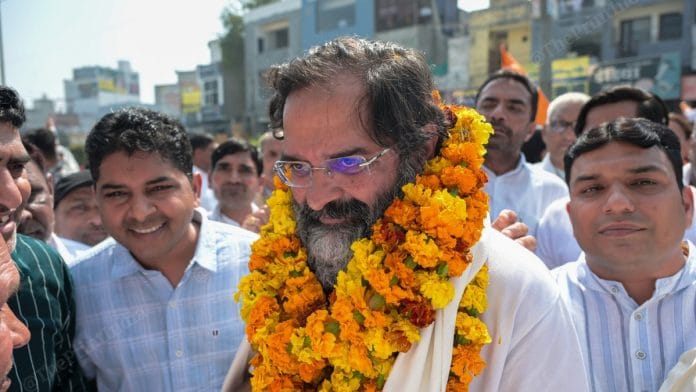



Kaithal (Haryana): Let’s begin with the beard. It was there on 5 October, when Brijendra Singh set off from Danoda village in Jind’s Narwana constituency—neatly trimmed, the kind of beard a man keeps when he has a mirror and routine.
For over two decades as an IAS officer and then five years as MP from Hisar, Singh had been clean-shaven. The beard came sometime after the assembly election loss in October 2024, when the counting was done and 32 votes separated him from victory.
What started as a trimmed beard on Day One of the Yatra has, over 153 days and nearly 2,000 km, become something considerably more.
Long, full, philosopher-grade. People on the route notice it before they notice anything else. Some say it makes him look like a sadhu. Others, less charitably, say it makes him look like he lost a bet. To most, his beard looks like Rahul Gandhi’s when he was on his Bharat Jodo Yatra across the country. Singh himself seems unbothered by any of these descriptions.
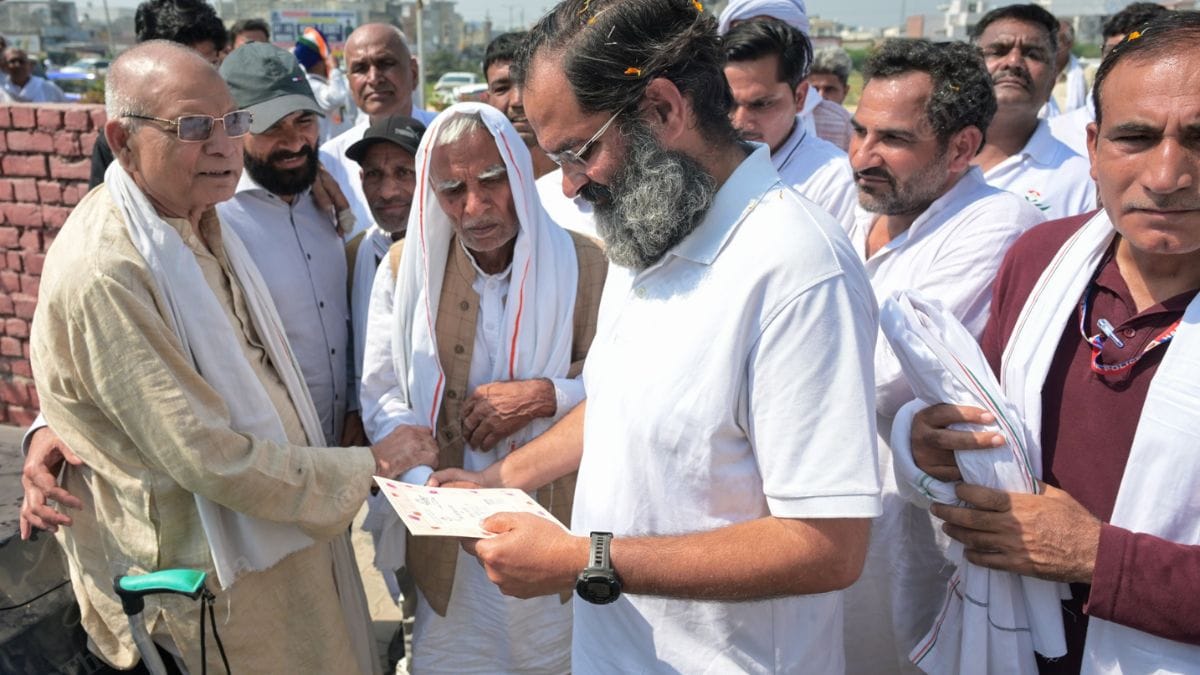
It was barely 11 am when ThePrint caught up with him at Jagat Singh Punia’s house near the Karnal bypass—a cup of tea with hot vegetable fritters, a drawing room full of local Congress workers, a schedule sheet listing 17 stops between here and a night halt at the Jaat Dharamshala.
This is what the Sadbhav Yatra looks like from the inside, five months in: Not a procession so much as a perpetual motion machine, modest in its mechanics, stubborn in its purpose.
From Punia’s house, Brijendra Singh and a few hundred walked to Sir Chhotu Ram Chowk, where Singh bowed at the statue of the agrarian reformer. A few others followed in cars.
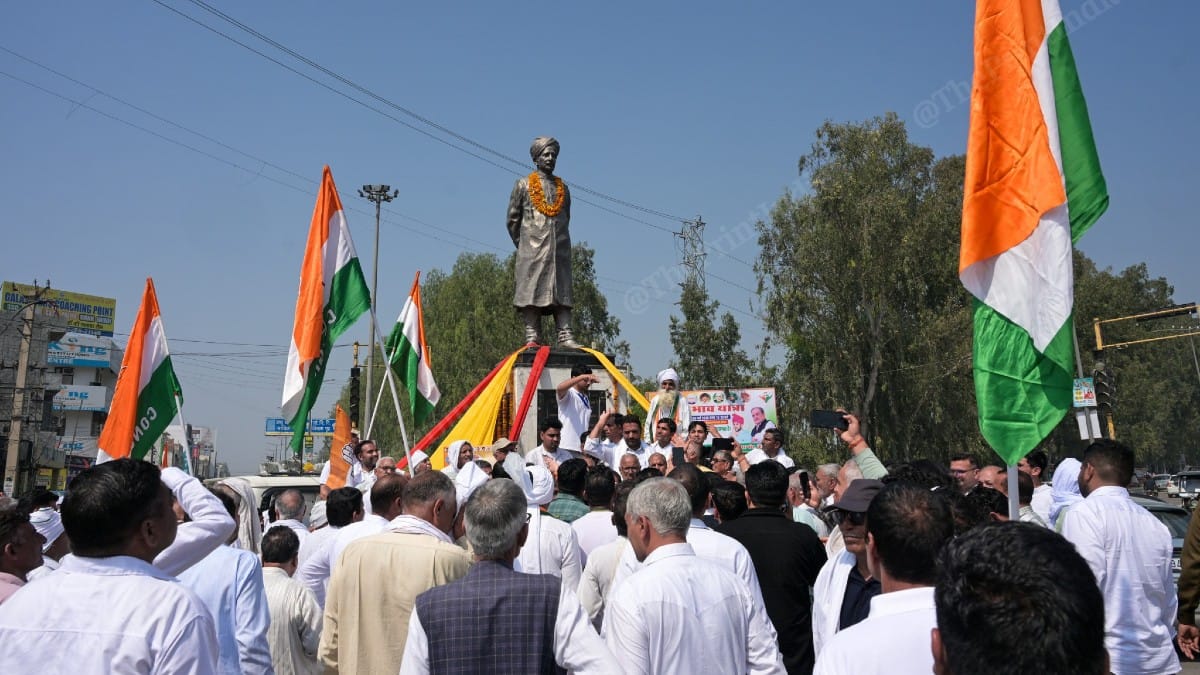
The gesture had layers. Deenbandhu Sir Chhotu Ram, who spent his life in early 20th-century undivided Punjab fighting for farmers and the rural poor, is also Brijendra Singh’s great-grandfather—his grandfather Neki Ram Sheokand, a minister under Bansi Lal’s Haryana government, had married Sir Chhotu Ram’s daughter.
“The respect one gets because of this legacy is in a way a boon as well as a burden,” Singh said later, with the slight smile of a man who has given this answer many times and still means it.
Also read: Why Rahul Gandhi chose ex-govt servant over veterans as Congress’s Rajya Sabha nominee from Haryana
The yatra nobody expected
To understand why Brijendra Singh is doing this, you have to go back to the evening of 8 October, 2024, when the Haryana election results trickled in and quietly demolished most of what the Congress had assumed about itself. The party had been doing well, the mood on the ground seemed positive, and there was a consensus that the BJP’s uninterrupted years in power in Haryana were finished. They were not. The BJP won for the third time.
The Congress lost Uchana Kalan, among many other seats, with Brijendra Singh himself going down by 32 votes. Thirty-two. He has gone to court seeking a recount.
What followed, Singh said, was a peculiar silence. “There was a general impression that the Opposition had disappeared. Workers were disheartened. People were disheartened. Despondency had set in among Congress workers and people who were waiting for its government to come after the assembly results were announced.”
The party’s senior leadership in the state seemed to retreat into quiet. It was in this vacuum that Singh began thinking about the yatra.
He earlier told ThePrint that he discussed the idea with Rahul Gandhi. Gandhi approved it. The Sadbhav Yatra began on 5 October 2025, from Danoda village in Narwana. Notably, when it started, neither Hooda nor state Congress president Rao Narendra Singh was present at the flag-off. Several other senior Congress leaders, however, including Kumari Selja, Randeep Singh Surjewala and Captain Ajay Singh Yadav, have joined his yatra.
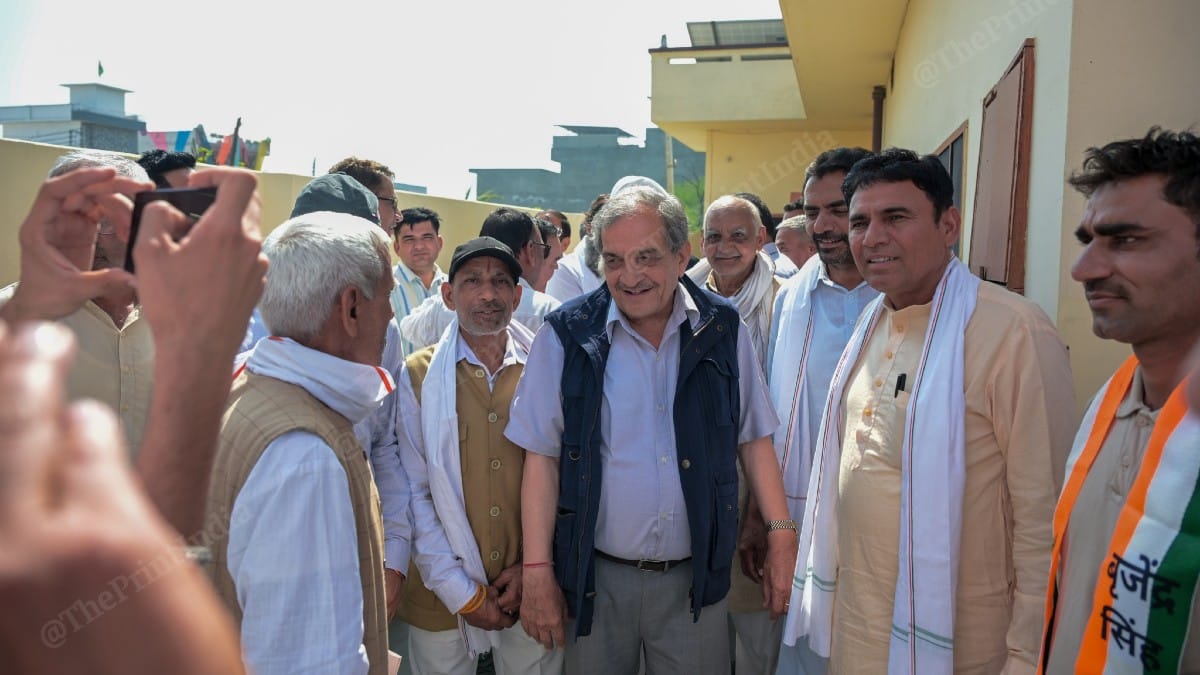
Some Congress leaders called it a “personal yatra”. Asked about this, Singh was diplomatic. He remains so now. “The problem is with leaders, not workers,” he had said at the time. On Friday in Kaithal, he didn’t raise the subject but when asked, moved on quickly. The yatra, whatever its origins in intra-party arithmetic, has by now developed a life of its own.
5 months, 57 constituencies
The route of the Sadbhav Yatra is, in its own way, is a map of Haryana’s anxieties.
The first phase, through October, covered 14 constituencies in the Jind-Hisar-Bhiwani belt—Singh’s own political territory, where the family name still means something and the crowds were reassuring. The second phase pushed south, into Nangal Chaudhary and the districts of Mahendragarh and Rewari—what Singh called the “real test” of the yatra, constituencies where the Congress footprint is lighter and where a warm reception could not be taken for granted. It was warm. “That was very encouraging,” Brijendra Singh said, “for the yatris and for me personally.”
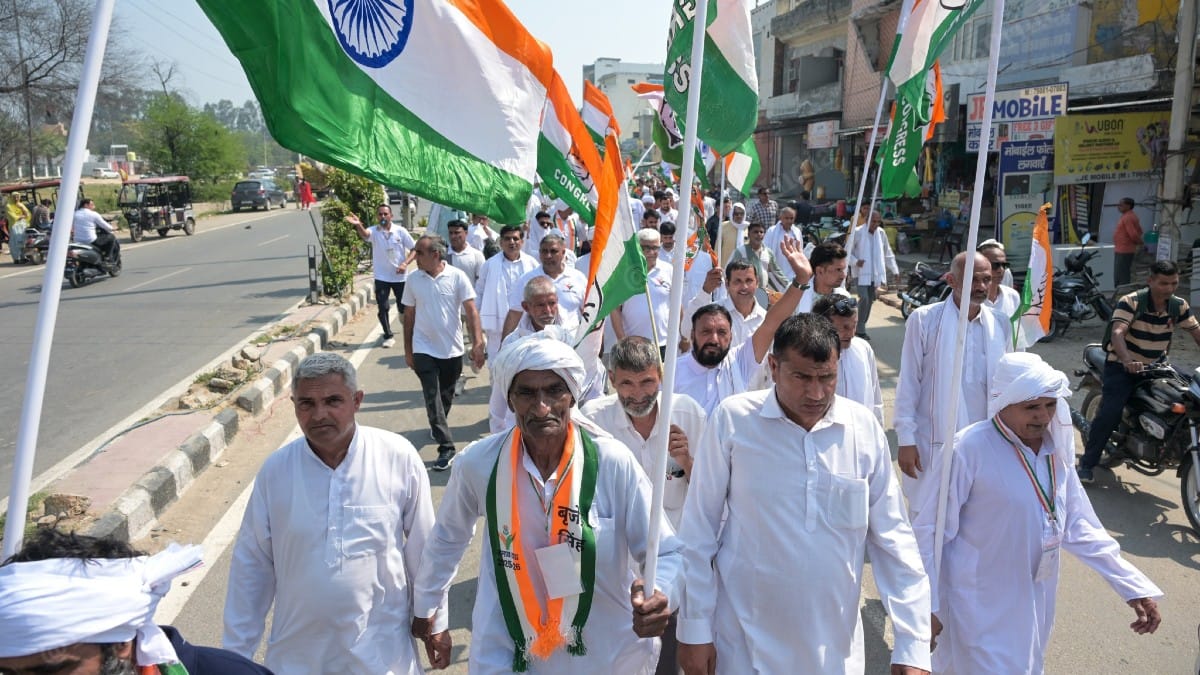
From there the Yatra moved through the Ambala and Yamuna Nagar districts, then Kurukshetra—the chief minister’s own territory—and now Kaithal. Thirty-three constituencies remain. The beard will grow.
Across these 57 constituencies, some patterns have emerged so consistently that Singh can now recite them in sequence, like a man who has memorised a document by walking through it. Agrarian distress. Youth unemployment. Roads that collapse the moment you exit a national highway. And, quieter, but running beneath everything else, a fraying of the social fabric that the people themselves describe in fragments, in whispers, or sometimes in the open, in market lanes.
‘Congress ko bacha lo’
Singh is careful about language when he talks about social divisions. He does not reach for the word “communal” immediately. He says “strains”. He says “fissures”. He mentions the 2013 Muzaffarnagar riots not as a political talking point but as a cautionary tale.
“In 13 years, those wounds have not healed,” he says. “They tried something similar in Mewat in Haryana. Fortunately, the Khaps, known as Pals in Southern Haryana, and Kisan unions went there and told people: Don’t fall into this trap.”
The government, he says, “has still been trying”. He mentions the language of one or two BJP MLAs as evidence of intent, without naming them. “Social division is the only agenda BJP has, because from a governance point of view, they have nothing to offer the people of Haryana.”
This is the core pitch of the Sadbhav Yatra. That the BJP has been politically successful in Haryana, three consecutive governments—precisely because it has been socially disruptive. That the Congress needs not just better candidates or better organisation, but a counter-narrative that can be walked into towns and villages and districts and made visceral.
What surprised Singh in the walking, he said, was not the anger—he expected the anger—but the yearning. In Yamuna Nagar, in Ambala, strangers would come up and whisper: Congress ko bacha lo. “They were not Congress workers or political activists,” he said.
“They were shopkeepers. People who had the good of the state and the nation at heart. What they said was coming from their hearts.” He paused. “Watching the national media, one gets a picture that people are only talking in Hindu-Muslim terms. But people on the ground really yearn for good things. Law and order. Less crime. A sense of mutual admiration among people of different faiths, communities, and castes. This I did not anticipate when I started my Yatra.”
Also Read: Haryana RS bypoll headed for a twist. BJP vice president jumps into fray as Independent
Jobs & migration
On unemployment, the issue that comes up in every constituency, rural or urban, Jat heartland or Ahir belt, Singh does not traffic in round numbers. He gets specific. An examination for assistant professor posts in computer science: 1,711 vacancies, nine years to conduct the process, 39 people found eligible. Another for assistant professors in English: 513 posts, 151 selected, more than a hundred of them from outside Haryana.
“The HPSC chairman goes on record to say that candidates failed because the academic standard of state universities is declining,” Singh said, his voice carrying the quiet outrage of a man who has held administrative responsibility and knows what bureaucratic abdication looks like from the inside. “You are in power for 12 years. You have been appointing RSS people as vice-chancellors. You are responsible for the decline, if any. But you are blaming the students.”
The other face of the unemployment crisis, the one he finds most viscerally distressing, is what he calls the “Dunki trail”. Young men from Haryana paying travel agents Rs 40 lakh to Rs 50 lakh to be taken, through illegal routes, to other countries in search of work. “I have come across hundreds of villages where I could not find young people, because all have moved to other countries,” Singh said.
What is new, he adds, is the geography. “Now even in the so-called interiors of the state, where going abroad was never an option, people are going abroad. The Punjab border areas have always seen migration. Now it is everywhere.”
What has changed, what hasn’t
The governance failures of the BJP government Singh lists in a particular order. Roads first, because they are the most immediately legible. “Just about ten days back we were in Ladwa, the chief minister’s own constituency. Six days after that we were in Gulha Cheeka. Both places were absolutely similar. There were virtually no roads.”
He said it with a practised mildness, the rhetorical equivalent of a shrug. “The moment you leave the expressways and big highways, you understand what that vikas (development) looks like.”
“It is here that I totally agree with BJP government’s claim that the party doesn’t discriminate on the basis of regions or constituencies. Haryana Ek, Haryanvi Ek, as they say. If the roads of other parts of the state are in bad shape so are the roads of Chief Minister Nayab Saini’s own constituency, Ladwa. No discrimination at all,” he said, and lets the sentence sit there a moment before moving on.
Then law and order, particularly the surge in extortion and crime in Kurukshetra district, where new industry has brought money and money has brought predators. “Kurukshetra was such a peaceful district of Haryana,” Singh says. “Apparently, in the last year or so, the most violent acts have happened there, extortions, ransom.”
Then the agrarian sector, where farmers in Hisar, Rewari, and multiple other districts are sitting in protest, some for a year and a half, and “the government is not even concerned or bothered enough to call them out, even their own MLAs”. This, he said, is what before the 2024 elections looked like on the ground, and it has not changed.
At the Bar: Brecht, and where it all leads
At the district courts, Singh was to address the Kaithal Bar Association. Ranveer Prashar, a representative of the Bar, had introduced the session by noting that they invite leaders from all parties but do not do politics at such meetings. Singh listened, and then opened with Bertolt Brecht—the German playwright, poet, and Marxist provocateur who died in 1956 and whose words have apparently found a constituency on the roads of Haryana in 2026.
He read from the poem on the political illiterate: the man who hears nothing, sees nothing, takes no part in political life, and does not know that the cost of flour, medicine and rent all depend on political decisions. And Brecht’s warning about what that illiteracy breeds: the abandoned child, the robber and, worst of all, the corrupt politician.
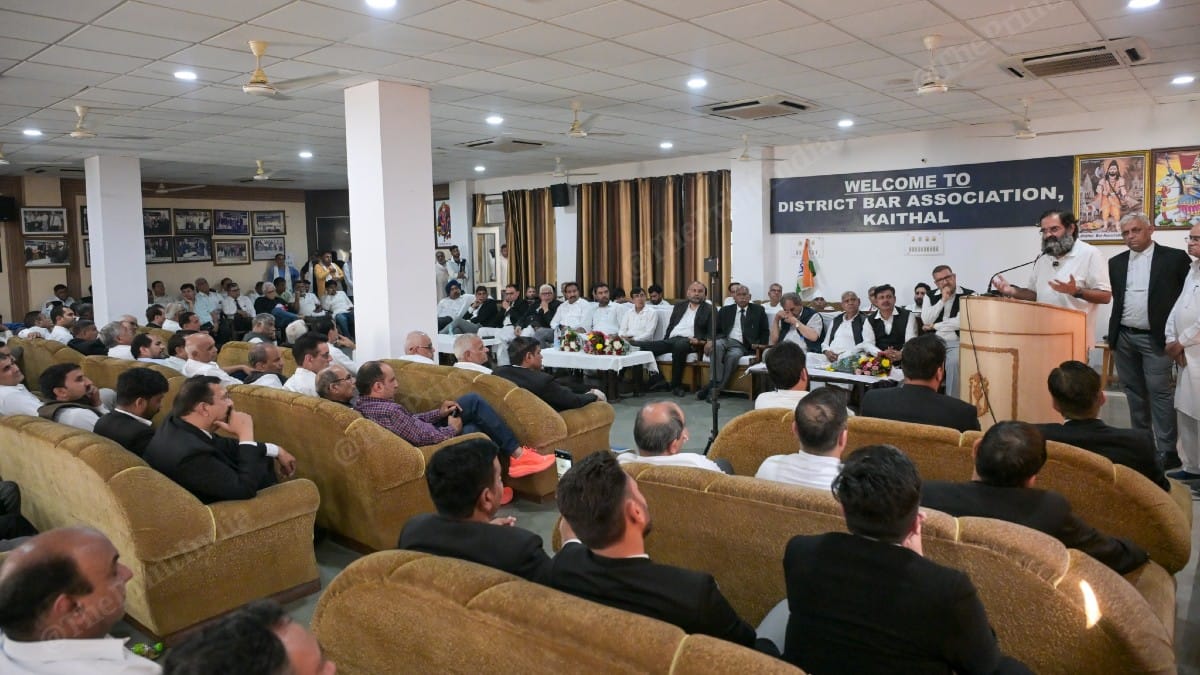
“Politics is everywhere in life,” Singh tells the lawyers. “One cannot avoid it.”
From Haryana. he ranges to the national, and from the national to the international — India’s foreign policy posture, the war in the Middle East, the Epstein files, India’s trade relationship with the United States. He ended by reading out a tweet posted the previous day by the US Treasury Secretary, permitting India to purchase Russian oil for thirty days. “This is where we have reached now,” he says, and sits down.
Back on the road
Those accompanying Singh on the Kaithal leg offer their own testimonies.
Savita Choudhary, district president of the Mahila Congress from Palwal, says Rahul Gandhi’s Bharat Jodo Yatra had enthused people across the country, and the Sadbhav Yatra is doing the same for Haryana, making people feel that the Congress is still present, still walking. Lajwanti Dhillon from Uchana, where Singh lost by 32 votes, says the yatra is sending a strong message across the state, of harmony, but also of Congress continuity.
Om Prakash from village Balu in Kaithal, a man in his seventies, not given to political affiliation, has the most concise summary of what he thought the Yatra was about. “Brijendra Singh’s only message,” he said, “is that people can vote wherever they want. But they should not allow those who are disrupting brotherhood to disturb them.”
Sandeep Lot, who contested the 2024 Lok Sabha election from Sirsa on an INLD ticket and joined the Congress before the assembly polls, says: “When MLAs and MPs across the state are talking about this yatra, it is already a great success.”
Shakuntala from Hisar says she had walked with the yatra for the first time on Friday. Her husband has been walking since 5 October.
Back on the road between the Chhotu Ram Chowk and Hanuman Vatika, Singh had offered one unguarded observation about the legacy question, about being the great-grandson of a man whose portrait hangs next to Bhagat Singh’s at Singhu and Teekri borders of Haryana with Delhi, where farmers sat on dharna for over a year in 2020-2021, because neither belongs to a party.
“Each individual has his or her own identity and own thought process,” he said. “You are a product of your own time. You think differently and act differently. However, as far as the agrarian community is concerned, it seems even ninety years after Sir Chhotu Ram, despite the Green Revolution, despite the progress and prosperity, the issues are still alive.” He paused. “Whether the solution lies in what Sir Chhotu Ram suggested ninety years ago, or whether something much more needs to be done, that is to be seen.”
Thirty-three constituencies to go. And the beard keeps growing.
(Edited by Nardeep Singh Dahiya)
Also read: Rahul’s blessings & a 6-7 month itinerary—Congress’s Birender Singh plans big with Sadbhav Yatra