





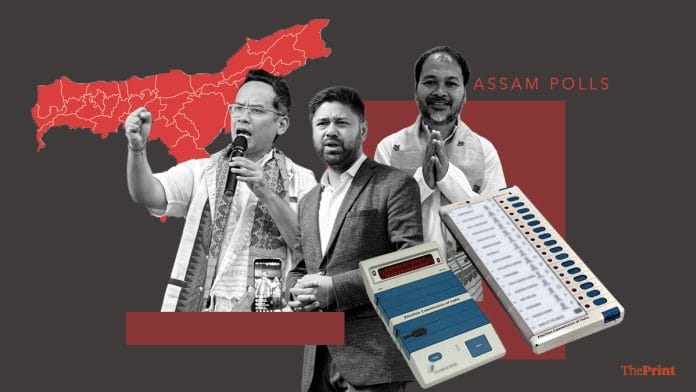



Guwahati: Assam Congress president Gaurav Gogoi, Raijor Dal founder Akhil Gogoi, and Assam Jatiya Parishad chief Lurinjyoti Gogoi never had much in common beyond their surnames.
Gaurav’s family legacy propelled his rise to the top. Akhil built his profile over decades, leading radical grassroots movements. Lurinjyoti, meanwhile, rode the wave of the anti-Citizenship (Amendment) Act (CAA) movement to carve out his political space.
While all three oppose the ruling Bharatiya Janata Party (BJP), they had never formalised a structured alliance. Yet, in recent months, the trio repeatedly found itself at the receiving end of shrill, collective attacks from the BJP, as though they were already allies.
The BJP dubbed them the ‘3G’, pejoratively branding them ‘Miya, Miya Pro and Miya Pro Max’ in an apparent attempt to paint them as pro-Muslim. At the same time, it warned Lurinjyoti that partnering with the Congress would amount to betraying “Assamese nationalism”.
The ruling party’s framing hinted at an underlying unease over the prospect of such an alliance. Late Thursday evening, that possibility became reality, with the three Gogois finally formalising an alliance, posing a challenge for the BJP, even as its earlier jibes suggested it had already begun bracing to take them on.
Holding a joint press conference with Akhil late Thursday, Gaurav announced that the Raijor Dal would contest 13 seats as part of the six-member Congress-led Opposition alliance. Its other constituents include the Assam Jatiya Parishad (AJP), the Communist Party of India (Marxist), the Communist Party of India (Marxist-Leninist), and the All-Party Hill Leaders’ Conference. In two of those 13 seats, there will be “friendly contests” with the Congress, Akhil said.
The significance of the alliance featuring the three Gogois lies primarily in their shared surname and the rest—the combined grassroots presence of their parties and their pooled support bases—follows from it.
The Gogois belong to the numerically modest but socially dominant Ahom community, which plays a decisive role in several seats in Upper Assam in the state’s eastern flank.
The Ahom dynasty, established by Sukaphaa, ruled Assam for nearly 600 years until the British took control in the early 19th century. Tai-Ahoms, also known simply as Ahoms, are among six communities in Assam that have, for decades, been demanding Scheduled Tribe (ST) status.
Also Read: Borah vs Gogoi cracks open Assam Congress. What letter to high command tells about warring factions
Slim margins, big numbers
In 2021, the Congress attempted to bring the Raijor Dal and the AJP—both forged in the anti-CAA movement that roiled Assam in 2020—into a common Opposition front. However, talks fell through, prompting the Raijor Dal and the AJP to contest together as a third front.
Numbers suggest that the Congress’s inability to forge a broad alliance helped the BJP retain power in a state where razor-thin vote differences often produce disproportionate outcomes. In 2021, for instance, the Opposition polled 43.7 percent of the vote against the BJP-led National Democratic Alliance’s 44.5 percent, yet ended up with 25 less seats.
The AJP and the Raijor Dal contested 82 and 29 seats respectively, securing 3.7 percent and 1.5 percent of the total vote—around seven lakh and 1.5 lakh votes in absolute terms—and won just one seat: Akhil in Sibsagar. However, in as many as 14 constituencies, the votes polled by the AJP or the Raijor Dal exceeded the victory margin of NDA candidates, indicating a split in anti-incumbency votes.
“There is overwhelming evidence that the BJP gained from the split between the Congress, the AJP and the Raijor Dal. Both the AJP and the Raijor Dal got protest votes in 2021 that would likely have gone to the Congress had there been an alliance,” a senior Raijor Dal leader told ThePrint.
In the 2024 general elections, the Raijor Dal chose not to contest to avoid fragmenting the Opposition space. The Congress fielded candidates in 13 seats, leaving Dibrugarh to Lurinjyoti. While the Congress won three seats, including Gaurav in Upper Assam’s Jorhat, Lurinjyoti finished second in Dibrugarh behind BJP’s Sarbananda Sonowal with over 4.14 lakh votes, underlining his growing influence.
Political analysts say the presence of the All India United Democratic Front (AIUDF), which won 16 seats in 2021, also hurt the Congress in Upper Assam, as many ethnic Assamese voters view the Badruddin Ajmal-led party as a patron of illegal Bengali Muslim settlers from Bangladesh.
This time, the Congress is keeping the AIUDF at arm’s length to avoid polarisation and prevent a consolidation of ethnic Assamese Hindu votes in favour of the BJP and its ally, the Asom Gana Parishad, which also has a strong base in Upper Assam.
“The coming together of the three Gogois sends out a clear message to fence-sitters in the indigenous Assamese community that the Opposition is a viable challenge to the BJP. It also ensures that across all 126 seats, there will be a single principal challenger to the BJP and its allies. This helps in perception terms, even as factors like vote transfer remain critical,” political analyst Sushanta Talukdar said.
The BJP, led by Chief Minister Himanta Biswa Sarma, has also faced allegations of diluting the political influence of the Ahom community through the delimitation exercise, which redrew the map of Assam’s 126 assembly constituencies.
Former Union Minister and four-time MP Rajen Gohain, who quit the BJP last October, accused Sarma of engineering the exercise in a manner that rendered the community’s political sway “non-existent”.
“Earlier, around 30-40 seats in the Assam Assembly were influenced by the Ahom community. Today, there is not a single constituency where it can decisively claim a ticket. The community has effectively been fragmented and scattered,” said Gohain, who also served as the BJP’s state president.
A month after resigning from the BJP, Gohain joined the AJP.
To be sure, the delayed formalisation of the alliance with Rajior Dal—Assam votes on 9 April in a single phase for the first time since 2001—also betrays the Congress’s nervousness after recent setbacks.
Within less than a month, two senior leaders—former state party chief Bhupen Borah and sitting Lok Sabha MP Pradyot Bordoloi—quit the party to join the BJP.
The alliance talks with the Raijor Dal had, in fact, nearly collapsed, with the Congress initially unwilling to concede even the 13 seats that it eventually agreed to. Akhil blamed Gaurav for the impasse, suggesting the latter appeared more focused on 2031 than the 2026 polls.
The Raijor Dal’s decision to accommodate several minority faces who had quit the Congress also did not sit well with the principal Opposition party. In the end, however, Akhil appears to have leveraged the Congress’s psychological disadvantage to his benefit, setting in motion the “three Gogoi” factor, whose electoral impact remains to be seen.
(Edited by Tony Rai)