





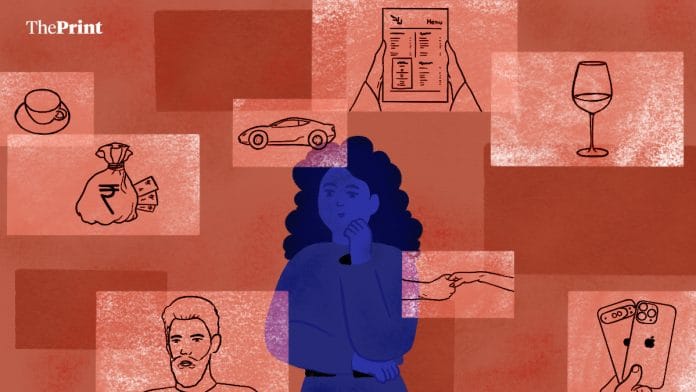



This is a complicated thought to break down, so we’ll move cautiously. First, let’s begin by assuming that this statement is indeed true for all women as a blanket rule. (It’s not!) For centuries, women have been conditioned to depend on their fathers/husbands for their financial well-being.
Owning property? Not allowed. Earning wages? Rare. Access to credit? Forget it. There were definite structural bottlenecks for women to acquire these means of securing their financial well-being. Naturally, their partner’s earning capacity became a deciding factor, not just for them, but for everyone advising them—mothers, uncles, society aunties and that one overly invested best friend. We don’t live in the ‘same’ time anymore. But we live in similar structures.
Women continue to face structural issues with regards to their financial well-being. A woman with the same potential as a man might earn less, grow slower in her career or take on more unpaid domestic labour. So, when women gravitate towards partners who earn more, it’s not necessarily out of greed. Often, it’s because their best fit—a partner who matches them in intellect, humour and values—happens to be someone structurally positioned to earn more.
There’s also the age factor. Traditionally, men date younger women. Even a couple of years makes a difference when you’re at the beginning of your career. A twenty-eight-year-old man might have already hit mid-manager salary brackets, while a twenty-four-year-old woman is just getting her second promotion. So again, we’re not comparing equals,we’re comparing a societal habit.
Third, even if we discount the structural and traditional influences on dating, and look at women as humans (damn, so radical!), it should not be a surprise to see a human being want to date someone who is financially sorted. Money is an indicator of several aspects of a person’s life, majority of which are beneficial for their partner as well.
But Isn’t That in a Sense Objectifying Men? Yes, it is.
And yes, it sucks. Being reduced to your bank balance is dehumanizing. A man is not a walking CTC figure. He is also a hug-giver, a pun-maker, a karaoke enthusiast, a snorer with dreams. When a man feels like he’s being judged only for his earning potential, it chips away at his self-worth. And rightly so.
Now, let’s flip the switch. In arranged marriage set-ups, women are often reduced to a checklist: fair skin, long hair, slim build, good cook, no job preferred. Entire biodata spreadsheets are rejected because ‘complexion too dusky’ or ‘MBA but still wants to work’.
Humans assessing other humans when trying to find a partner is not an isolated experience faced just by one gender. It is a human folly. What feminism yearns to explain is that some concerns harm all humans, and within those concerns, women often face an additional layer of oppression due to their gender.
Does the dating industry objectify men? Yes.
Does the arrange marriage set-up objectify men? Yes.
Is it exclusively women’s fault that that happens? No.
Also read: Marxist painter Frida Kahlo had a deep interest in Hindu spirituality, read Upanishads
It’s a societal structure, not a solo conspiracy. Women didn’t set up banking systems that disallowed them loans. They didn’t write inheritance laws that excluded daughters. They didn’t build workplaces with male-coded networking norms. What many women do today is navigate these systems as best they can.
This said, I personally believe it’s a myth that women only date men who earn more than them. In fact, you will also often find a lot of men who are not comfortable with the idea of their partner earning more than them, especially when the partner is a woman.
Also, women have not set up legal and societal frameworks that disallow men’s rights to grow their wealth or seek a partner they want. Individual biases where one person might value their partners income enough for that to be a decisive factor during dating do not automatically create legal frameworks for the same.
Also, men are free to approach a woman they want to. But it is not the duty of the woman to return the interest. If it were true that women only cared about a man’s money, you wouldn’t have lonely rich men flying to Thailand to get laid, and you wouldn’t have low-earning but nice, kind, physically attractive, funny, witty (or any of the other qualities) men be in happy marriages or relationships. Here’s the truth: people, including women, are not algorithms.
Women are complex human beings (surprise surprise!) and not a single-minded organism that processes like an algorithm. When feminism talks about gender disparity at the workplace, it seeks to disrupt structures that have disallowed women to financially progress. On the other hand, when disenchanted media personalities con young boys into thinking that all women are gold diggers, they are perpetuating a false narrative that benefits them, while creating a larger rift between the genders.
But that’s the trade-off of having free media. People are free to shit as they please. What you need to remember is you don’t have to go around sniffing it.
 This excerpt from Harshveer Jain’s ‘Putting the Toilet Seat Down’ has been published with permission from Penguin India.
Thanks for a non-generalizing write up and refreshingly treating women as human beings, I was sick of people playing a Mary Kom card past few days against feminism and making it their own battle for no reason, what is wrong in expecting a financial security from your partner? esp in a social fabric where men MIGHT have not been domestically equipped enough. I equally agree objectification of any kind is wrong .
Modern feminism always baffles me. As much as I am a staunch believer in feminism, I also find it annoying that women don’t want equality in places where they know it would be a disadvantage for them if they get equality,
There is a growing anger which is spreading across young men who think that the laws are pretty bad against men (I mean seriously we put people in jail because a women complains that’s they had consensual sex in “false promise of marriage”).
Can we please remove this ? I don’t want to see incels roaming in the street because of such stupid laws.