





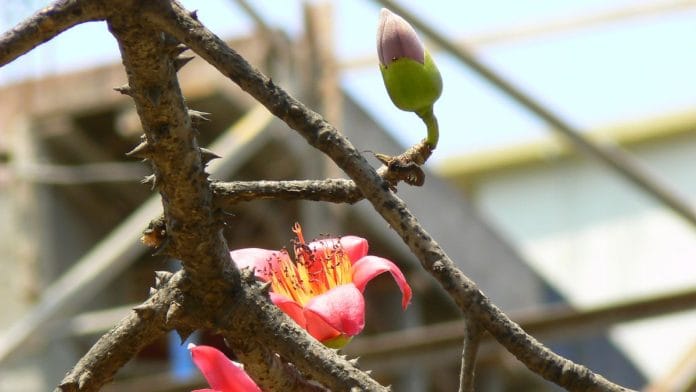



We go looking for semal red before the Covid lockdown happens, before we have even an inkling of the fact that the world will careen to a complete halt.
We have made a plan of exploring the streets of Delhi for our favourite tree. Vallari has an old Alto car, with an unexpected clock sitting on the dashboard. I have an old Figo that once went into a large neem tree, breaking bones on my face and chest and damaging my left eye. We don’t like driving, but our faithful, broken-but-piecedtogether mechanical steeds seem fitting for our quest. If this was a movie, we would be threading flowers into our broomsticks.
But in real life, we have both done fieldwork in Delhi, with patchwork steeds to carry us, and it’s always been bittersweet—with difficulties in transport, with our private joy at the birds and trees ruined by very public teasing. While it hasn’t been easy—we also know we are not looking for easy. I think the more accurate articulation of the experience is that it has never been smooth; our body has been constantly calibrating to prepare for an awful thing that will happen and collapse the pack of bird/tree cards you have set up since morning. It’s that wait for the inevitable awful that poisons the very adventure, staining it with a deep turmeric yellow that doesn’t wash off for days after.
Together, we want to change this narrative and wash off our hands. Maybe it will be better together. Maybe it will be fun together. We get a thick felt pen, and I draw a terrible map of Delhi, with less terrible drawings of semal trees in it. The trees are flagposts for us. We are recounting a map of the places where we have seen the semal: growing on the triangles of land next to a traffic light at the beginning of Aruna Asaf Ali Marg; spotted at the site of a protest in Sarojini Nagar, ironically against the cutting of trees near Dilli Haat; growing like a torch next to the grade separators at ITO and AIIMS, so they remained on eye-level as we passed; one in the iconic Teen Murti building; and trees that line roads we can picture but can no longer place.
Also read: What Mughal and British rule did to India’s forests
We drive to the places we remember. We feel we cannot miss a single tree. We start with South Delhi. We go to Defence Colony, Chanakyapuri, to little parks in Sarojini Nagar, and avenue roads near the government flats in RK Puram. In the north, we go to Alipur and Wazirabad. In Haryana, we go to Aravalli and Mangar and Bhondsi, promising to return to see the flowering of the palash trees we spot. We trace the Delhi Ridge, running a finger down the green spots on map of Delhi. The largest patch of the Ridge is at the very bottom of the state. It looks like droplets condensing at the bottom of a window.
Year after year, we wait for semal flowering. In the interim, we read, and we observe. We catalogue butterflies in a plant nursery and find that nurseries are a great place to find birds and insects. We walk through neighbourhood parks to find an odd remnant of a native tree that horticulture has spared. We find entire groves of semal, and single roadside trees that feel like an institution. Years pass and our notes pile up.
Vallari and I are fast friends now, bonded by the sap of trees. She stops for every plant while I look for birds. I didn’t even know it, but I used to overlook plants, but spending time with her is curing my plant blindness. She is so sweet and generous, she feels like a once-in-a-year blossom, and I wonder how she has survived Delhi.
It is March of 2022, and the COVID lockdown has ended. We have decided to make our way into older places, which we hope will have older trees.
We are to go to the oldest place of all, at least in name. The Old Fort in Delhi, the Purana Qila, a Mughal structure that is almost five hundred years old. The Old Fort is an interesting backdrop to many other events in the city. It has a small waterbody next to it, and the water is dirty, yet people delight in it, in the casual way citizens inhabit pollution as if schooled by the metropolis to do so. Next to the Old Fort is Delhi’s zoo, presenting a strange confectionery–an ancient building full of somnolence next to a zoo full of pacing creatures.
Once, while walking in Sunder Nursery (which is behind the Delhi zoo), I heard growling. It was the sort of hair-raising, deep-throated snarl-growl I had heard from tigers in sub-Himalayan, river-girded forests. The sound had resonated through forests of depth and mystery, adding another layer of the unknowable, creating a place as majestic as it was frightening. Here in Delhi, could it have been a big cat in the zoo grumbling about his evening meal? The zoo was a pinning together of things to make a scrapbook–a foreign snake, an Indian monkey, a black jaguar native to Central America, a baby giraffe from Africa, all kept in enclosures in varying conditions. Things collected and acquired, to suit all tastes and nationalities, things collected because they could be. This is Delhi too.
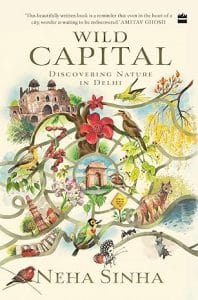 This excerpt from ‘Wild Capital’ by Neha Sinha has been published with permission from HarperCollins Publishers India.