





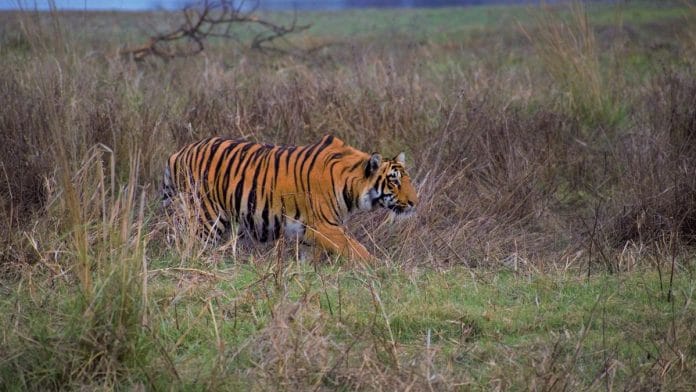



It was 7 a.m., and October was nearing its end. A cool winter nip was beginning to set in. The entire forest basked in the soft golden sunlight. Spotted deer grazed cautiously by Tadoba Lake, while a crocodile lay sunbathing nearby. Cormorants and ducks stirred the waters occasionally. On this quiet morning, Nibuddhe, a field assistant at Khatoda and his team, set out on patrol.
Foot patrols are a crucial aspect of forest department’s work. Each guard is required to cover at least 125 kilometres on foot every month. The patrol teams, comprising three to five members, traverse vast areas of the jungle, primarily to prevent poaching, illegal logging and grazing. It’s dangerous work—they can unexpectedly encounter tigers, leopards, sloth bears, Indian gaurs, snakes or scorpions. Vigilance is paramount.
Nibuddhe and his team moved cautiously. Their trained eyes and ears stayed alert to even the subtlest movement. After circling the lake, they reached the main road. Just then, a tourist Gypsy approached from Pandharpauni. As it neared, the driver brought the vehicle to a halt. Typically, safari guides pause briefly to enquire if the forest staff has noticed any movement of tigers. But today, this Gypsy had stopped for a different reason.
The tourists inside appeared anxious, and the guide and driver were visibly tense.
‘Sir, I’m Tulshi Ramteke,’ said the guide.
‘What happened?’ Nibuddhe asked.
‘Sir … there’s a tiger.’
‘What about it?’ Nibuddhe’s voice rose instinctively.
‘It’s lying dead!’
‘What? Where?’
‘On the Jamni checkpost—Waghai road, in the nallah (seasonal stream).’
It turned out that several tourists on their morning safari had spotted a tiger in the Wagahi Nallah. The animal was lying about 20 meters from the road, half-submerged in water, with its head resting on the bank. After observing it for a while, the tourists moved on, assuming it was resting. However, Tulshi noticed that the tiger hadn’t flicked its ears even once. Suspecting something was amiss, he borrowed a tourist’s binoculars and looked closer. The tiger’s chest wasn’t rising and falling—no sign of breathing. Observing more closely, he saw its tongue hanging out of its mouth. He realized that something was wrong. Tulshi immediately instructed the driver to head towards Tadoba Lake to alert the forest department.
Also read: India’s special relationship with water needs to change
‘Oh my God …’ exclaimed Nibuddhe, as he rushed towards the nallah with his team. It was 7.21 a.m. They knew a spot on the way where they would get mobile network coverage, so they paused there briefly to inform the round officer of the Tadoba range about the incident.
By 7.45, Nibuddhe and his colleagues had reached the nallah in Compartment 95 of Kolara. The sight they witnessed left them breathless. The lifeless body of a tiger was wedged between a cluster of bamboo and paper flower thickets. Its head rested on the bank while its hind legs were submerged in water. As they approached, they realized it was a tigress.
Regaining his composure, Nibuddhe immediately called his superiors to give them the update. He warned his team not to touch the body and instructed them to survey the surrounding area. Meanwhile, he took out a GPS device to record the exact location. The team found pugmarks of the tigress in the stream, which they traced carefully. There was no sign of any trap or weapon.
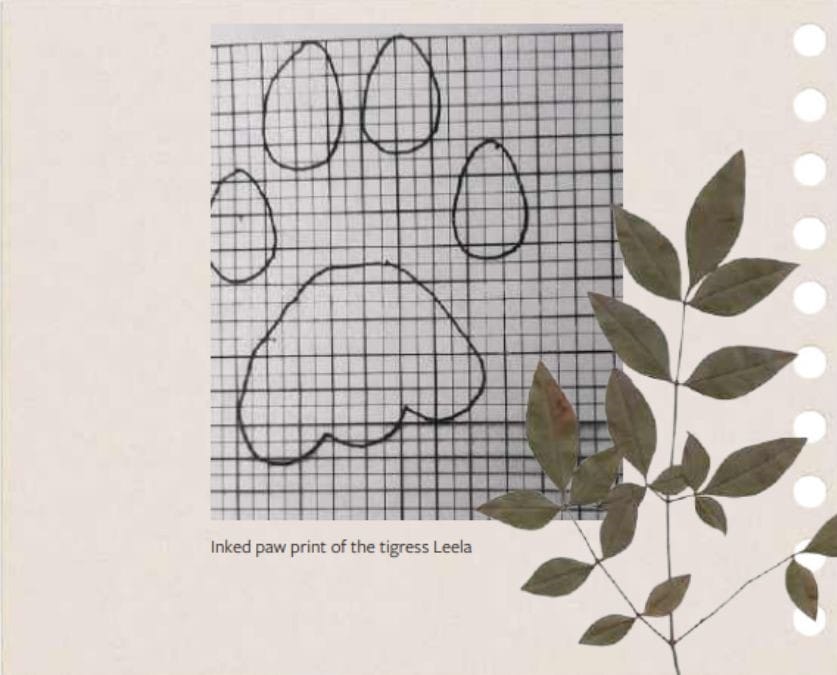
Soon, the field director, deputy directors of the core and buffer zones, other officers, and witnesses arrived at the scene. Veterinarians Dr P. D. Kadukar, Dr Sandeep Chhaukar and Dr Sachin Hagwane were also present. The bamboo and paper flower thickets were cleared, and the tigress’s body was moved to an open area. The veterinarians, wearing gloves, first examined her teeth, claws, whiskers and other vital organs to ensure nothing was amiss. They photographed and documented every detail. Age: approximately five to seven years. Length: 170 cm. Tail length: 93 cm. Height: 110 cm. Girth: 120 cm. Impressions of her hind paws were taken using ink.
The postmortem began. The veterinarians made a clean incision on her abdomen and pulled out the intestines. They carefully collected small tissue samples from her liver, lungs, heart and other critical organs, placing them in plastic jars. A total of ten samples were taken, and each jar was labelled immediately.
The officers and staff watched the entire process in stunned silence. But everyone’s eyes welled up with tears when the veterinarians pulled out four cubs from her womb—three males and one female. The tigress had been pregnant.
That day, Tadoba lost five tigers.
The postmortem revealed that the tigress had died 10 to 12 hours earlier, between midnight and 1 a.m. Blood clots in her body indicated that she had succumbed to a snakebite.
By 3.20 p.m., all formalities, including the preparation of a panchnama (official report), were completed. In the meantime, forest labourers had gathered wood from East Indian satinwood and Indian boxwood trees and built a pyre. The tigress was cremated there. The entire scene was documented and the cremation was carried out with due process. Afterwards, everyone departed with heavy hearts.
The next day, on 28 October 2012, newspapers carried the headline: ‘Tadoba Tigress Leela Dies of Snakebite.’
 This excerpt from ‘Maya’ by Anant Sonawane has been published with permission from HarperCollins Publishers India.