





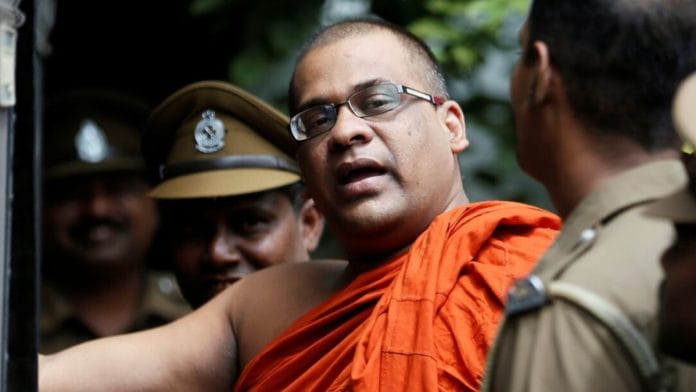



Three months after the 2014 mob attack in Aluthgama, the monk Galagoda Aththe Gnanasara hosted a special guest in Sri Lanka: Ashin Wirathu, a Burmese monk who had founded the 969 movement and the Ma Ba Tha organization. The two monks shared an obsession with Muslim men. Wirathu propagated a theory he called “the sex strategy,” which alleged that Muslim men were seducing Burmese women in a bid to overtake Myanmar’s Buddhist population and turn the country into an Islamic state.
At the time of his visit, Wirathu was already the world’s most notorious Buddhist monk. In 2013, he had appeared on the cover of Time magazine with the headline “The Face of Buddhist Terror,” highlighting his role in inciting deadly riots in towns like Meiktila, where dozens of Muslims were killed. Despite this, the Sri Lankan government not only approved his visa but also gave him a security detail. At a stadium packed with tens of thousands of monks, nuns, and laypeople eager to hear him speak, Wirathu announced that his 969 movement would collaborate with Gnanasara’s Bodu Bala Sena to “protect Buddhism around the world.” He offered no further clarification, leaving his message open to interpretation. “It’s the responsibility of monks, as Buddha’s sons, to teach bad and uncivilized people to become good and civilized,” he said.
The rally marked a major success for Gnanasara, boosting his profile among Sri Lanka’s growing rabble of militant monks. With his rising influence, his speeches became increasingly inflammatory. He expressed disdain for women in hijab and made false claims about the Quran allowing Muslims to acquire the wealth of non-Muslims through fraudulent means. When Muslim leaders challenged his fabrications, he issued the chilling threat of “another Aluthgama.”
That threat materialized after a group of Muslim men assaulted a Sinhalese Buddhist truck driver in late February 2018, in Digana, a small town in Sri Lanka’s Central Province. When the driver died from his injuries, mainstream media and social networks amplified the story, with posts on Facebook and WhatsApp calling for revenge. One widely shared post quoted a monk telling his followers: “The sword at home is no longer for cutting jackfruit—sharpen it and go.”
Also read: Indians and their cultural inferiority complex, explains Romila Thapar
Among the militant monks, Sinhalese nationalists, and angry young men who converged on Digana was Ampitiye Sumanarathana Thero, a notorious social media personality and ordained monk from Batticaloa, a city on the island’s eastern coast. Sumanarathana enjoyed filming himself threatening minorities. In one viral video, he marched up to a man until he stood so close their noses nearly touched. His hands emerged from the folds of his robe like claws and he bellowed, spit flying from his mouth: “Every single Tamil will be cut into pieces! They will all be killed! All the Tamils in the south will be butchered! The Sinhalese will massacre them.” In another widely circulated clip, shared with his hundreds of thousands of Facebook followers, he slapped a Christian clergyman whom he accused of missionary activities in a Buddhist area.
In Digana, Sumanarathana stormed into a police station to demand the arrest of the Muslims involved in the assault on the truck driver.
Gnanasara also came to town, ostensibly to offer condolences to the dead man’s family. Within hours of his arrival, a Muslim-owned grocery store was looted and set on fire. Later, a mob of several hundred descended with sticks, stones, and gasoline. Worshippers at a local mosque fled into the surrounding snake-infested jungles. They later recounted how the mob entered the mosque grounds, poured kerosene on motorbikes, and desecrated copies of the Quran. “The mosque was destroyed,” an onlooker told me. “We had to rebuild it from scratch.”
Families returned to a ruined landscape. Garden hoses were all they had to extinguish the remaining flames.
During this chaos the body of twenty-seven-year-old Abdul Basith was discovered. Basith’s parents operated a shop out of their two-story home. When the mob set the building ablaze, Basith, who had recently started a job as a journalist, became trapped on the second floor. His brother later testified before a fact-finding committee that police officers stood by and did nothing to extinguish the flames.
The final toll was devastating: over three hundred homes, more than two hundred shops, dozens of vehicles, twenty mosques, two Hindu temples—and Abdul Basith was dead. “The state failed in its duty to protect the Muslim minority during attacks; hold perpetrators to account; and deliver justice,” declared Amnesty International. The international outcry finally prompted action. The government arrested more than a hundred people, including prominent Sinhalese nationalist leaders. Yet, despite their key roles in inciting the violence, the monks Sumanarathana and Gnanasara remained untouched by the law.
 This excerpt from ‘The Robe and the Sword’ has been published with permission from HarperCollins Publishers India.