





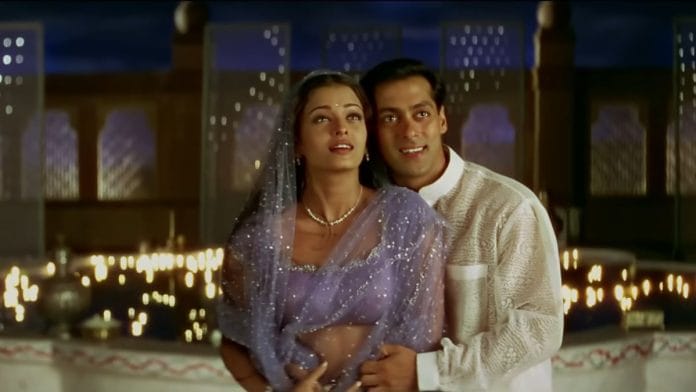



Every once in a while, an actor feels the need to scale up to reach for something more than box office numbers. Salman was already being celebrated by trade but was probably hoping to be seen as more than just a bankable star. He wanted to add some mettle to his résumé and prove that he had the emotional chops to carry a film. Or perhaps he simply wanted to back Sanjay Leela Bhansali, who was truly a film-maker with grand ambitions that demanded more from his actors. Salman knew he had to rise to Sanjay’s vision. And he did so in what is among the most memorable and heartbreaking performances of his career.
The film’s story starts with Sameer (Salman), a carefree NRI, who arrives in India to learn classical music from a respected guru. There, he falls in love with the guru’s daughter, Nandini (Aishwarya Rai). Their romance blossoms in secret, but when they are discovered, Sameer is asked to leave. Nandini is married off to Vanraj (Ajay Devgn), a kind-hearted man who senses her unhappiness. When he learns of her past love, he decides to reunite the lovers. Bhansali was over the moon when the film clicked with audiences and critics alike. After the failure of Khamoshi he didn’t know how to bounce back, but with Salman’s encouragement yet again, Sanjay made a film that struck a chord with audiences and hit the jackpot at the box office.
In an interview, Salman was asked why he decided to take a punt on Bhansali despite the dismal box office performance of Khamoshi. Salman explained, ‘When Sanjay came to me with Khamoshi, I really liked the script. I did the film when no one was doing it at that time. He is the same Bhansali for me even today. He has passion for cinema and will always do his best to give a good film. No wonder he goes over budget at times (laughs). I have always taken risks in my life. The trend in our film industry is that no one wants to work with a new guy. If you are a newcomer, you will remain a newcomer. I think it is the ability in me to understand good script. I am a writer’s son. I have it in my genes. Though I don’t write films, I understand the film at the script level—whether it will work or not.’
And the film worked wonders, kick-starting Bhansali’s golden run, which continues till date. In one of the first interviews after its release, Bhansali said, ‘One can put emotions, craft and hard work into films but without the audience’s approval, the art of film-making is incomplete… After Khamoshi, I decided I had to bring the audiences to the theatres, but without compromising. After the failure of Khamoshi, for two months, I was sleepless and angry … I channelized my anger positively. I worked 24 hours a day …’
Sanjay’s films have a distinct quality, primarily that they serve as the perfect escape for audiences through their elaborate sets, over-the-top drama, and heroes and heroines who look ethereal. He said, ‘Sachhai bahut dekh li (I’ve seen enough of reality). I want to meet nice people and see nice people. The characters of Salman and Ajay are nice people. I show what should happen and not what happens in life. You know, I don’t read newspapers because I don’t want to start a day with anguish. Bad news disturbs me.’
The film also remains etched in the memory of fans as the starting point of the iconic but troubled relationship between Salman and Aishwarya. News reports say that it was Salman who suggested Aishwarya be cast in this film, who until that point, hadn’t delivered a single hit. People on set knew Salman was obsessed with her, but Ash didn’t give in initially. When she came on board, they weren’t seeing each other. But for Salman it was more than just a passing infatuation. When he was initially offered the role of Aishwarya’s on-screen brother in Mansoor Khan’s Josh, he turned it down. The part eventually went to Shah Rukh.
As Bhansali said in an interview recently, love was in the air. Ash wanted to make a career and was dreaming big, but Salman eventually managed to woo her with his persistence!
On set, the two were completely immersed in Sanjay’s world—living and breathing his opulent vision. They fell in love under grand chandeliers, among the golden dunes of Rajasthan, draped in breathtaking costumes.
Also read: When gangsters Amirzada and Alamzeb made an enemy of Bollywood actor Dilip Kumar
What stood out was the unmistakable tenderness in their eyes for each other. The heady, all-consuming kind that marks the early flush of love, beautifully framed and captured by Bhansali. Despite pressure, he refused to alter the ending of the film, in which Ash’s character Nandini returns to her husband Vanraj. ‘I was forced to shoot an alternate, happy ending for Khamoshi due to pressure from distributors, who didn’t want a tragic conclusion. But with Hum Dil De Chuke Sanam, I stood firm on the ending I had envisioned from the beginning,’ he said.
Clearly Salman wasn’t on board with Bhansali’s climax for the film. He even said in an interview, ‘I did not agree with the ending in Hum Dil De Chuke Sanam. Sanjay Bhansali told me that he wanted a depressive high. … But if you are making a traditional film, then (cuss word) love. Nandini (Aishwarya) should have left her husband and gone with the guy she loved (Salman). Her husband (Ajay Devgan) was like a god to her for what he did. If I had made Hum Dil De Chuke Sanam, I would have let her go with the guy she loved.’ Visually, the film was stunning and was deemed a must-watch for that reason alone. It brought poetry to life on-screen without tipping into pretension. Hum Dil De Chuke Sanam felt personal and larger-than-life at once. At the centre was the crackling chemistry between Salman and Aishwarya, which was made all the more intense by whispers of their off-screen romance. It gave the love story an ache, a thrill, a sense of reality under all the fantasy.
Salman gave his all to the film. He allowed his spontaneity to show, and he stripped his emotions bare on-screen, something he usually didn’t allow himself to do. Recounting the experience of shooting the song ‘Tadap Tadap Ke’ in a hot desert, cinematographer Anil Mehta said, ‘I remember, in the desert, Salman just went with the scene. Otherwise, which hero is going to lie down in the hot sand and ask people to put that sand on him. He was doing it himself and that’s infectious. You are drawing from that energy and then he started doing some random stuff. I took the camera off the tripod and then I was with Salman in that moment. I soaked in what he was doing and later the camera also pointed at the sun which was a “no, no” at the time. Today, it is the norm. But, it was the energy of the piece and the performance and then, of course, there was the master of drama at work—Sanjay.’
Ismail Darbar’s music lent the film an enchanting aura, as it beautifully blended traditional Indian music with the allure of exotic foreign landscapes. The film felt like a dream. Songs like ‘Tadap Tadap Ke’ and ‘Aankhon Ki Gustakhiyan’ became a rage with people. The film’s success brought with it it’s fair share of controversy, one of them being Darbar’s proud declaration that he was better than his rival, A.R. Rahman. He said in an interview, ‘My work has always been better than his. Hum Dil De Chuke Sanam was better than Taal. Even Devdas was better than Saathiya. But it is destiny that he got international fame …
Whenever my work is good and he takes the awards, I feel bad. I wonder why people run after name and fame, and not good work. Kyunki humare yahan bahut kum akal ke log hai (Because we have very few intelligent people here). We see some foreigners holding someone’s hand, and he becomes a big man. But the foreigners have also praised my work in Hum Dil De Chuke Sanam.’
The film premiered at the Berlin Film Festival on the recommendation of the taxi driver who was ferrying the official festival representative around in India when she had come to take her pick of films for the movie gala. ‘The Berlin Film Festival’s representative for South Asia, Dorothy Wenner, was in Mumbai. One evening she asked her taxi driver if he had seen any good films lately. The driver—God bless him—immediately recommended Hum Dil De Chuke Sanam. That’s how she ended up seeing the film, loving it and inviting it to Berlin. I owe that taxi driver a big thank you,’ Bhansali said at an interview during the premier of his 2022 movie, Gangubai Kathiawadi, at the same festival.
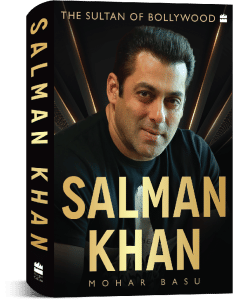 This excerpt from ‘Salman Khan’ by Mohar Basu has been published with permission from HarperCollins India.