





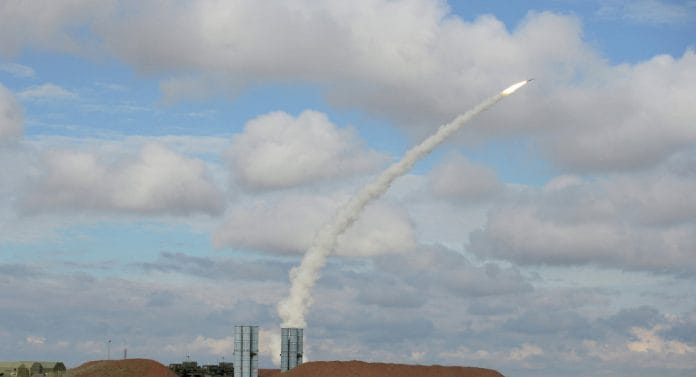



In Adampur Airbase, Group Captain Animesh Patni was in the hot seat in the early hours of 7 May, helming firing units of one of the IAF’s most prized possessions – the Russian-built S-400 ‘Triumf’ surface-to-air missile system designed to intercept even ballistic missiles.
This Russian-made surface-to-air missile system, known as ‘S-400’, became one of the heroes of Operation Sindoor. Approved for acquisition in 2015, the IAF placed an order worth Rs 40,000 crore – $5.43 billion – for five S-400 regiments (sets of radar systems, multiple batteries, launchers and a command and control centre). India did this knowing fully well it risked sanctions from the United States under the Countering America’s Adversaries Through Sanctions Act (CAATSA).
Washington threatened consequences for countries engaging in significant transactions with Russian defence firms. New Delhi, which considers strategic autonomy the cornerstone of its foreign policy, chose military capability over diplomatic fallout. The order went through.
The S-400 is a highly mobile, long-range surface-to-air missile system capable of intercepting stealth aircraft, cruise missiles, ballistic missiles and drones. In use with Russia since 2007, it is widely recognised as superior to comparable systems like the US Patriot in terms of versatility and target-engagement capacity. The integrated system can track 300 targets at a time and launch missiles against 36 at a time. It does so at speeds up to Mach 14 (17,000 km/hour), with an advertised response time of under 10 seconds.
With missiles flying across the international border, Patni knew he could be called into action in minutes.
He was. Patni was ordered to fire. Weapons free, engage targets. It was a scenario that he had trained for time and time again, but always with his formidable weapons system in safe mode – the missiles would not leave their launchers. The radars and systems would simulate incoming threats. And kills would not be real.
But this was the real deal.
Actively monitoring the air-picture around him through the data-linked IACCS network, Patni had a real-time picture of the jets in the air manoeuvring, targeting, locking on and launching.
There was no time to lose.
He ordered the primary long-range air search radar of his S-400 system to open up. Almost immediately, Patni had a lock.
The S-400 was a relatively new acquisition. It had never been tested in battle in the subcontinent. Its capabilities existed on a piece of paper, claims made by its Russian manufacturer. Until the first missile blasted off; no one really knew what to expect.
The jet that Patni engaged was more than 200 km away. The IAF had never taken out an aerial target at that range. Very few countries had.
‘On the first night,’ Patni admits, ‘we had butterflies in our stomachs because the system had not been combat tested but it was now in a live operation. There are a lot of safeties which have to be removed before we carry out any kind of live operation, just to avoid any kind of accident.’
Safety systems for sophisticated weapons systems like the S-400 include a suite of engineered mechanisms, procedures and protocols designed to prevent accidental launches.
One by one, Patni called for them to be removed. The S-400s missiles were now prepped. A single button push was all that it would take to fire a round, each missile costing upwards of a cool $1.5 million.
‘Taking out all the safeties was my call. Okay, remove this safety, remove that safety and so on. The final call that I gave was, “we are ready, the target has been assigned to us, we are ready to launch, the target is in the kill zone now, we can shoot it down.”’
Patni took a deep breath. It was now or never. Would the system, a maze of high-tech engineering, actually work? Had he followed all his launch protocols? Was there any step that he had missed?
‘The command [of the unit] is mine. However, the person who was pressing the button [to launch the S-400’s missiles], was my number two, a Wing Commander.’
‘I took a deep breath before giving my final call – “Okay, launch”, and then it was the turn of my 2IC [second-in-command]. He asked me to confirm launch because this was the first time we had ever launched a surface-to-air missile into enemy airspace. We were trying to shoot down the enemy over his own territory.’
The Wing Commander set to depress the launch. He needed to know – one last time – if he had heard the orders properly.
‘He asked me to confirm once again. “Sir, confirm fire.” “Affirm,” I said, “you are cleared to launch.” It all took a couple of seconds, and then the missile was on its way.’
Time seemed to melt at that moment; it all seemed to be a haze. ‘It felt like an eternity,’ says Patni. ‘The button had been pressed – was there something wrong?’
He then heard the boom. The earth shook under his feet as the missile – 25 feet tall – soared onto the night sky.
The S-400’s missile accelerated to speeds well above Mach 5. The pilot who had been attacked now had seconds to attempt to out-manoeuvre the killer headed his way. His radar warning receiver would have been screeching an alert. He may have been dropping chaff and flares – decoys – in an attempt to deceive the incoming missile. Except, it didn’t work.
‘It’s a huge sound and it actually lit up the entire sky, and after that sound, I heard one more sound. And that was the call of “Bharat Mata ki Jai”. The men all started shouting “Bharat Mata ki Jai” after seeing that missile launch and everybody was charged up.’
Seconds later – ‘Splash.’ Patni laconically made the universal Air Force call-out announcing a successful hit.
The Pakistani fighter had been shot down. Its radar track disappeared off the screens of the S-400’s radar and weapons controllers. ‘We were hoping like hell that it could have been a J-10 so as to give him an even bigger slap, if possible,’ he says with a smile. After systematic verification, the IAF chose to share that the fighter Patni shot down was a Chinese-built JF-17 ‘Thunder’.
It wasn’t just Patni and his Wing Commander who had held their breath as the first S-400 was fired. While crews test extensively on simulators, nothing really prepared most at Adampur base for what happened when the system launched a live round. ‘When the first S-400 was fired, my guys did not even know what had happened,’ said Group Captain A.G. Kumar, the COO of the base. ‘The sound of the missile launch was so loud that some of them thought a bomb had been dropped on them[.] I was very lucky to witness it firsthand,’ he says, knowing he saw history being made in front of his eyes.
 This excerpt from ‘The Sky Warriors: Operation Sindoor Unveiled’ by Vishnu Som has been published with permission from Juggernaut Books.